Overview
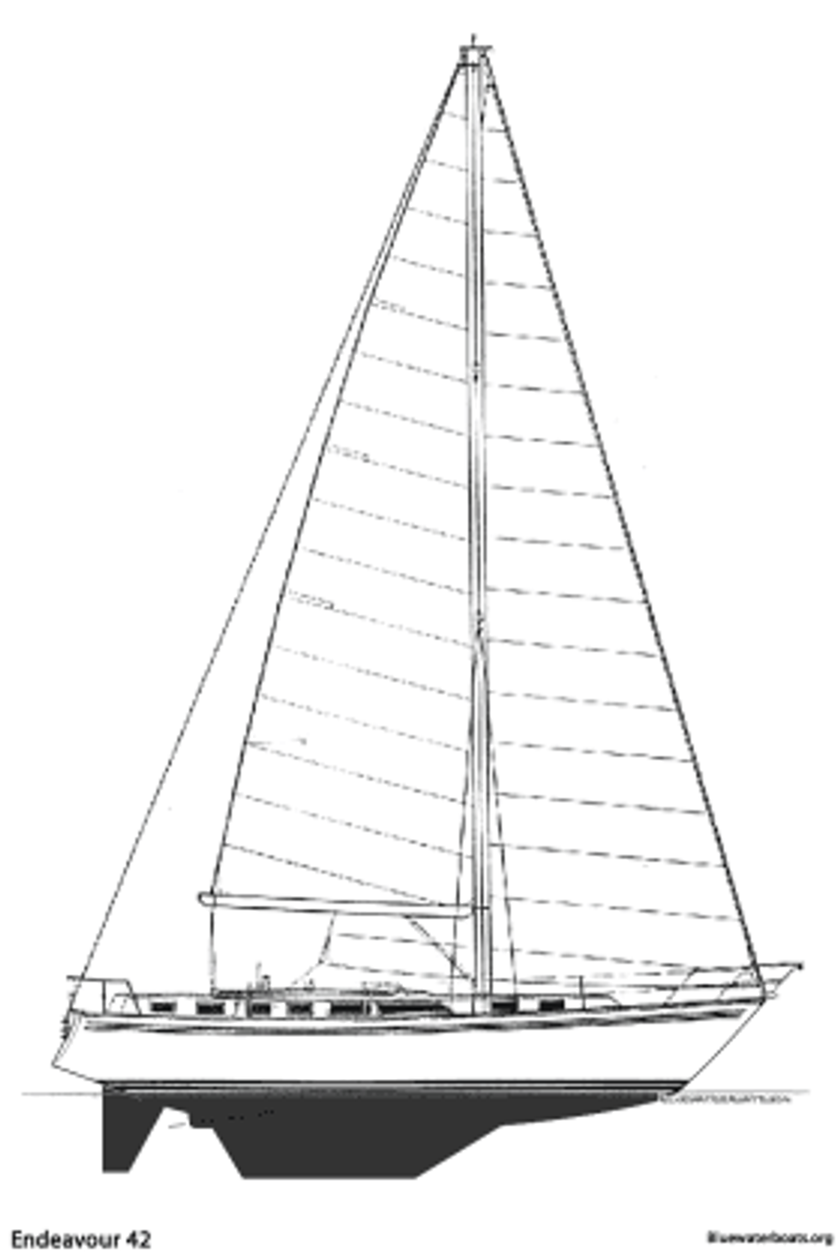
Endeavour Yachts, already known in the 1970s and early 1980s for simple, shoal-draft, big-accommodation “Florida” cruisers, brought in America’s Cup designer Johan Valentijn in 1985 to move the lineup toward more performance-minded designs, resulting in the Endeavour 42 and its larger sibling, the Endeavour 51. The 42 kept the shoal draft and roomy interior the builder was known for, but added a taller rig, inboard chainplates, and balsa-cored topsides aimed at improving on the company’s earlier windward performance. It remains, honestly, a comfortable coastal liveaboard rather than a bluewater passage-maker.
History
John Brooks and Rob Valdes founded Endeavour Yachts in 1974 in Largo, Florida, at the height of Tampa Bay’s production-boat era alongside Morgan, Irwin, and Gulfstar. In-house designer Dennis Robbins penned the company’s early E32 and E37 before Valentijn arrived in 1985 to design the 42 and 51 as the market shifted toward higher-performance, center-cockpit cruisers. Coastal Financial Corp bought the company in 1986 and struggled financially for the following decade before selling it in the 1990s to new owners who redirected the brand toward cruising catamarans. Brooks, who had stayed on as production manager, was killed in a home burglary in 1996. Bob Johnson, later of Island Packet, worked as a designer at Endeavour in the late 1970s, a connection some point to when comparing the two builders’ design lineage.
Design and Construction
The hull carries balsa-cored topsides with plywood reinforcement for compression strength, and solid fiberglass below the waterline. Among the west Florida production builders of its era, Endeavour is generally regarded as a notch behind Gulfstar and ahead of Morgan and Irwin on build quality. The standard engine is a 62 hp Perkins 4-154, a durable unit but one for which rebuild parts have become difficult to source. Molded interior liners, while good for finish quality, severely restrict access to the bilge and the tankage buried within it.
Under Sail
Like the shoal-draft Island Packets it’s sometimes compared to, the 42 performs poorly to windward and in light air, a direct tradeoff for the 5 ft draft that makes it well suited to South Florida and Bahamas cruising grounds. It carries itself steadily in trade-wind conditions, but no independently verified offshore passage was found for this model in this research pass, consistent with the design’s own coastal-cruising brief.
Buyers Notes
The molded bilge liners that give the interior its finished look also bury the aluminum fuel and water tanks behind limited access. Those tanks are widely reported to corrode and develop leaks after about 15 years, and replacing them is a genuinely major job, estimated at $50,000 or more, specifically because of how hard they are to reach. Ask directly about tank age and replacement history on any survey; a boat with unreplaced original tanks approaching or past that age should be priced and budgeted accordingly.
Layout
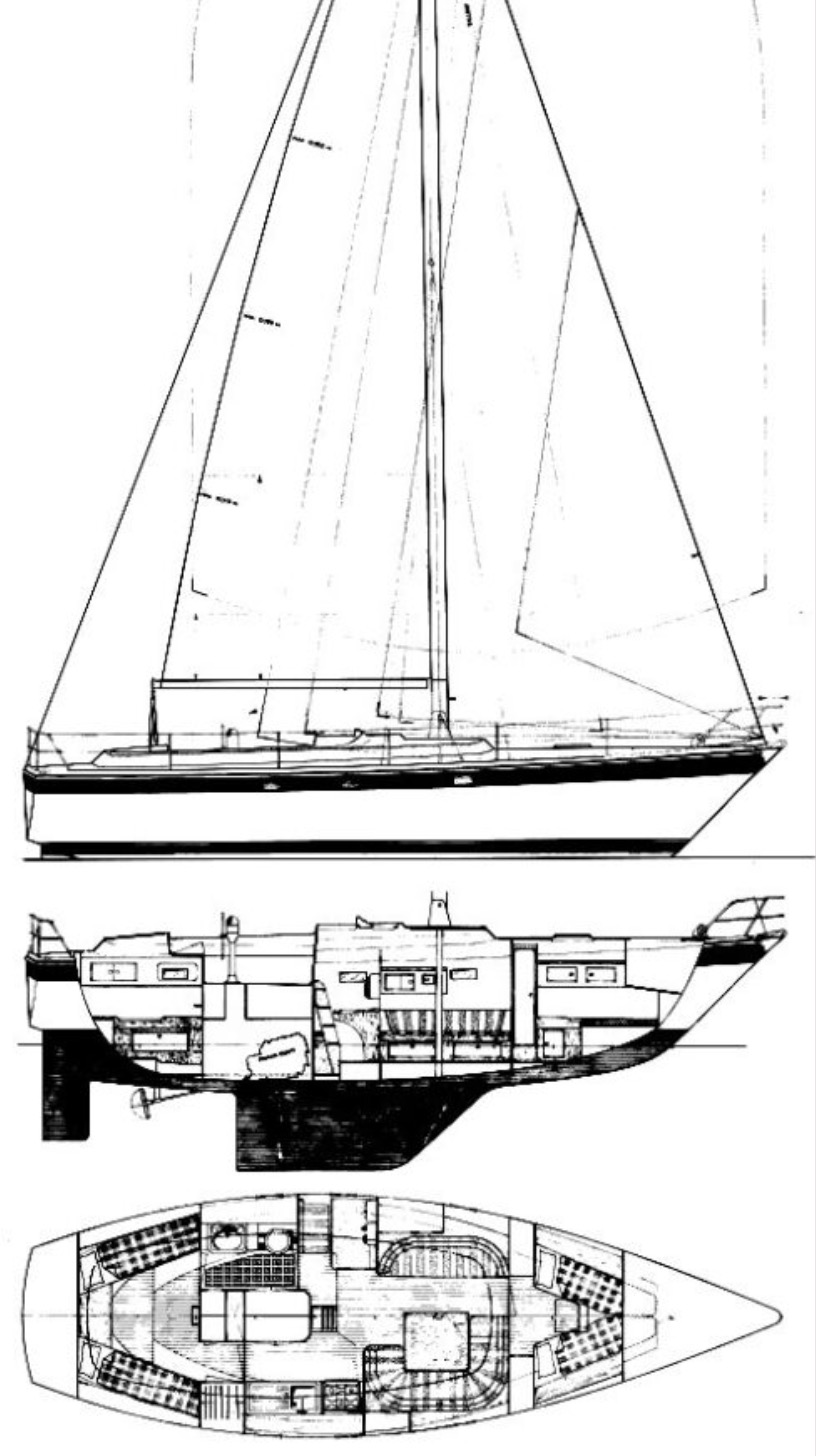
The accommodations are the real selling point of this design: a center-cockpit arrangement with an island queen aft and a V-berth forward, the layout most buyers of this type of cruiser want, and a galley along the walkthrough passage with sinks positioned either under the companionway or outboard, depending on the specific boat.