Overview
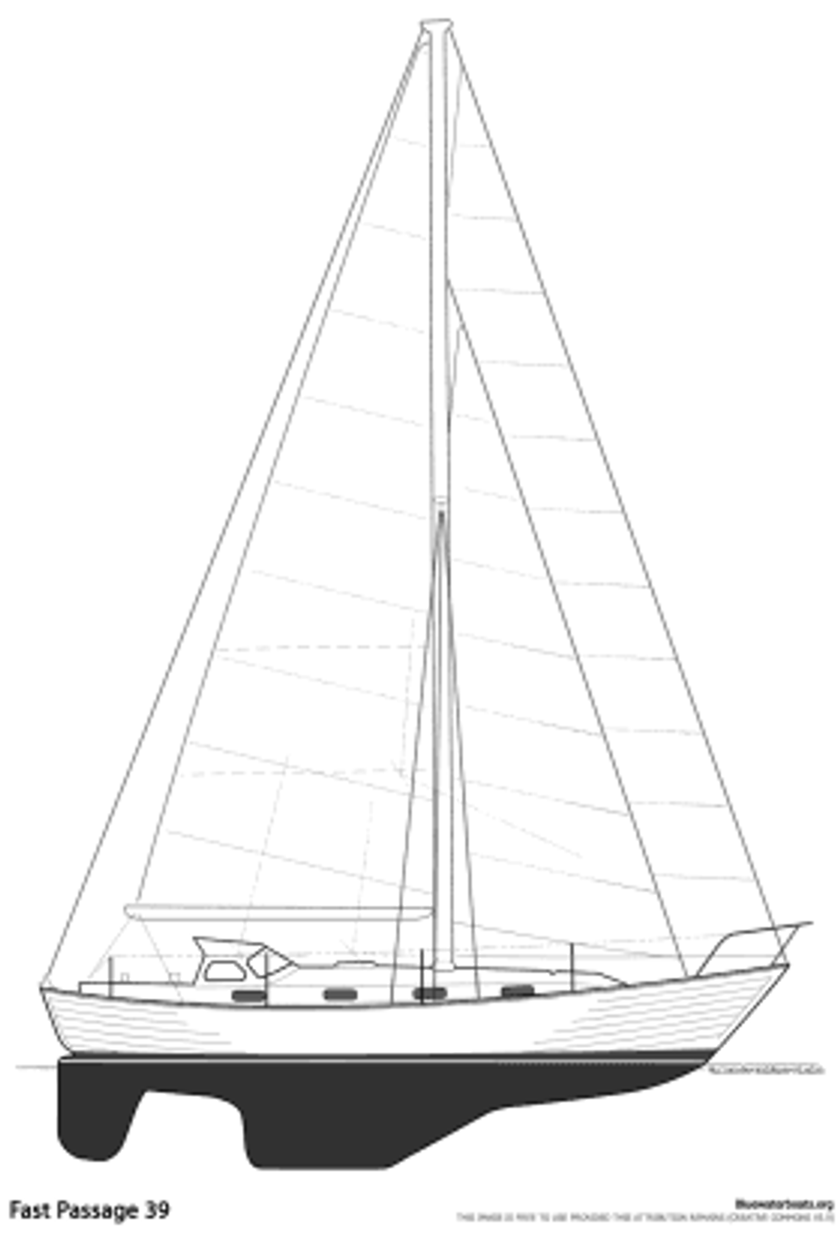
Owners and reviewers alike keep drawing the same comparison for the Fast Passage 39: a stout double-ender with a real claim to Valiant 40 territory, combining speed, ruggedness, and a genuine racing pedigree. With only around 41 hulls ever built, tracking one down takes real patience.
Her lineage runs back to William Garden’s Bolero, a 40-foot sloop he drew in the 1960s. Denny Coverdale, working at Philbrooks Shipyard in Sidney, BC on Vancouver Island, spent a summer cruising in company with Bolero, and with his yard looking to take on bigger projects, brought the idea of a modernized production version back to Garden himself. The result, launched in 1975, is reportedly the boat Garden said he’d choose to go cruising in himself.
Philbrooks built 36 hulls, some sold as owner-finished kits, before selling the molds to Tollycraft, which completed four more in Kelso, Washington, before production ended in 1985. Francis Stokes bought one of the Tollycraft-built boats, named her Moonshine, and sailed her to second in class in the inaugural 1982-83 BOC Challenge, one of only 10 finishers from a field of 16. Cruising World’s own retrospective, published two decades later, noted that at least two, probably more, Fast Passage 39s had gone on to complete circumnavigations of their own.
The Valiant 40 comparison holds up under the numbers: similar LOA and LWL, nearly identical displacement and ballast, and closely related underwater shapes, though the Fast Passage runs a touch narrower with less wetted surface and flatter sections fore and aft of the keel, a slightly more refined take on the same formula.
Stokes’ own BOC account backs up the reputation across a full range of conditions. Her comparatively shallow 5’6” draft worked in her favor running downwind, and strong directional stability paired with a responsive rudder kept her tracking well under wind vane even surfing down steep seas. Sailing alongside a Valiant 40, he found he needed to reef earlier but never gave up speed doing it. Upwind she makes real leeway once heeled past 20 degrees, and light air is where she’s genuinely happiest.
Production didn’t end entirely with the Tollycraft run. Years later, Jeremiah Mitchell tracked down the disused molds, sitting forgotten in tall grass, and set out to revive the design, updating the deck to Airex coring with Kevlar reinforcement in place of the original balsa. Only one boat came out of that effort, built by Northern Marine in 2000 and sold under the name Fast Passage 40.
Buyers Notes
Delamination shows up in two recurring spots: the original rudders were under-built and have needed correction on many boats, and deck leaks have rotted out balsa coring on others, leading to the same delamination problem there. Philbrooks-built hulls carry a strong reputation for quality; on kit-finished boats, check the finish work carefully, since they typically sell for less to begin with. Stokes’ own experience shows the Tollycraft-built hulls hold up just as well.
She’s genuinely rare on the used market. Few were built, owners tend to hang onto them, and some boats change hands privately without ever hitting a public listing.
Links, References and Further Reading
» Fast Passage 39 Review by John Kretschmer, Used Boat Notebook p187-191» Cruising World Magazine’s review of the Fast Passage 39 by Mark Schrader, Dec 1997» Blue Water Sailing Magazine’s look at the Fast Passage 40, Jun 2010» A look at the Fast Passage 40 by Quentin Warren writing for Boat.com, Aug 2000