Overview
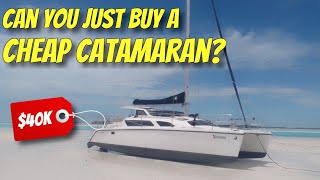
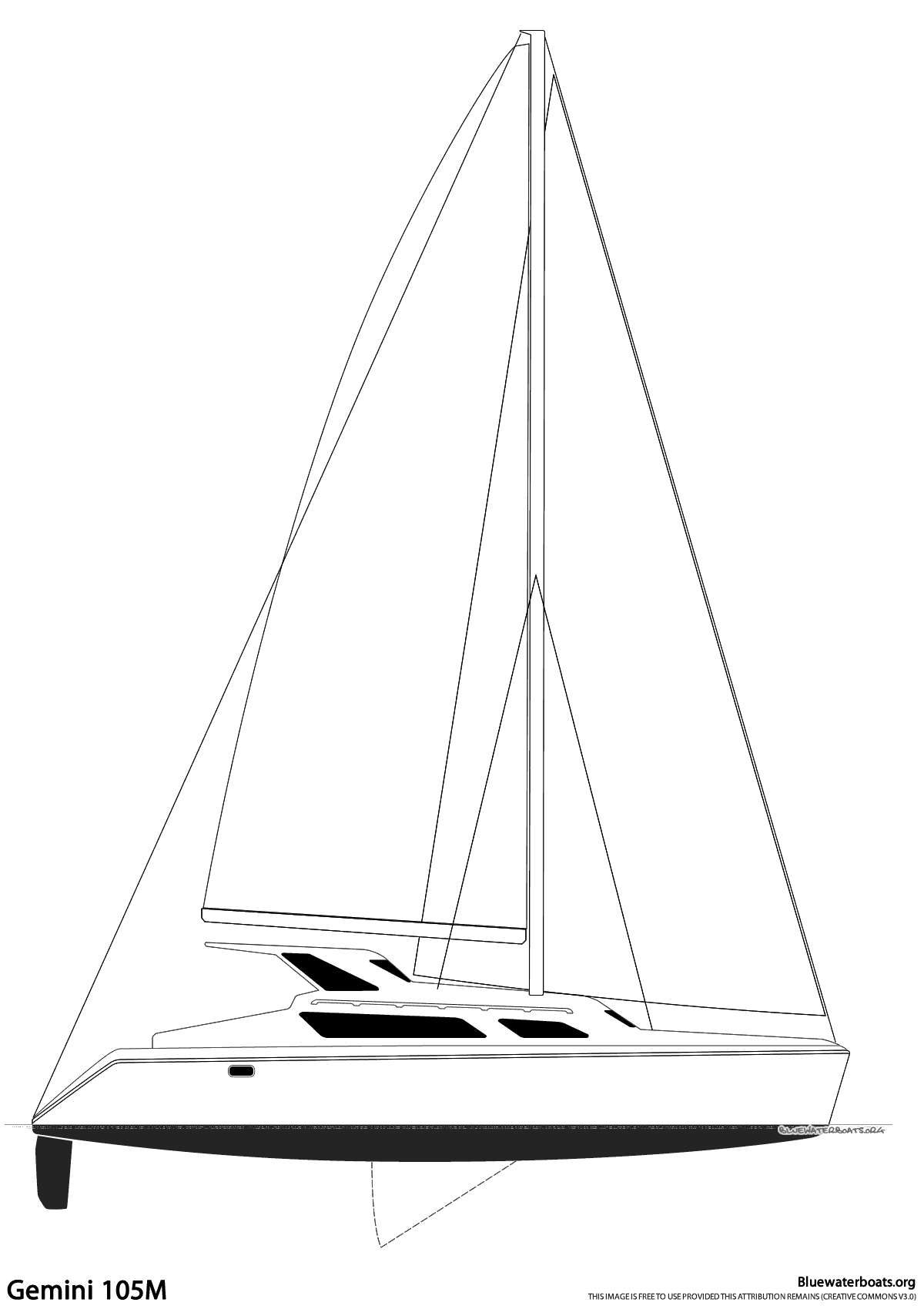
The Gemini 105M is the best-known and most numerous model in Tony Smith’s Performance Cruising lineup, a shoal-draft, trailerable-beam cruising catamaran that became one of the best-selling multihulls built in the United States. Most of its hulls serve as coastal cruisers, but a meaningful number have made ocean passages, including crossings made by Smith himself.
A large cockpit with wheel steering leads up a short flight of stairs to a hard foredeck ringed by a stainless pulpit, with lifelines running along narrow side decks. At roughly 8,000 lb loaded displacement, ground tackle need not be heavy, but light displacement also means heeling angle needs watching underway: past about seven degrees of heel it is time to reduce sail. Below, a salon table seats four comfortably (eight in a squeeze), with the head and shower down a few steps to port. An instant propane water heater means hot water is available whenever the two 35-gallon tanks have fresh water in them. Each hull carries a queen berth aft; the starboard hull’s forward cabin is the master. A propane-driven, ammonia-cycle refrigerator and generous dry-goods storage round out the galley.
Design and Construction
Each hull has a cable-driven, hand-cranked centerboard that retracts fully into a trunk (cutting draft to about 1.5 ft with the rudders also raised) or drops roughly four feet for markedly better upwind performance; most sailing is done somewhere between the two extremes, adjusted to wind, current, and whether the boat is under sail or at anchor. A 27 hp Westerbeke diesel drives a Sillette tilting saildrive on the 105M/105MC; the saildrive’s bellows are a known maintenance item worth checking on survey. The hull is solid GRP, laminated from woven roving and mat in isophthalic polyester resin, with an outer gel-coat layer to guard against osmosis; the deck and cockpit sole are balsa-cored GRP sandwich.
History
Smith’s earlier “classic” Gemini (1981-1990) and the 3200/3400 that followed it (1990-1996) were all built in Annapolis, Maryland, before the 105M’s redesigned hulls arrived: maximum beam moved further aft to cut wave drag, giving a 9:1 length-to-beam ratio and higher static stability than the earlier models. This is the model most likely to be found doing bluewater duty. Production later moved, and Performance Cruising partnered with Hunter Marine to continue building the 105MC in Alachua, Florida.
Under Sail
Tony Smith’s own account of sailing a Gemini across the North Atlantic with his son Neil, a 23-day passage that ran into 45-knot winds and 35-foot seas, is independently documented by Practical Sailor and stands as the strongest evidence for this design’s offshore capability. Owner-reported ocean crossings are further chronicled in Gemini Gems magazine and the active Gemini owners’ forum, though this catalog has not independently verified those accounts.
Buyers Notes
The Sillette saildrive’s bellows need regular inspection, a common failure point flagged across independent reviews. Because the centerboard-and-rudder system is core to how this design manages both draft and upwind performance, confirm both boards and rudders raise and lower smoothly and fully on survey rather than relying on a static dockside check.