What sailing channels say about the Hallberg-Rassy 69, quoted from video transcripts with a link to the exact moment. Opinions belong to the speakers; the written review above stays independent of them.
discusses
The presenter shows a powered transom that lowers to reveal a tender garage taking about a 3.2 m tender. A button lets someone in the water lower it, and a swimming ladder sits in a cassette as an emergency way back aboard.
discusses
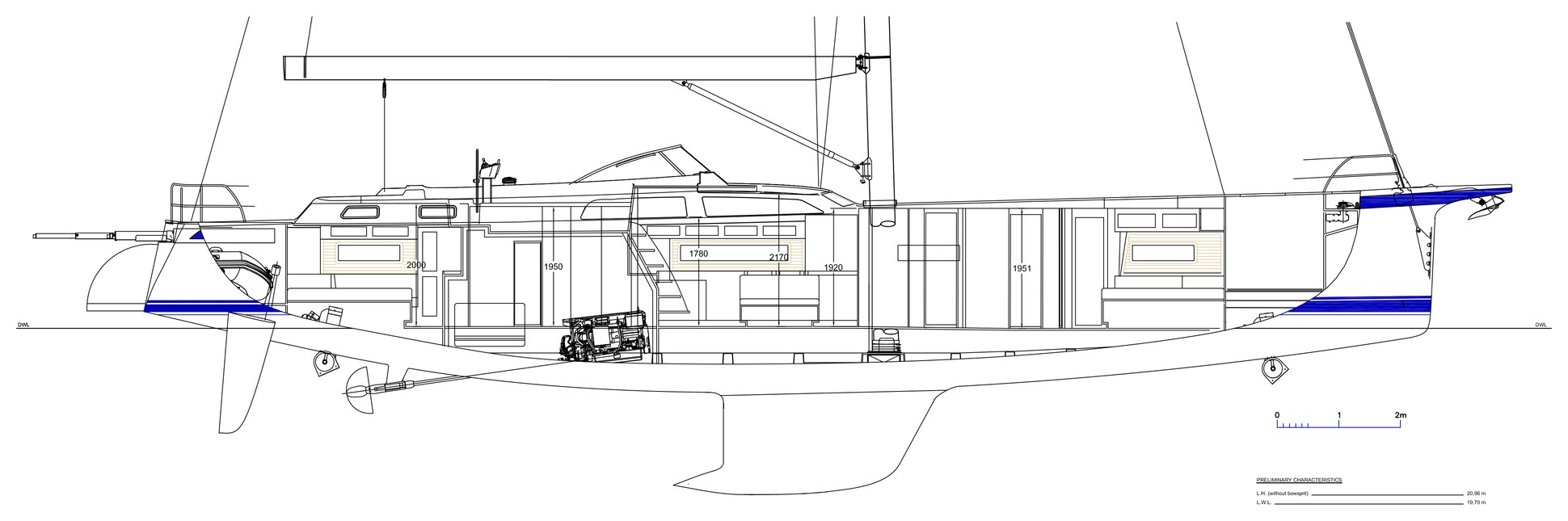
The engine room is roomy enough to get right around the Volvo Penta D6 300, which the presenter calls a low-stressed engine because D6s go up to about 440 horsepower. He recalls the generator as 17 and a half kW, and says the door thickness shows how well the machinery space is soundproofed.
discusses
The presenter lists carbon spars, in-mast furling and stainless rod rigging, with everything controlled from the cockpit. Hydraulics handle halyard tensioning, and a furler on the bowsprit takes a code zero.
discusses
On performance the presenter says he is told the boat will easily sail at about 10 knots, which he calls a very good cruising speed, and that more wind and harder sailing will go faster.
discusses
The presenter describes a boat-show layout with the galley on one side of the companionway and a nav station opposite. He says the galley can instead be larger with the nav station moved across, and that there are also two-cabin and three-cabin forward options.
recommends
Beating in 26 knots of apparent wind with a reef in the headsail and a reef in the main, the delivery crew make just over 8 knots in a short North Sea chop. The presenter calls the boat "very comfortable" with a "very quiet, very easy action", and "very powerful but stable" at a good angle of heel.
recommends
Crossing the Channel with 15 knots of northwesterly wind on the beam, full main and full headsail, the boat makes 7 and a half to 8 knots. The presenter says "this is what a Hallberg-Rassy 69 likes" and calls it "very safe, stable and strong".
recommends
In the Bay of Biscay with two reefs in the headsail and the main, the boat makes 9.3 to 9.5 knots through the water and "carries her weight through the water very well" as the sea builds. Later, on a beam reach, the presenter reports 10 knots through the water and calls her a "superbly fast boat", very stable, and one of the best Biscay crossings he has had.
repairs⚙ mainsail battens
A mainsail batten slipped down its batten track on passage. The presenter made a temporary repair with cable ties and cord, noting that "even new Hallberg-Rassys" need every item watched, and planned to ask the builder for the proper fix once in phone range.
recommends
When the wind picked up, the presenter says the push buttons make it easy: if the wind gets up you can bear away and refill the headsail very quickly and easily. He did it single-handed with the autohelm and got her back on track with no stress.
discusses
Welcome-aboard tour: twin wheels, a plotter at each helm and at the chart table, electric winches, a carbon fiber boom, four cabins with two en suite, a day heads, and a galley with a dishwasher and a tap with instant hot water. He says they sailed down past Denmark the day before under full main and full genoa and reached Kiel at sunset, and that "the boat sails great."
discusses
Presenter's tour of the engine room: "absolutely fantastic", an enormous space you can walk into, which makes daily engine checks easy. The generator is housed in the same space alongside the 300 horsepower Volvo Penta engine, with a day heads, wet locker, and a washer and dryer in the corridor aft of the saloon.
discusses
Presenter's galley notes: dishwasher, several freezers and fridges whose temperatures can be set individually, an induction hob with built-in microwave that does not draw much power, and an instant boiling-water tap that makes tea on watch easy.
discusses
Magnus Rassy of the builder, after a few weeks of sailing the just-launched boat in winds from zero to 24 knots true: "even faster and more enjoyable" than he expected for a yacht of this size. Without waves or surfing he reports up to 14.5 knots, which he describes as a more or less permanent speed, "a true mile eater". Builder's claim, not an independent test.
discusses
The builder says the mast, boom and spreaders are carbon, which saves several hundred kilos aloft and gives a stiff boat with a high righting moment. The rig is rod rigging with a longer mast crane for a full roach and headboard, and the sails are Elvstrom Technora.
discusses
Interior tour: the carbon mast is keel stepped, hidden in a wooden box that can be unscrewed for access, with the mast jack beneath. Forward of it the presenter points out a very thick structural bulkhead beside a thinner non-structural one, which "gives a solid feeling".
discusses
The presenter says there are several large deck storage lockers for light-wind sails, folding bicycles and diving gear, "close to 15 cubic meters of deck storage".
discusses
Engine room tour: a walk-in space with full headroom and good sound insulation, with the diesel generator in line with the main engine so the heavy items sit at the center. The main engine is a Volvo Penta D6 of 300 horsepower and 5.5 liters; at 1,600 RPM the presenter says it does around 8.4 knots. Five fuel tanks each have a drain valve and a hand pump for sampling the bottom of the tank.
discusses
The presenter says the boat has a backup for almost everything: the stove, washer and dryer run off the inverters, but a switch lets all the 230 volt systems run directly from the diesel generator if the inverters fail.
discusses
On the first day, reaching with the Code Zero set at about 110 degrees true in roughly 10 to 12 knots of true wind, the presenter says that over around 12 knots the boat is "into double figures very easily and stays there." On day two, in about 15 to 16 knots, the record was just over 13.
discusses
The presenter shows the steering gear: the quadrants, with an autopilot attached to each side and a bar across, so losing one steering system leaves the other. An emergency tiller fits on the rudder stock with a block and tackle across. He adds he has not seen a spare propeller this size on a production yacht.
warns⚙ water system
The presenter's bug bear on this expensive boat: in the owner's cabin you hear the water pump running whenever someone flushes the heads. He would put the pump in an insulated box, away from the cabins.
discusses
The walk-in engine room has a 300 horsepower engine. The presenter says Magnus wants to be able to run at low revs and that at 1,600 rpm the boat makes over 8 knots. Fuel tank valves let water be drained and checked in the filter, with two large fuel filters and an oil pump mounted for easy changes.
warns
The presenter's first impression of the galley is that it is pretty compact for a 70-footer: a small double sink and a single small bin, leaving little room for pots and pans. He suggests skipping the dishwasher or giving up a fridge to gain space.
discusses
The presenter says the oak veneers get eight coats of varnish, with ten on hard-wearing areas, and calls it very impressive. Moving forward while the boat is heeled under full headsail and main, he hears "exactly nothing" except the water rushing past the hull.