What sailing channels say about the Outremer 52, quoted from video transcripts with a link to the exact moment. Opinions belong to the speakers; the written review above stays independent of them.
discusses
The video describes the Outremer 52 as a very light catamaran, weighing about 12 and a half tons.
discusses
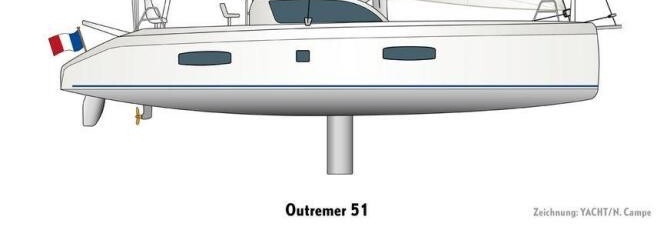
Being an Outremer, the 52 comes with daggerboards.
discusses
The Outremer 52 puts the helm down low, close to the action and the spray, unlike the Lagoon 52, which steers from a large flybridge.
discusses
The video puts the price of a new Outremer 52 somewhere between 1.5 and 2 million dollars, which it calls top-tier pricing for a catamaran this size.
discusses
The berths are much lower than on the Outremer 51, where the bulkhead was 40 centimeters higher and owners complained the beds were hard to get into. The 52 has a 1.6 meter queen berth that can be widened to king size.
discusses
The hull structure is laminated, while the accommodation is built as independent blocks that do not touch the structure. That is why the boat is very silent under sail, with no creaking or cracking.
discusses
Access around the engines is much wider than on the 51, where the aft area was very narrow. The mechanical steering is easy to disconnect, and the fuel pre-filter, belts and water pump are accessible.
discusses
The hull has four watertight compartments plus a double floor system, so the hull can in effect be cut in two with no water getting into the living quarters. The builder presents this as a safety feature against floating logs and containers.
discusses
Unlike other catamaran builders, Outremer lets the daggerboard head go one meter below the deck when fully down. The case therefore has to be much stronger, and a raised board stays no higher than the lifelines, which reduces windage in a storm.
discusses
Draft with the boards down is 2.6 meters. The builder says the boat can match the wind angle of a good cruising monohull upwind and that its VMG will be equivalent because it is so much faster.
discusses
The steering is unusual: the pedestal on the starboard side rotates through four positions, and on the port side there is a carbon tiller.
discusses
In lighter breeze with the big headsail out and the reefs shaken out of the main she sailed over 10 knots all the time, with a peak speed of just over 13 knots, and the tester found her very well balanced.
discusses
Going upwind at nine knots in 12 knots of breeze at a true wind angle of 67 degrees, with the daggerboards fully down and a draft of 2.6 meters.
discusses
The mast on the test boat is carbon. An alloy mast is standard, but the builder pushes the carbon one, which saves 160 kilos.
discusses
Unlike the 51, which is a completely glass boat, the 52 has its main structural bulkheads in carbon fiber as standard, which saves 600 kilos.
discusses
Despite choppy seas and some pounding upwind there was no creaking or groaning below. The joinery inside is not connected directly to the hull or structure, which the builder uses as a sort of shock absorber.
recommends
After a test sail the owners were truly blown away by how the boat sails, especially upwind and in light air.
discusses
The galley has tons of storage and an electric induction stove.
discusses
The guest cabin has its own shower and a mini washing machine, which the owners say is really mini and they are not sure what fits in it.
discusses
The boat has only one manual winch, on the side the owners call the racing side, where there is also a carbon tiller.
discusses
The builder changed the fabrication process on the 52 to optimize the foam core. This gives a better shape and needs a lot less resin, which saved significant weight. They used that saving to add interior volume and headroom.
discusses
The space between the salon and cockpit was opened up using a carbon bulkhead, which also made the structure more solid. Additional carbon bulkheads in the hulls make the boat stiffer, more durable and lighter.
discusses
The 52 has a three position tilting helm that lets you sail the boat either inside or outside. You can do your night watch from the helm cockpit or the newly centered nav station.
discusses
The helm comes with an electric engine throttle for more precise control in marinas. There is a signature hand tiller on the port side, which also acts as the emergency steering if something in the steering system breaks.
discusses
There are watertight bulkheads and spaces at the waterline under each hull forward for added protection. The hull bottoms are solid fiberglass, which gives extra impact resistance in case you drag over something.
discusses
The main solar panels are mounted on the davits, with additional flex panels on the coach roof, for 2,000 watts of solar as standard. The deck hardware comes in modern black rather than stainless steel.
recommends
One thing we really like about our boat is there's plenty of room to work and the ergonomics are really great. It feels like logical workstations for whatever needs to be done, and it's easy to see the lines, the sails and everything else going on.
discusses
On the crossing to the mainland they got to over 20 knots of true wind and over 11 knots of boat speed with the main and genoa up. They say the route later in the video includes hitting 17.9 knots.
discusses
With about 22 knots of wind they had two reefs in the genoa to take one reef in the main, then let one reef out of the genoa, so they were one and one. The skipper says the boat is happy.
discusses
With 22 knots true wind and one reef in each sail, the boat is steady at between 11 and 12 knots. Inside the boat you'd never know it, and down in the cabin it was nice and quiet.
discusses
Running with waves from behind the starboard quarter, they hit 15 knots of boat speed while the skipper surfs the waves. The narrator calls the sailing lively.