Overview
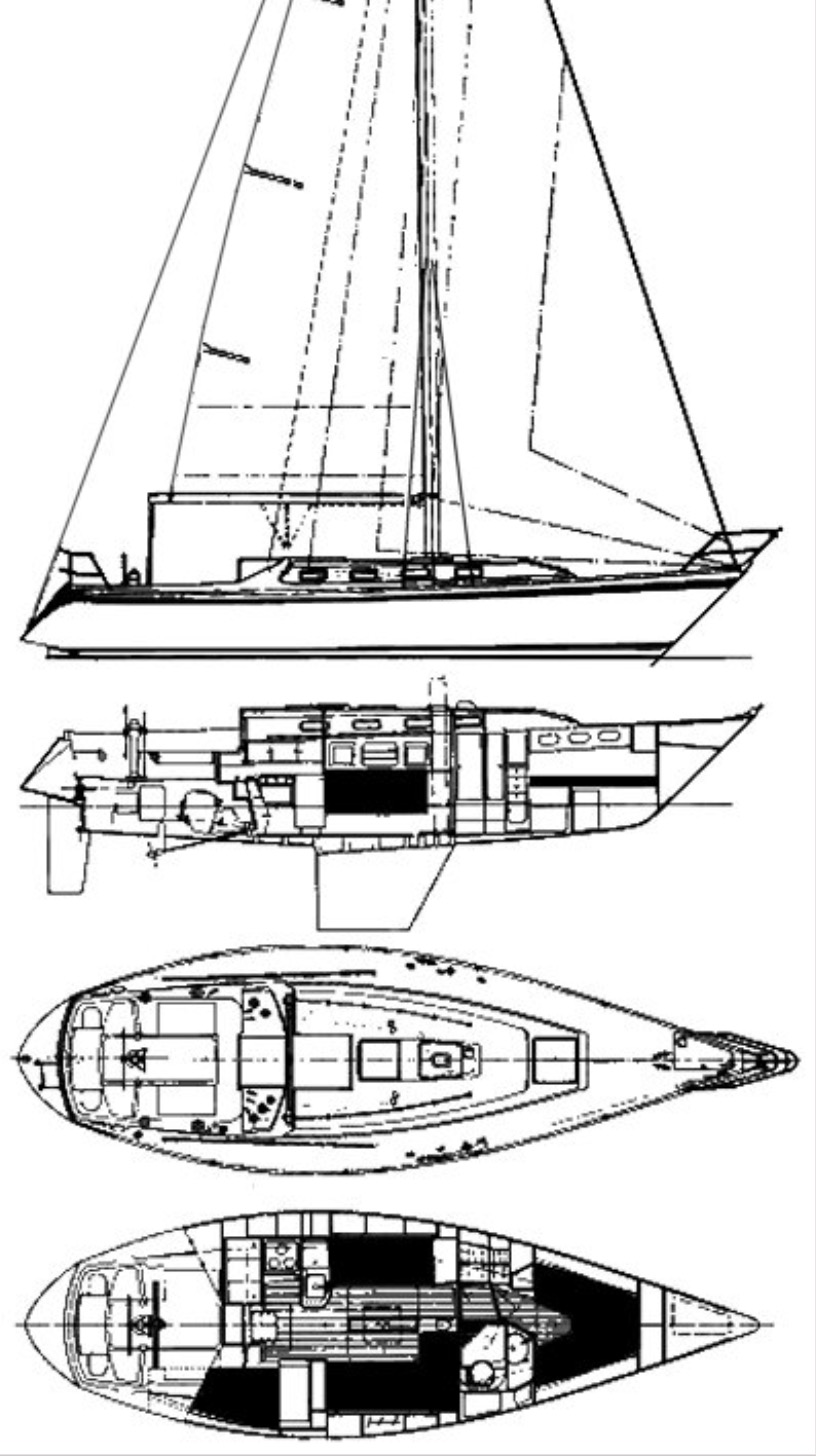
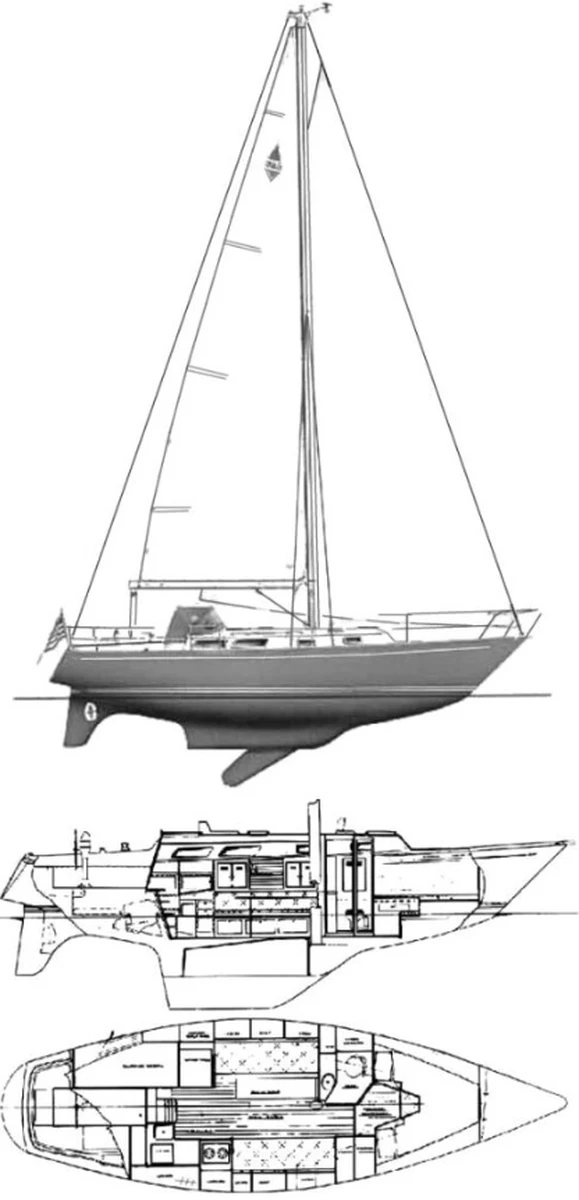
The Bristol 35.5 is a Ted Hood design produced continuously by Bristol Yachts of Warren, Rhode Island from late 1977 through 1996, with approximately 183 hulls built. Naval architect Ted Brewer described it as a “husky cruising auxiliary clearly designed with racing in mind”: generous displacement, moderate sail area, deep-draft underbody, and a propeller tucked in a skeg aperture to protect it from lobster trap lines. That detail reflects the New England context in which it was designed.
Where many production boats of the era competed on performance or price, Bristol competed on quality. A SpinSheet review compared the 35.5 to a luxury automobile - “conservative in design, a little on the heavy side, offers smooth steady performance though not at break-neck speeds, and when you close a door you’re left with a comfortable feeling of a solid well built product.” That assessment has aged well.
Design
The 35.5 represents what ListingSport calls Ted Hood’s “second generation” design: a transition from the narrower hulls of 1960s production boats toward more voluminous, performance-oriented cruisers without abandoning offshore conservatism. The hull uses a fin keel with rudder on skeg - a layout that balances the directional stability of a skeg-hung rudder with the windward efficiency of a modern fin. Practical Sailor described it as pointing effectively while remaining forgiving of helm inputs, with good initial stability and a comfortable, non-snappy motion offshore.
The boat was offered in two configurations: the standard fin-keel model at 5 ft 9 in draft, and the 35.5C centerboard variant with a board-up draft of 3 ft 9 in for Chesapeake Bay and shoal-water cruising. The centerboard integrates cleverly into the salon cabinetry without intruding on the cabin sole and is controlled by a low-geared horizontal winch on the coachroof. The STIX static stability index of 115 (centerboard version) is regarded as respectable; the fin-keel model is comparable or better.
Construction
Bristol built the hull in two halves joined along the centreline - a method that made possible what Practical Sailor called one of the finest hull-to-deck joints in production boatbuilding. The flanged hull is through-bolted to the deck with a teak toerail also through-bolted through both layers, creating a structural beam at the rail. Secondary bonding is described across multiple independent surveys as “almost always flawless,” and the hand-laid fibreglass was significantly overbuilt by modern production standards.
Interior joinery is hand-laid teak with ash inlays in the sole, screwed, glued, and bunged. Hardware was specified at a quality level unusual for production boats of this era: Lewmar winches, Edson steering, Bomar hatches, and Racor fuel filters were standard. Most well-maintained examples still carry working original equipment 40–45 years after launch.
Under Sail
The boat finds its stride at 12–15 knots. Despite a D/L ratio of 322 and SA/D of 15.5, performance is better than the numbers suggest: it points well and is notably quick in moderate air, where the fine entry and balanced rig do their best work. Ted Brewer, comparing the 35.5 against the Pearson 36 and Cheoy Lee 35, noted that the heavier displacement of the Bristol and Cheoy Lee gave superior motion comfort for extended cruising - maintaining windward speed in chop where lighter boats decelerate sharply.
In heavier conditions, the 43% ballast ratio is the defining characteristic. The 35.5 is stiff, recovers crisply from knockdowns, and heaves-to cleanly. The Capsize Screening Formula of 1.76 is below the 2.0 offshore threshold. Light air is the limitation: below 8 knots the heavy displacement imposes patience. Engine access is the main operational frustration - the compartment is described by Practical Sailor as “mediocre,” requiring tools to be worked in at awkward angles. The Yanmar 2QM 20H fitted to early boats is poorly regarded; Westerbeke and Universal diesels in later models are much preferred.
Buyers Notes
Verify with a surveyor familiar with Bristol production before purchase.
Four known problem areas, consistent across independent sources:
-
Deck core - balsa coring is vulnerable to moisture intrusion around chainplates and any hardware that has been re-bedded improperly; use a moisture meter across the entire deck.
-
Centerboard assembly (35.5C only) - stainless steel sheaves and pivot pins wear over time; unexpected board drop risks structural damage.
-
Fuel and water tanks - original aluminium and stainless tanks are susceptible to electrolysis and pinhole leaks; budget for replacement.
-
Mast step - keel-stepped masts can pool standing water at the base; inspect carefully and ensure drainage is clear.
Avoid unmodified 1978 models - early centerboard versions required factory modifications not all boats received. Per Practical Sailor, 1981 models offer the best value: post-modification quality without the premium that later boats command. Water tankage is generous at 100 gallons. Fuel is modest at 30 gallons. The Chesapeake Bristol Club maintains technical archives, historical brochures, and wiring diagrams for the full Ted Hood–era model range.
A 1989 hull named Adena, owned by Glen and Marilyn Kinsey Brown since 2004, illustrates the kind of long service life these boats see: 25 years of Great Lakes cruising out of Escanaba, Michigan, including a 150-nautical-mile run to Ontario’s North Channel made ten times. That is coastal and inland-lake use, not an ocean passage, and does not bear on this boat’s offshore evidence.