Overview
The Bristol 41.1 pairs Ted Hood’s classic styling with New England craftsmanship, a second-generation Bristol Yachts design built from 1981 through 1994. It carries the reputation its builder’s history would suggest: Bristol grew out of Clinton Pearson’s earlier work founding one of the first production fiberglass boatbuilders, and this era of Bristols is generally well regarded for fit, finish, and offshore-minded construction, though no independently documented named passage was found to confirm that reputation with a specific crossing.
History
Clinton Pearson co-founded Pearson Yachts with his cousin Everett in 1955, building some of the first production fiberglass sailboats, before leaving in 1964 to buy a struggling builder called Sailstar in West Warwick, Rhode Island. He renamed the company Bristol Yacht Company in 1966, after relocating to a former Herreshoff yard on Popasquash Road in Bristol, Rhode Island. Bristol’s early boats were Carl Alberg designs with full keels and keel-hung rudders, stout boats known for an easy motion at sea. By the time the 41.1 arrived, Bristol had moved to Ted Hood’s design office for most of its line; Dieter Empacher, who had also worked on the earlier Bristol 39 and 40, served as the primary naval architect on the 41.1 itself. Bristol built 104 hulls of the design between 1981 and 1994, after which the company shifted to custom yacht work before closing in 1997.
Design and Construction
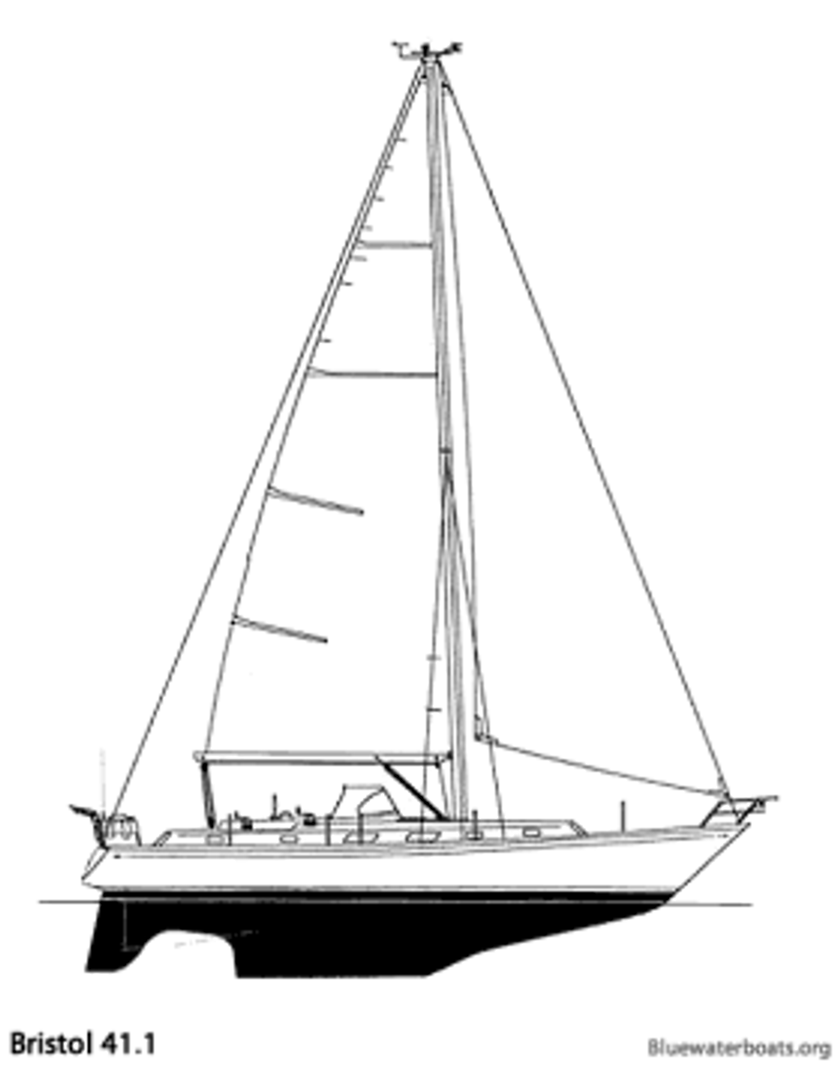
The hull is solid fiberglass, laid up in woven roving and polyester resin, with 10,500 lb of lead ballast encapsulated in the keel. A centerboard, standard on Ted Hood designs of this period, drops the draft from 4.5 ft with the board up to 10 ft down, trading shoal-water access for a meaningfully better upwind angle when needed. The rig is a masthead sloop as standard, though sailboatdata.com’s own notes record an alternate factory cutter rig as well. Both aft-cockpit and center-cockpit deck layouts were offered, with the center-cockpit version, and its full-width aft stateroom, the more common configuration. Deck and trim are finished in generous teak, with joinery below in teak and Honduras mahogany. A related model, the Bristol 43.3, shares the same hull mold with a modified interior (an island queen aft and a corner galley in place of the walkthrough layout) and accounts for roughly 26 additional hulls.
Under Sail
Reviewers and owners consistently point to strong sailing manners as this design’s main draw: a medium-displacement hull that tracks well and handles heavy weather comfortably. Lowering the centerboard makes a real difference to windward, reportedly worth about 10 degrees of pointing over the board-up configuration.
Buyers Notes
Interior layout varies by cockpit configuration: center-cockpit boats get a full-width aft stateroom (split berths or a king), an L-shaped saloon settee opposite swivel chairs or a straight settee, and a V-berth forward. As with any centerboard boat of this age, the board pendant, cable, and trunk are worth close inspection, since that mechanism sees decades of wear that a fixed-keel boat’s equivalent doesn’t. The related Bristol 43.3, sharing the same hull and mold, is worth cross-referencing for parts and systems questions given the shared underlying design.