Overview
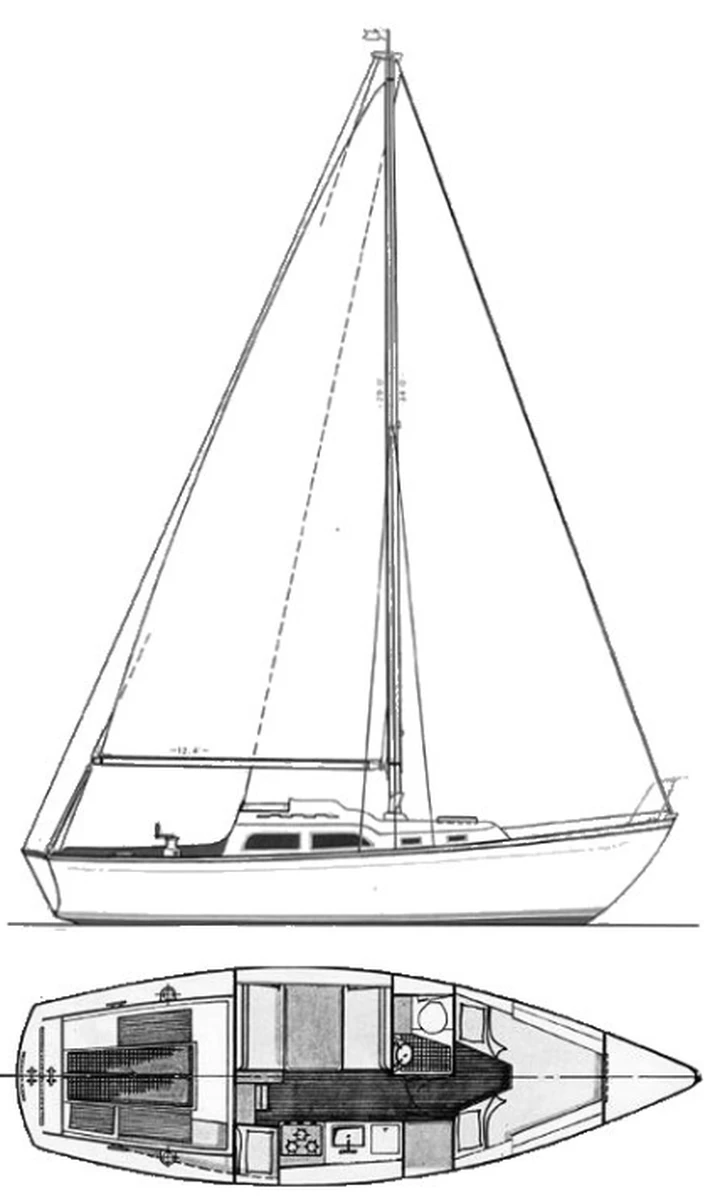
The Offshore 28 is a Bill Luders design built by Cheoy Lee in Hong Kong through most of the 1970s, and it stands apart from most of the yard’s other small offshore boats by using a centerboard rather than a full keel. That makes the “full-keel” tag on the original stub wrong, and it matters to a buyer weighing this boat: the draft with the board up is a shoal 3’6”, but the boat depends on the board being down for windward performance and for the deeper lateral plane that full-keel designs get for free.
History
Cheoy Lee built the Offshore 28 from around 1972 through the late 1970s, with production numbers on the modest side, on the order of 40 to 60 hulls by most estimates. The designer, Alfred E. Luders Jr., known as Bill Luders, drew several boats for Cheoy Lee during this period including the Luders 30, the Offshore 47, and the Clipper series, and the 28 shares the family’s masthead sloop rig and inboard diesel as standard equipment. Buyers could order the boat with a tiller or a wheel, an option Baldwin also noted in his own entry for the boat.
Construction
The keel/centerboard arrangement is the defining feature of this boat’s construction. Baldwin’s notes flag it directly: “Like most centerboard keels, they are prone to jam, break cables, and are difficult to maintain.” A board that will not retract, or one whose pennant or cable has failed, turns a shoal-draft cruiser into either a boat stuck at whatever depth the board happens to be in, or one that has lost the lateral plane it needs to sail to windward. The hull itself is hand-laid fiberglass in keeping with the rest of Cheoy Lee’s production from this era, and the inboard diesel that came standard is worth checking on any specific boat, since forty-plus-year-old original engines are not uncommon on Cheoy Lee cruisers this size.
Under Sail
With the board down, the Offshore 28 gains meaningful draft and should sail like a reasonably conventional masthead sloop of her displacement, at 8,000 lbs on a 28-foot hull. With the board up she can get into water a full keel of similar size could not touch, the usual centerboard tradeoff of shoal access against a mechanism that needs upkeep. Baldwin’s one recorded plus is simple and specific: “Moderate draft,” which is really the whole case for choosing this boat over one of Cheoy Lee’s full-keel offerings of similar length.
Buyers Notes
Baldwin’s notes are unusually complete for this boat and worth reading in full. On the plus side: “Moderate draft.” On the minus side: “Teak decks of this era require replacing or removal. Like most centerboard keels, they are prone to jam, break cables, and are difficult to maintain. Better to avoid a centerboard unless the design is…” (Baldwin’s own note is cut off at that point in the source data). That last point deserves attention from any serious buyer: a survey of this model should center on the centerboard trunk, the board itself for corrosion or delamination, the pennant and lifting cable, and the winch or tackle used to raise it, in addition to the standard checks for original teak decks, which by now are past due for replacement or removal on any boat that has not already had the work done.