Overview
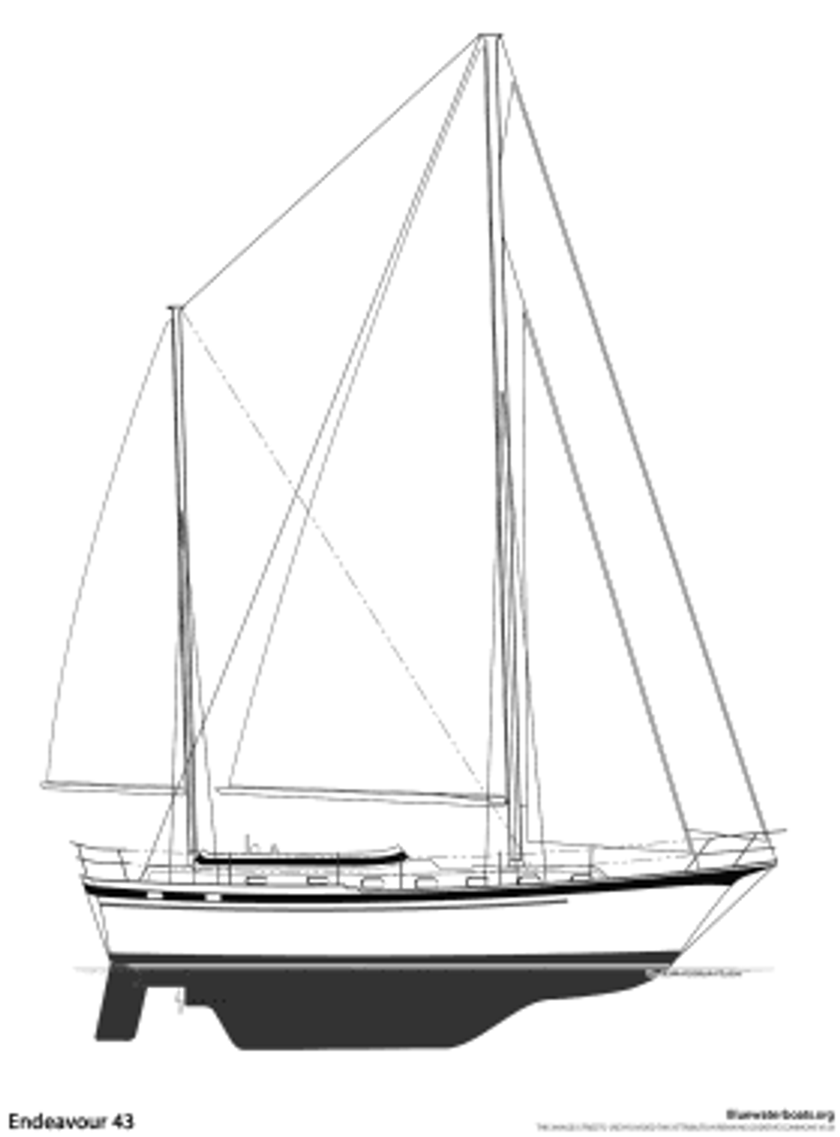
Endeavour commissioned Robert Johnson to draw a roomy center-cockpit cruiser after the yard’s 32- and 37-foot models. The result used 43 feet of hull, a bowsprit that brings the published overall length to 45 feet 3 inches, and a 14-foot beam. The design priority was living space and shoal-water access rather than minimum weight.
Production dates are inconsistent. The Endeavour owners archive lists 1978–1983 in its summary, then describes production through 1984. SailboatData uses 1979–1985. The catalog keeps 1978–1984 as a practical range, but buyers should use the hull identification number and build records for a specific boat. The sources also differ on production count: the owners database reaches hull 199, while SailboatData lists 185 built.
Construction
The owners archive describes a one-piece fiberglass hull with an integral keel and encapsulated lead ballast. The deck and cockpit form another molded unit. Plywood core stiffens the cabin top, deck, seats, and cockpit sole. The deck sits on an integral hull flange with adhesive sealant and stainless bolts, then receives a bedded teak caprail.
The main mast is keel-stepped. On ketches, the mizzen is deck-stepped over a support. Chainplates are bolted through the hull in reinforced areas. Cable steering turns a quadrant on the rudder post, with the support frame also carrying machinery loads. These details provide clear survey points: core moisture, chainplate bolts, mast support, steering conduits, support-frame corrosion, and the rudder-post stuffing box.
Rig and Specification Conflicts
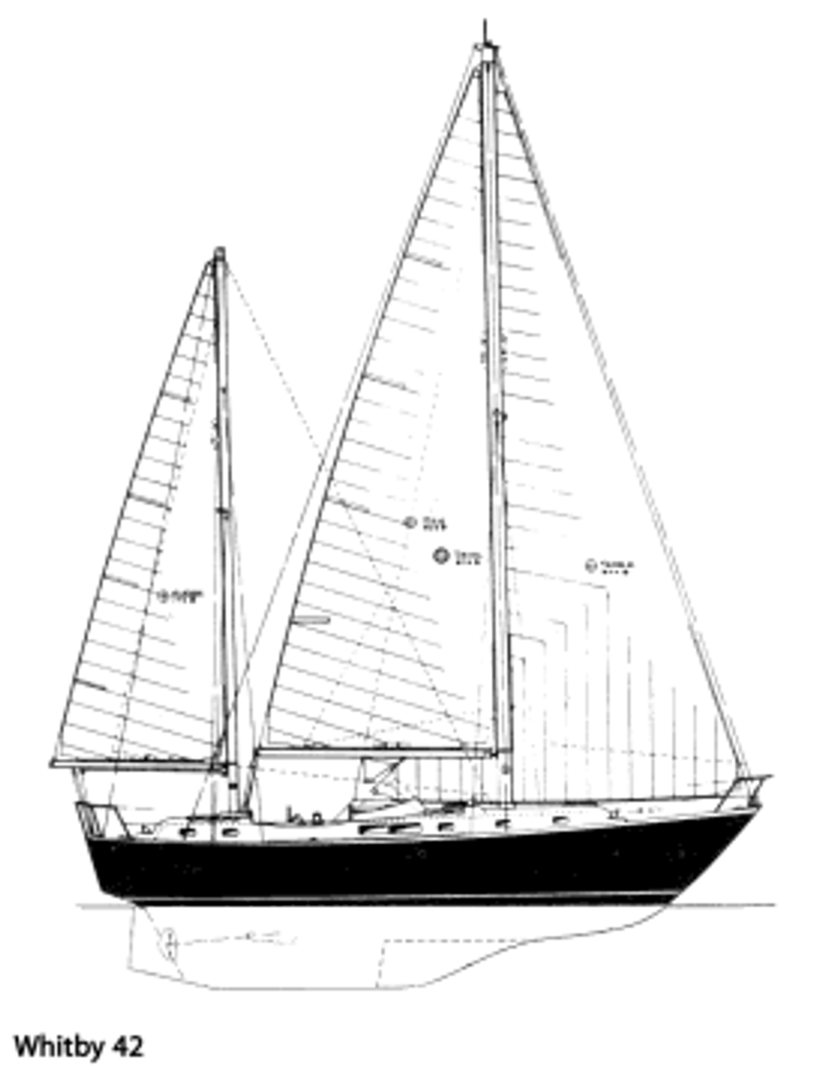
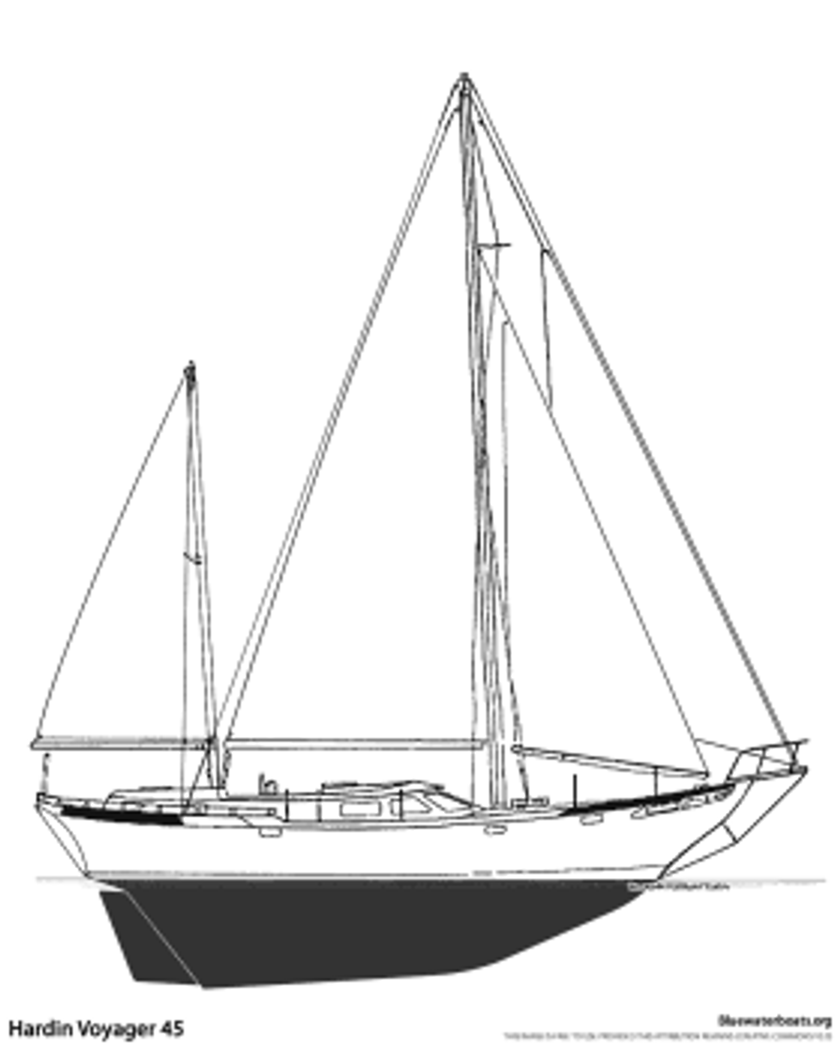
Endeavour offered sloop, cutter, and ketch versions. SailboatData says the owner version used a taller mast, inner forestay, and additional winches, while the charter version had a shorter mast and no inner forestay. The catalog now records the ketch as the primary rig and the other two as variants.
The owners archive reports 1,030 square feet of sail area and a draft of 5 feet 3 inches. SailboatData also reports 1,030 square feet, but its calculation from the listed rig triangles is 895 square feet and its maximum draft is 5 feet 6 inches. The difference in sail area reflects reported sail inventory versus measured rig triangles. Draft may vary with loading or source convention. The catalog uses the reported sail area and the larger draft while keeping the conflict visible here.
Under Sail
The 33,000-pound displacement and 35-foot waterline produce a displacement-to-length ratio above 340. The boat will carry momentum once moving, but rapid acceleration and light-air work are not its design strengths. The rig choice also changes how easily a short crew can divide sail area as the wind rises.
The available sources do not provide a controlled sea trial or a named ocean passage for this model. The archived review is critical of windward ability and following-sea handling, but this research pass did not find independent measured results to support those claims. They should be tested on the individual boat rather than repeated as settled model-wide defects.
Accommodation and Machinery
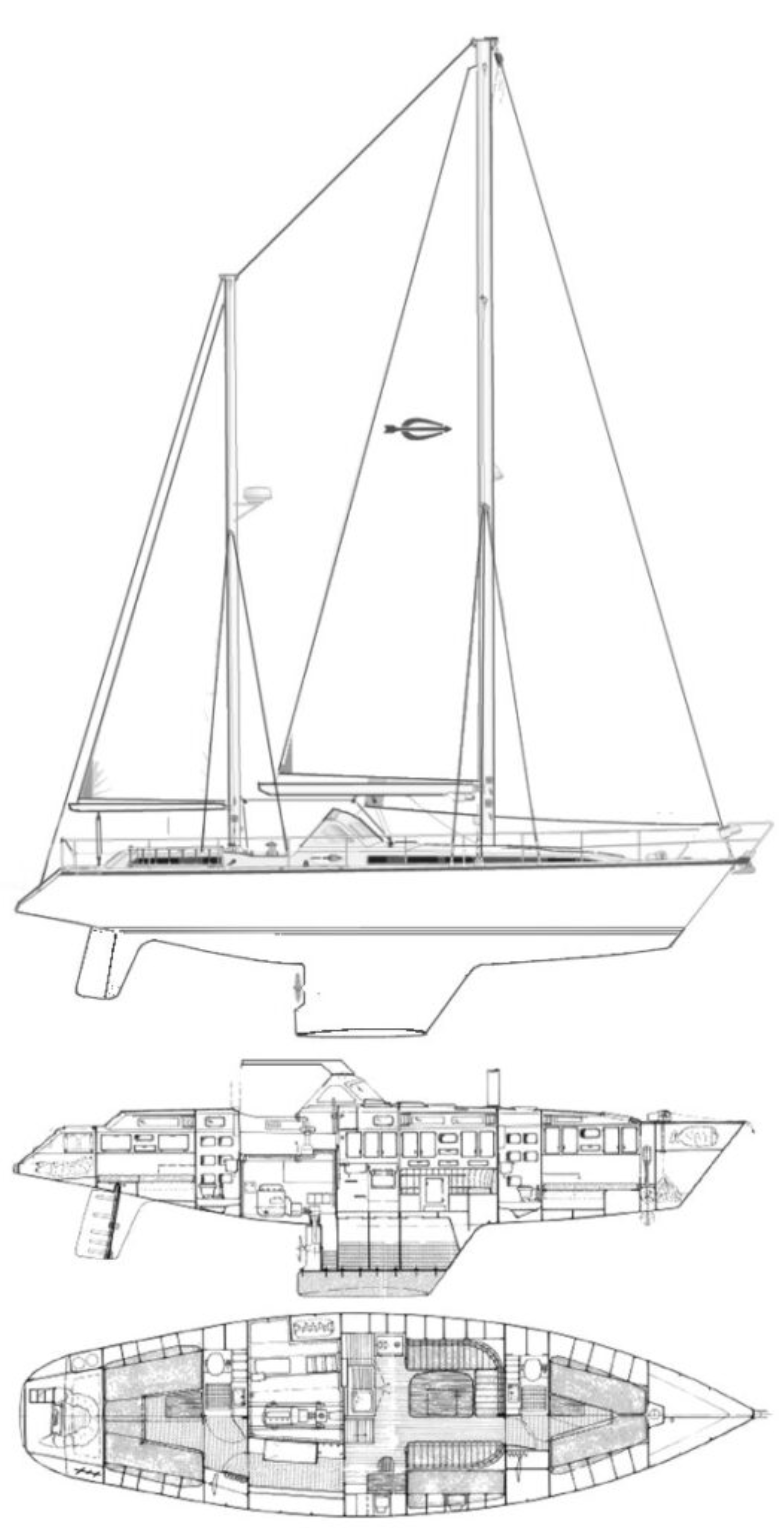
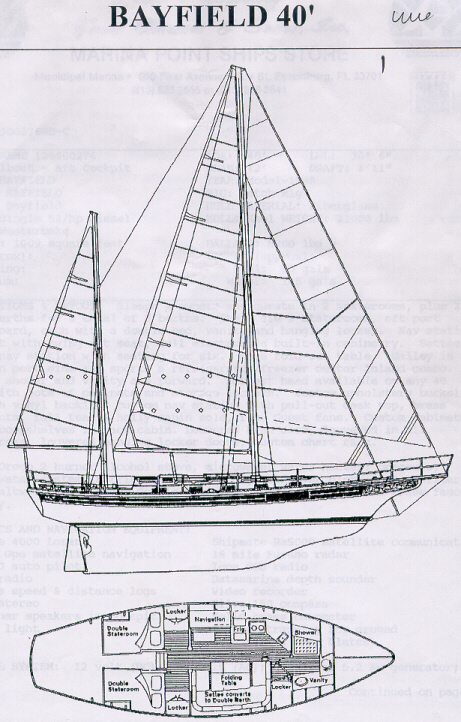
The two-stateroom arrangement is the defining feature. Published headroom is 6 feet 7 inches. The usual plan has a forward V-berth, main saloon, navigation station, and galley, with a port-side passage leading aft past the engine. The aft cabin has a transverse double berth and a private head. The owners archive describes strong engine access and space for a generator ahead of the main engine.
Original tankage is listed as 175 gallons of diesel and 200 gallons of water. That is a large aging tank system. Inspection should include material, supports, access, fills, vents, and signs of leakage. Original propulsion was commonly a Perkins 4-154 diesel turning a 1.25-inch shaft through a cutless bearing on a skeg-mounted shaft log.
Buyers Notes
Establish the rig and owner or charter configuration before comparing specifications. Inspect the plywood-cored deck around every fitting, the bolted hull joint beneath the caprail, chainplates, both mast supports, steering frame, rudder post, and shaft log. Confirm that tank access is realistic before treating the large capacities as an advantage.
The Endeavour 43 offers substantial liveaboard volume and shallow draft for its size. Its offshore case remains unverified here because the available research documents construction and accommodation more clearly than passage history or sailing behavior.