What sailing channels say about the Nautitech 40 Open, quoted from video transcripts with a link to the exact moment. Opinions belong to the speakers; the written review above stays independent of them.
discusses
The owners looked at a Bali catamaran first, but wanted something more robust that they could sail comfortably on longer passages and potentially take across an ocean, and that is how they ended up with the Nautitech 40 Open.
discusses
In the Bay of Biscay they had three to four days of violent slamming. Smoke alarms and a magnet fell off, doors flew open and the freezer opened, but the owners expected something like it sooner or later.
discusses
Only the starboard helm had a throttle, so the owners had engine controls installed at the other helm to help when docking on the port side.
discusses
Many people complain about the dual helm stations being exposed. The owners have enjoyed them: when spray gets too much you step away and steer from inside, and the helms give a clear view for docking.
warns⚙ anchoring
The anchor drops from underneath and is held on a bridle. The owners plan to change it, because as it is you cannot reach the anchor to attach an anchor ball or put out a secondary anchor.
recommends
The owners chose the Open version over the flybridge version of the Nautitech 40 because the boom is low, which makes it safer to manage the sails and, they think, improves sailability.
discusses
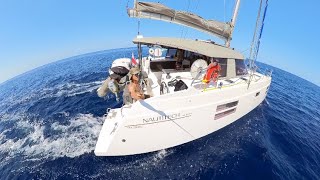
On the passage back to Tahiti they were sailing at 7 to 8 knots in about 25 knots of wind, with big swells and an unpleasant sea state.
discusses
With the wind between 20 and 25 knots, they kept the third reef in the main and a reefed jib, and sailed along at 6 and a half to 8 knots.
discusses
On a broad reach the boat is sailing along really well. At an average of seven knots the 200 mile crossing would take just over 24 hours.
warns
In the evening he reefed the jib to give a more comfortable ride for sleeping. When going fast the boat skids over the waves and bounces, and the underwing hits the big pointed waves.
discusses
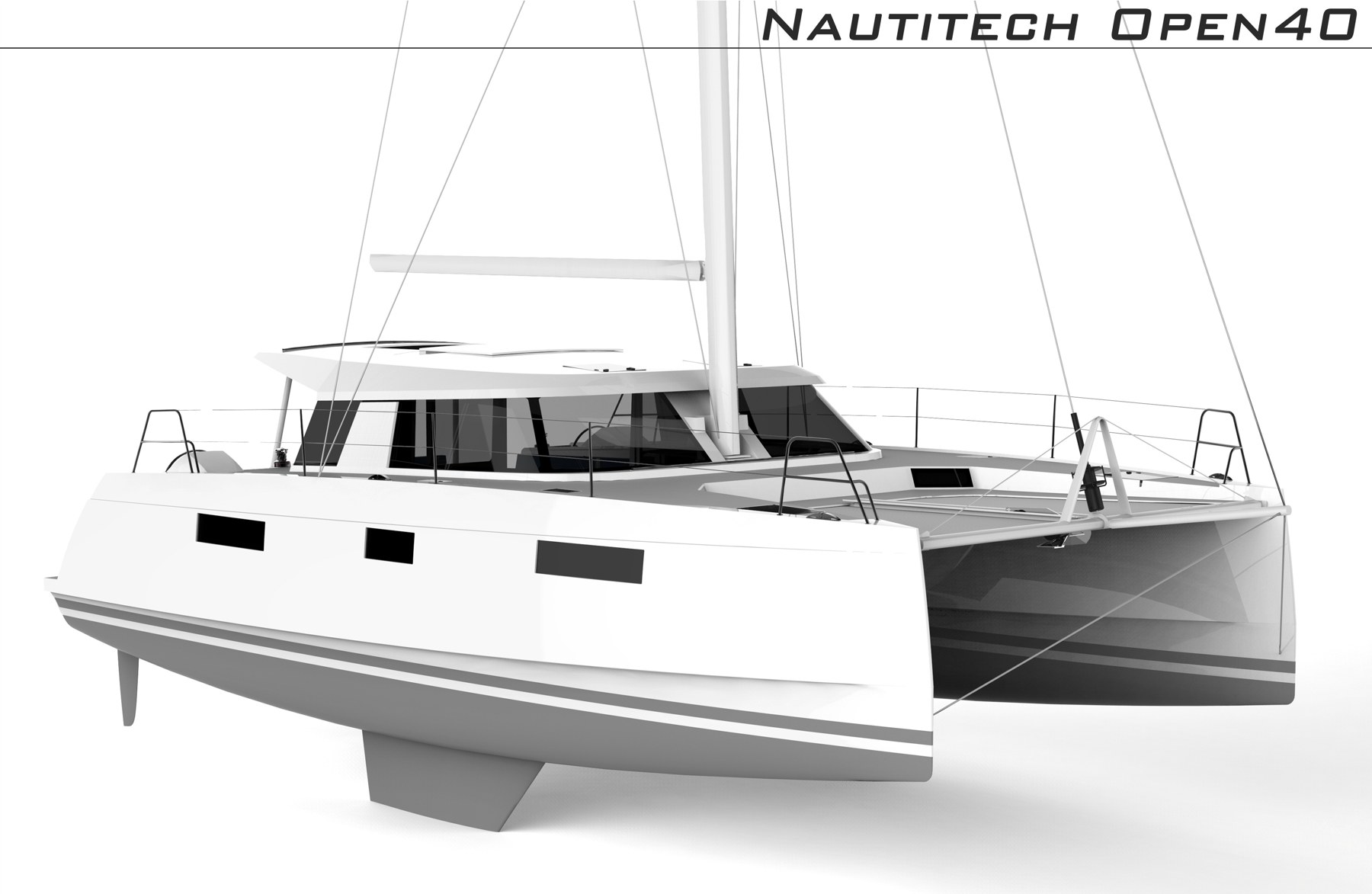
Nautitech differentiated this catamaran from the competition in two ways: the size of the outer seating area, and a twin wheel steering system at the stern of each hull.
warns
Open hatches and the sheet and traveler lines that run through the deck are tripping hazards.
warns
The net between the two hulls is a lounge area, but it is not a trampoline and the maximum weight is 200 kilos.
warns
The saloon is not the strongest point of this catamaran, because the goal was a comfortable, spacious cockpit. There is a bit of a lack of space in the saloon.
warns
In the aft cabins there are only two small hatches and one hull window, so a minus could be a lack of natural light.
discusses
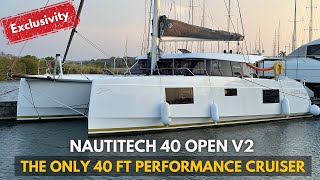
On the V2 the helm station is improved and feels much more protected. The navigation screen is 9 inch rather than 7 inch, and there is easy access to the coach roof.
discusses
The boom is low, a Nautitech trademark, and the main traveler sits on top, which frees space below. The boat has a self-tacking jib and a long bowsprit for a code zero.
discusses
An extra winch on the port side can be used to lift the dinghy or to trim the main, so the mainsheet can be trimmed from both helm stations.
discusses
The window and bay between the cockpit and the saloon can be opened entirely to create a really big space.
discusses
The first version had a step here and the V2 does not, so it is all flush. The first version also let rain pour onto the instruments when the window was open, and that is not the case anymore.
discusses
The boat has a 65 litre per hour water maker.