Overview
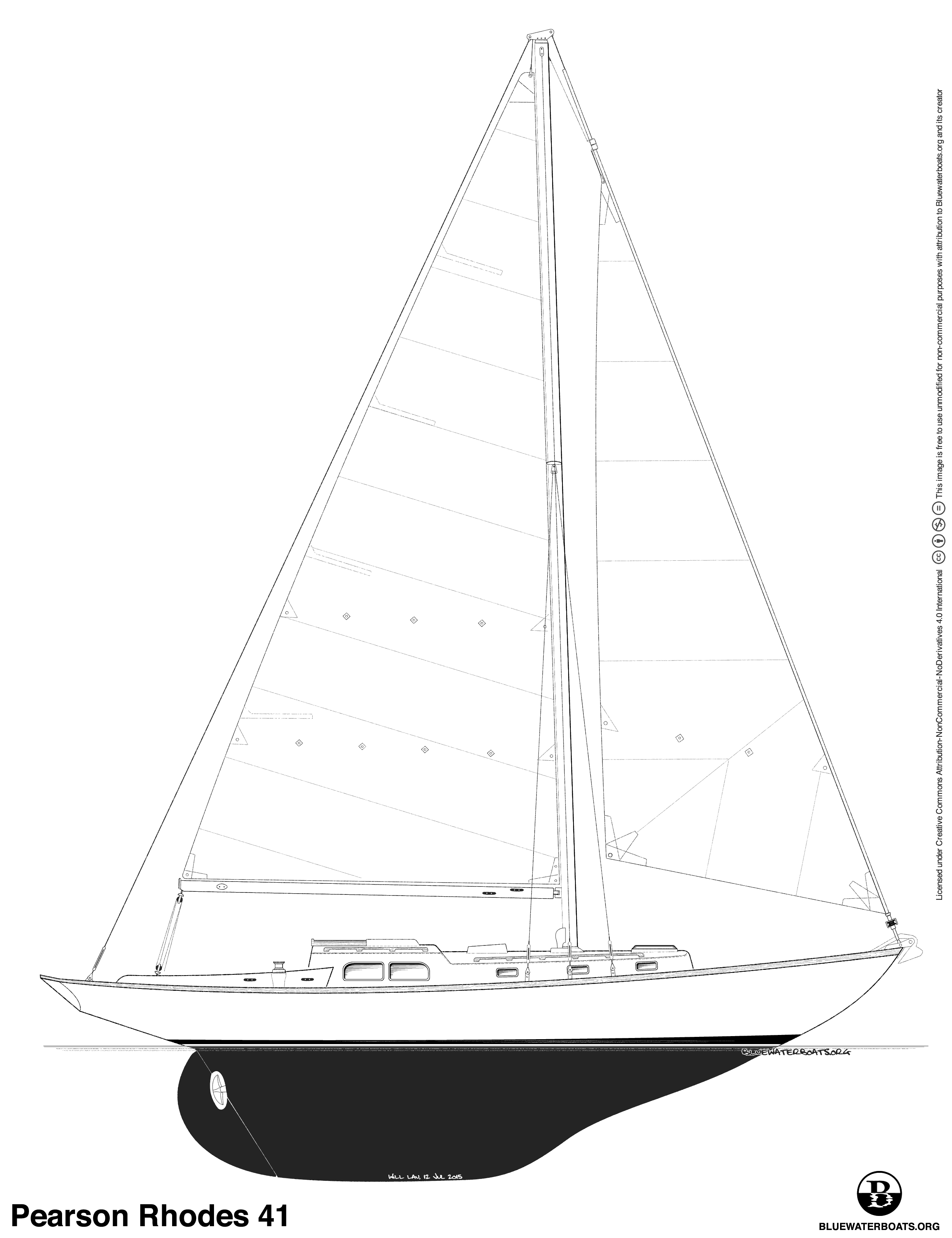
The Pearson Rhodes 41 carries the long overhangs and graceful lines of the CCA era, a Phillip Rhodes design built by Pearson Yachts from 1961 to 1968. Roughly 50 were built, and by most accounts nearly all of them are still around today, with a devoted following that makes them, in Practical Sailor’s phrase, “one of the most sought-after oldies-but-goodies afloat.”
History
The design’s roots go back to 1939, when Phillip Rhodes drew a 38-foot 9-inch wooden sloop called Bounty for Fred Coleman’s Coleman Boat and Plastics Company. After World War II, rising labor and material costs pushed Coleman toward fiberglass, and he teamed with Vince Lazzara to form Aero Marine in Sausalito, California. Their first offering, the Bounty II, was actually a fiberglass reproduction of a different Rhodes design, the 1955 sloop Altair, with William Garden consulting on tooling and layup. Over 100 Bounty II hulls were built before Aero Marine’s parent company, Grumman, liquidated the operation in 1962 and shipped the tooling to its own Pearson Yachts subsidiary in Portsmouth, Rhode Island. There, production resumed in 1961 as the Pearson Rhodes 41, essentially the same mold with more freeboard, smaller doghouse windows, lead instead of iron ballast, a mast moved aft, and the engine relocated behind the companionway for better access. Rhodes himself considered the changes minor enough that the 41 never received its own design number, carrying the Bounty II’s Rhodes Design #658 instead. Production ended in 1968 as IOR-era design took over the market.
Design and Construction
At 18,800 lb displacement with a 28 ft waterline, Rhodes boasted the boat had the accommodations of a 30-footer, a fair claim given the era’s other wood-hulled designs. Construction is solid fiberglass with encapsulated lead ballast, a genuine strength: encapsulation removes keel-bolt inspection from the maintenance list entirely. Practical Sailor rates the era’s hand-layup quality highly, with good void control and better-than-average blister resistance for a boat this old. The interior mixes a surprisingly modern white Formica-and-gelcoat finish with traditional teak trim, and the stick-built structure with bonded, tabbed-in bulkheads gives real additional support to the hull and deck while keeping interior surfaces reasonably accessible for maintenance.
Under Sail
Classic CCA overhangs mean the boat gains real waterline length, and therefore speed, as she heels; a relatively short, low-aspect rig with a modest sail-area-to-displacement ratio means she needs a genuine breeze to get going, but she offers a kind motion and strong directional stability once underway, good qualities for shorthanded, self-steering-dependent passages. The clearest evidence of real performance: Eric Crawford’s restored Restless won the 2000 Newport to Bermuda Race overall, a serious ocean race, competing against considerably newer designs.
Buyers Notes
Deck delamination in cored areas is a known issue; small spots are epoxy-injectable, but larger damage means a real core-replacement job. Early hulls used monel for fuel and water tanks, a genuinely durable choice but an expensive one to replace today given how much the metal’s cost has risen. Given the design’s age, expect most examples to need a meaningful refit; budgets documented by Practical Sailor range from $10,000 for a project boat up to $100,000-plus for a professionally restored one.