Overview
Few production designs anywhere carry a solo-circumnavigation record like the S&S 34’s. Designed by Olin Stephens for Sparkman and Stephens, it proved itself first as an IOR-era racer, then became the boat of choice for a string of record-setting singlehanded voyages, and along the way earned a genuine reputation as a serious bluewater cruiser. Stephens himself said at the time he hoped the design would prove “a good all-round boat,” good enough offshore racing to also make a good cruiser; the boat’s history has more than borne that out.
History
The design traces to Stephens’ work on the 1967 and 1970 America’s Cup defender Intrepid, the first 12 Metre with a separated rudder and keel, an innovation carried straight into the S&S 34. British yachtsman Michael Winfield commissioned the production design in 1968 after his own 36-foot one-tonner, Morningtown, impressed him enough to ask Sparkman and Stephens for a production version. The first hull built, Morning Cloud, won its class in the 1969 Sydney Hobart under owner Sir Edward Heath, later a British Prime Minister; S&S 34s went on to win or place in that race every year from 1969 to 1974. Winfield built a dozen or so boats in England before selling his molds; roughly 50 to 100 were eventually built in the UK, some finished by other yards and sold in the US as the Palmer Johnson 34. A second mold went to Australia, where the Swarbrick brothers built 34 boats between 1969 and 1984 before the company failed; four more were built afterward by Maybrook Marine before the molds were stored. In 2003 the molds returned to Western Australia, and a new company, Swarbrick and Swarbrick, resumed production using modern foam-sandwich construction under consultation with Sparkman and Stephens, calling the updated boats the Constellation class. Roughly 200 hulls exist across both continents and both eras of construction.
Design and Construction
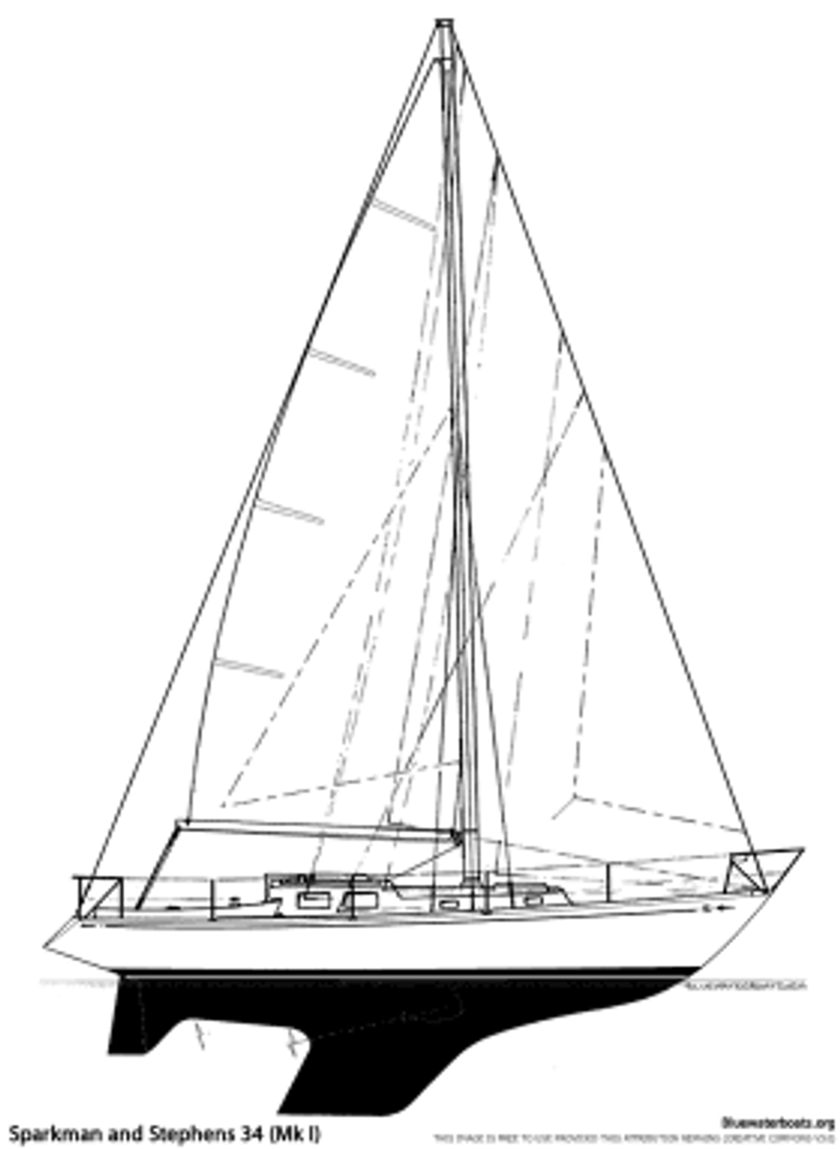
The hull carries a strikingly modern shape for a 1967 design: a fine bow, narrow stern, and a short fin keel with nearly all ballast centered amidships, paired with a skeg-hung rudder well aft, an innovative configuration for its day. The masthead rig is relatively tall with a high-aspect mainsail and enlarged foresail, a combination that later became common on racing designs generally. A roughly 40 percent ballast ratio makes for a genuinely stiff boat.
Under Sail
Owners still describe the S&S 34 as quick more than 40 years on; by the numbers only 20 hp is needed to drive her to hull speed. She is regarded as exceptionally fast to windward even today, holding tacks as tight as 80 degrees in a good breeze, though she is, like most Sparkman and Stephens designs of her era, a wet boat. The clearest evidence of her offshore capability is the record itself: Jon Sanders’ 1981-82 double circumnavigation via Cape Horn in Perie Banou set 12 world records, including 48,510 nonstop miles over 419 days. David Dicks (Seaflight, 1996-97, age 17) and Jesse Martin (Lionheart, 1998-99, age 18) each set the youngest-ever solo nonstop circumnavigation record via Cape Horn in an S&S 34, and Jessica Watson later became the youngest to sail solo, unassisted, and nonstop around the world at 16 in Ella’s Pink Lady. In a related but smaller-scale feat, quadriplegic sailor Jamie Dunross solo-circumnavigated Australia in the S&S 34 Spirit of Rockingham in 2010.
Buyers Notes
The design exists in materially different eras of construction: original Winfield/Aquafibre/Swarbrick hulls built through the 1980s, and the modern 2004-onward Constellation-class boats built in foam-sandwich composite, roughly 25 percent lighter and stiffer than the originals. Confirm which era a specific hull comes from, and whether it carries the original deeper Mk II keel and curved spade rudder or the earlier configuration. An active owners’ association exists, concentrated mostly in Australia; consult it for current class knowledge before buying.