Overview
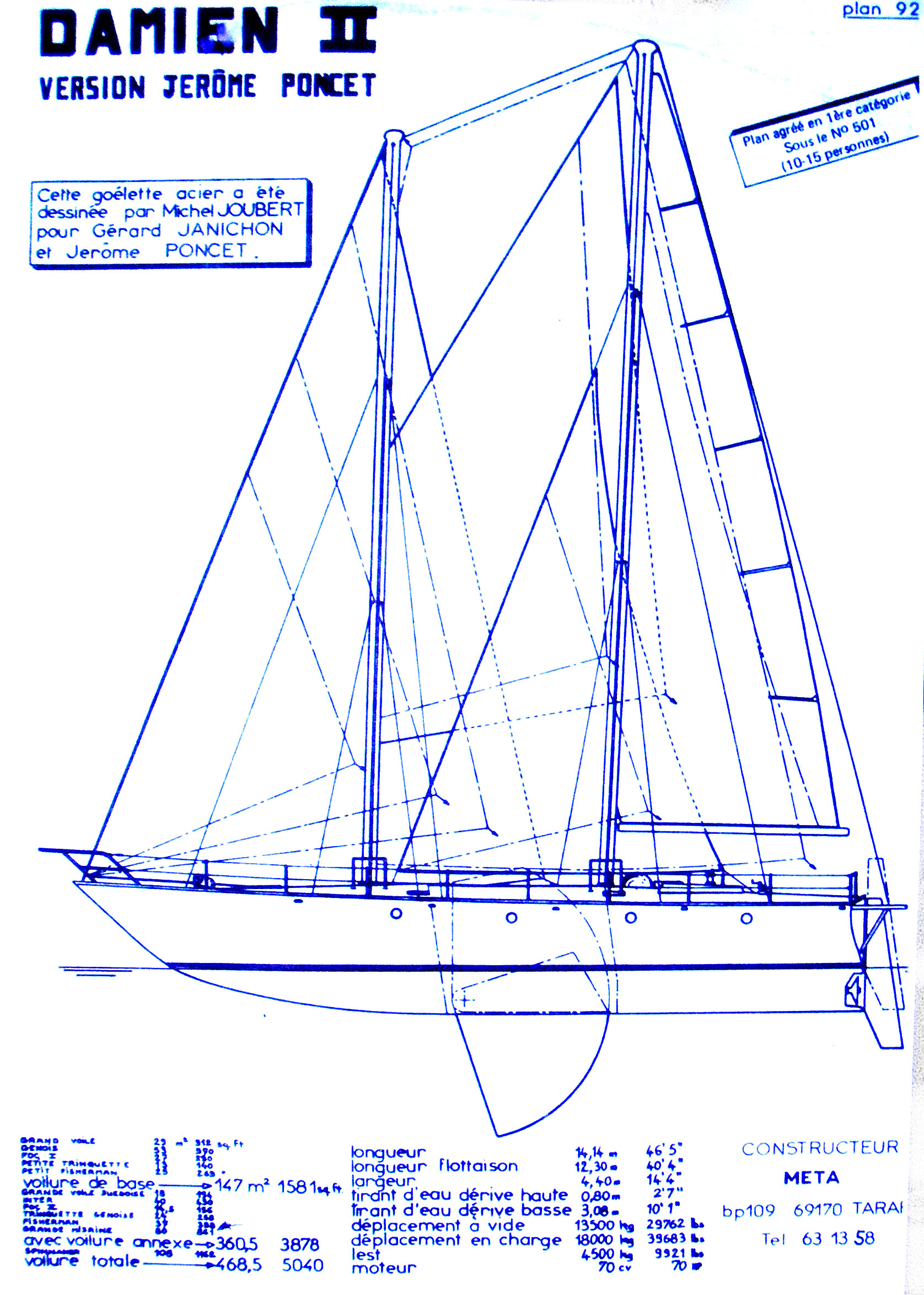
Damien II is a steel schooner designed by Michel Joubert for Gerard Janichon and Jerome Poncet, the two sailors who had already circumnavigated from Spitsbergen to Antarctica together aboard the original Damien, a 10-meter wooden sloop, from 1969 to 1973. Wanting a bigger, purpose-built boat for the high latitudes they had come to specialize in, they commissioned Joubert to design a dedicated expedition schooner, and Meta, the same shipyard that built Bernard Moitessier’s Joshua, built it at Tarare starting in 1974. Meta went on to build roughly 25 to 30 hulls to the same lines through 1981, most sold for the owner to complete, the same kit-like arrangement Meta and several other steel-boat yards of the era used.
Design and Construction
The defining feature is a lifting ballast keel, a steel centerboard carrying the boat’s entire 4,500 kg (9,921 lb) of ballast, that lets the boat beach itself or work into shallow water to avoid ice, drawing as little as 2.6 feet with the board up against over 10 feet with it down. Skip Novak, writing in Yachting World, credited this combination, a robust steel hull, the lifting keel, a cambered flush deck, and a plexiglass pilothouse bubble giving 360-degree visibility from inside, with essentially creating the modern high-latitude expedition-yacht type. Earlier boats had reached the far south (David Lewis’s Icebird, Bill Tilman’s Bristol Channel pilot cutters), but Novak’s assessment is that they were one-off voyages by vessels not really suited to the region, while Damien II created a repeatable design for it.
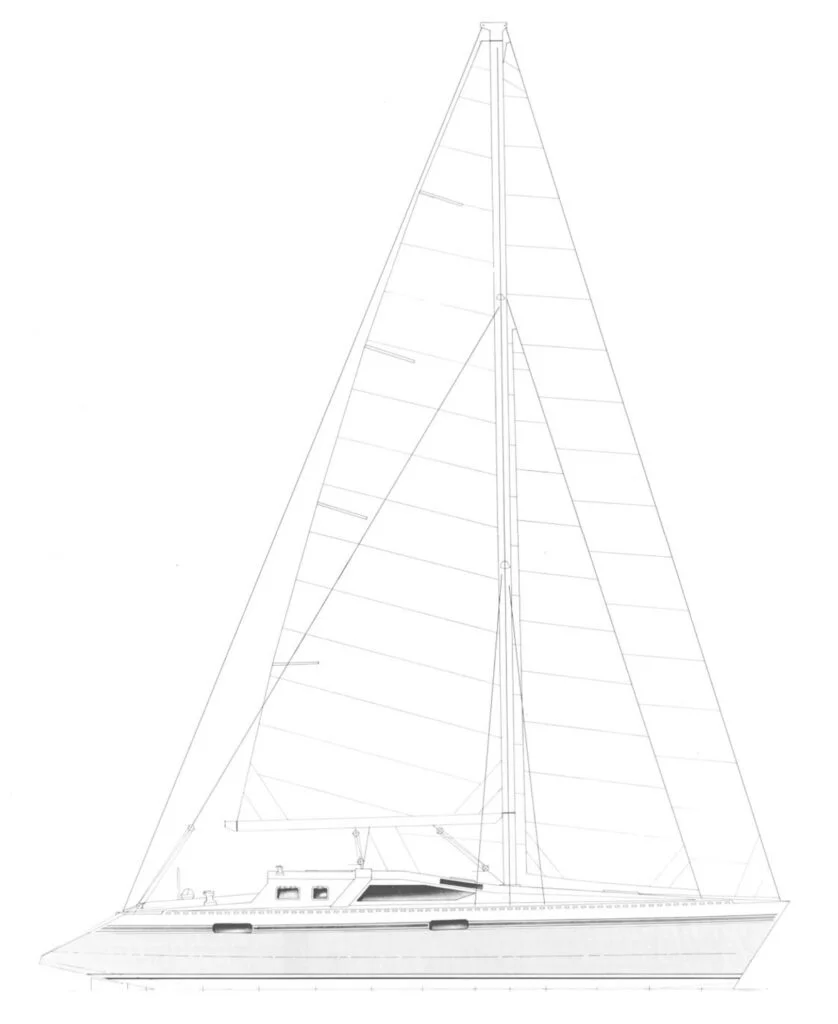
The hull carries a two-masted schooner rig (Poncet’s own hull specifically staysail-rigged), though at least one other Damien II was finished as a cutter, reflecting how much individual owner-finished hulls varied. Loaded displacement runs to nearly 40,000 pounds on a 40-foot waterline, a heavy, powerful platform built for standing up to ice and Southern Ocean conditions rather than for speed.
Under Sail and Passage History
Jerome Poncet commissioned his own Damien II in 1974 and, with his wife Sally, lived aboard her for roughly twelve years, sailing from Europe to Brazil, Polynesia, Tasmania, New Zealand, and the sub-Antarctic islands. In 1978-79 she became the first yacht ever to winter over in Antarctica, icebound and serving as the family’s home through the polar winter; their son Dion was born aboard, on the saloon table, during a South Georgia winter. The Poncets used the boat for wildlife and seabird survey work, chartered her to the British Antarctic Survey for elephant seal research along South Georgia in 1985-86, and supported BBC natural-history filming including Life in the Freezer. In 1992 the Cruising Club of America awarded Jerome and Sally Poncet its Blue Water Medal, by name, aboard Damien II, for twelve summers of Antarctic cruising and for publishing a handbook to help visitors protect the region.
The design’s record extends past this one hull. Northanger, a separate Damien II, has chartered for years in Patagonia and Antarctica. Issuma, built originally under a different name and completed and sailed 48,000 miles by a later owner as Shekin V, is a working example still cruising today. A third Damien II, Basile, carried a mixed team of sailors and mountaineers to South Georgia in 1979, an expedition that became well known in France through a subsequent film and book.
Buyers Notes
Individual hulls vary considerably since most were sold for owner completion, so interior layout, rig details (schooner versus cutter), tankage, and finish quality need evaluating hull by hull rather than assumed from the class as a whole. As with any older steel expedition boat, a survey should focus on plate thickness readings throughout, weld condition, and the state of the lifting keel’s trunk and mechanism, a moving, load-bearing part with no equivalent on a fixed-keel boat. No production-run-wide ownership or resale data was found during this research pass; treat this as a design to evaluate hull by hull through the owner community (several individual boats maintain their own sites, linked from Issuma’s page) rather than as an active market with standardized comparables.