Overview
Designed by German Frers and introduced in 1992, the Hallberg-Rassy 31 has been one of the yard’s most consistently popular models across an 18-year, 356-hull production run. It occupies the smaller end of Hallberg-Rassy’s offshore range, pairing a beamy medium-displacement hull with a fin keel and balanced spade rudder, aimed at real go-anywhere capability in a compact package rather than a coastal-only design scaled down from something larger.
Bob Perry reviewed the boat favorably in Sailing Magazine, praising its high cockpit seatbacks and fractional rig, and Swedish yachting magazine Batnytt called the interior “extremely spacious, light and inviting” with sea-keeping qualities “in a class of its own.” Frers, who has designed exclusively for Hallberg-Rassy since 1989, gave the 31 noticeably more speed than its predecessors, close-winded and quick through the water in most conditions, though owners report it can struggle in light air and short, choppy seas. All control lines lead aft to the cockpit, making the boat genuinely easy to sail short-handed.
Design and Construction
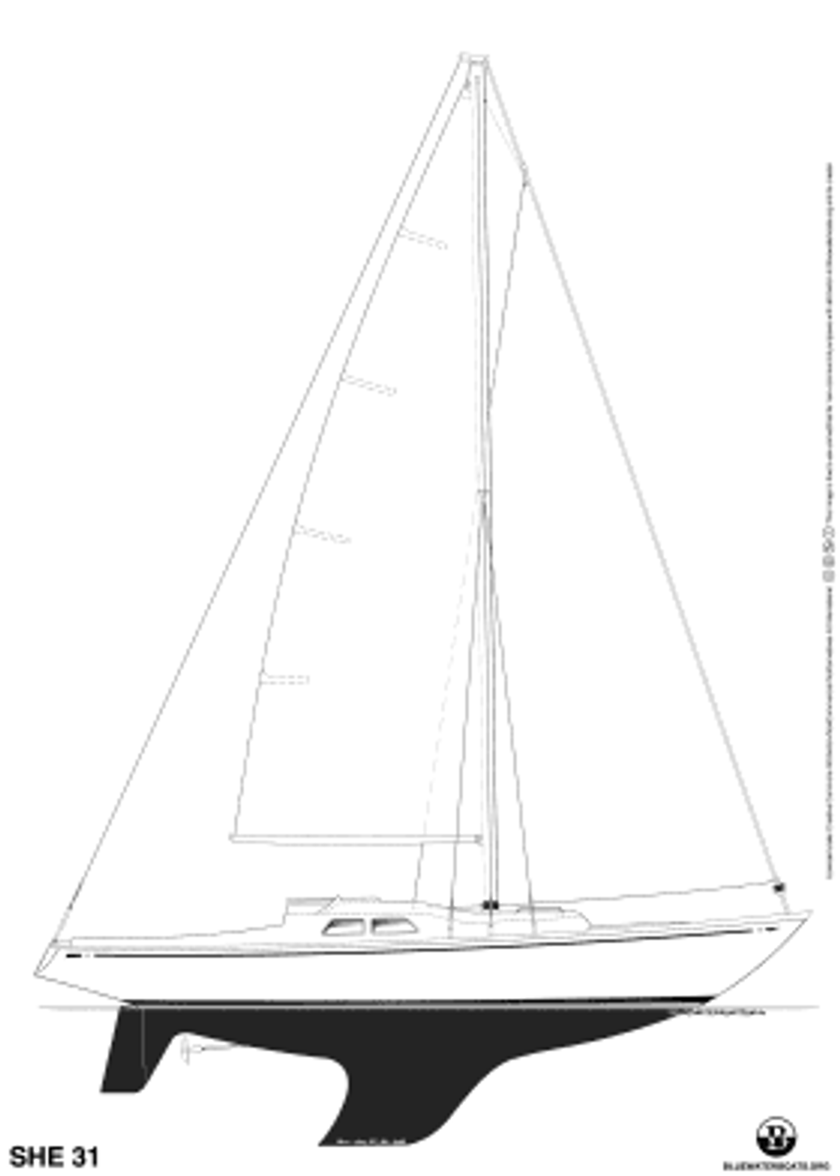
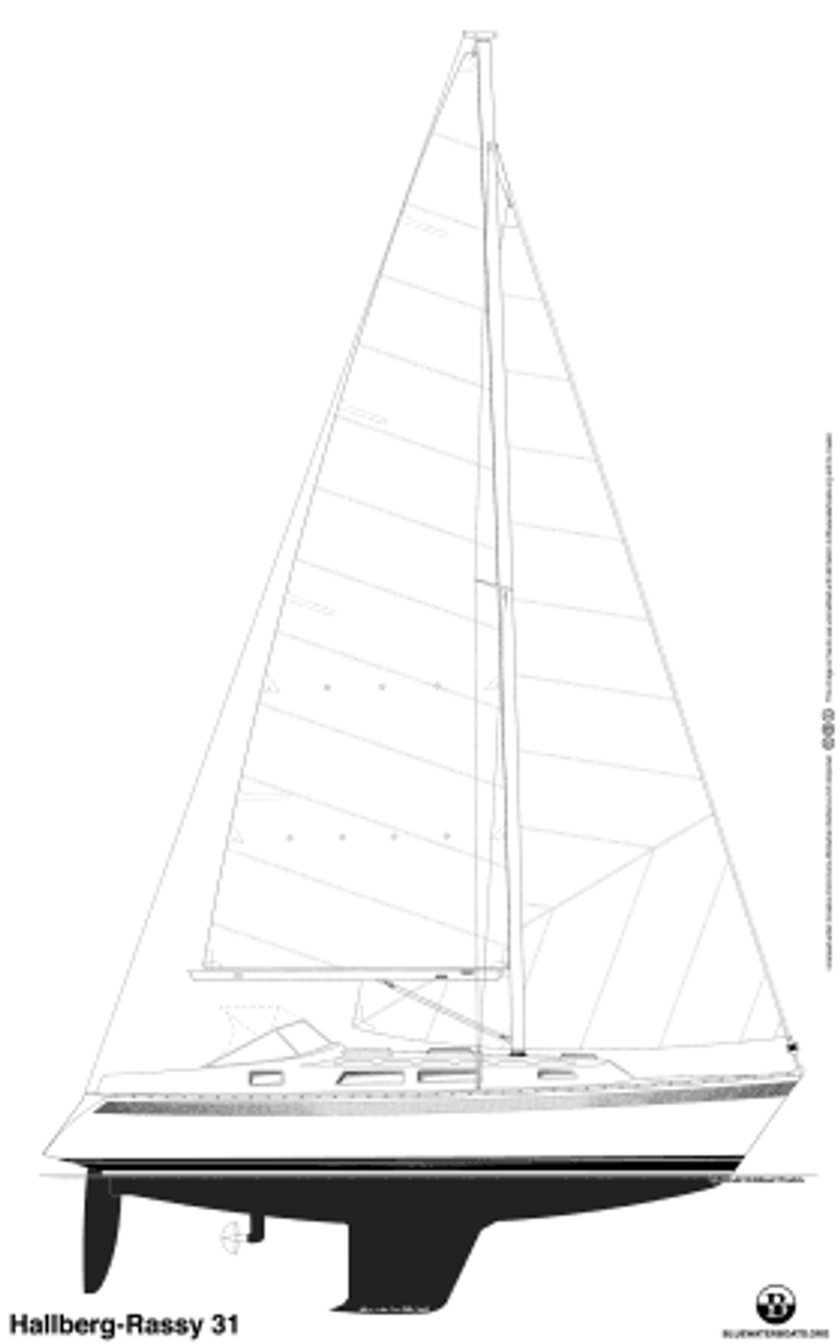
A sweeping sheerline keeps freeboard low without sacrificing interior headroom, achieved instead through a raised cabin top; a high cockpit coaming and Hallberg-Rassy’s signature fixed windscreen keep the crew dry and protected, though the earliest 1992 boats were delivered without that windscreen. The fractional rig avoids the running backstays a masthead racing rig would need, relying instead on a fixed masthead backstay and aft-swept spreaders for headstay tension. The standard keel draws 5.61 ft; a factory shoal-draft option draws 4.62 ft, a real and meaningful choice for anyone planning shallower cruising grounds. The boat originally shipped with a Volvo Penta 2002 diesel, later updated to a Volvo Penta 2020.
Below deck, mahogany joinery throughout is a Hallberg-Rassy signature. Two double cabins, one forward and one aft, flank a full-size head and shower compartment aft, with a good-sized saloon and a full chart table. Berths run on the narrow side, best suited to those under about 5 ft 10 in. The cockpit is comfortable and well protected, with a lifting starboard seat opening onto generous stowage.
History
The 31 continues a long line of Hallberg-Rassy 31-footers going back to the 1972 merger of Harry Hallberg’s and Christoph Rassy’s boatyards. Olle Enderlein’s Monsun 31 became the company’s best-selling model ever, 904 hulls built between 1974 and 1982, before the more modern, fin-keeled 312 (Christoph Rassy and Olle Enderlein, 690 hulls, 1979-1993) took over. This Frers-designed 31 replaced the 312 in 1992 with a lighter, beamier hull and across-the-board refinements. A 2006 Mark II update brought a lighter twin-spreader rig, an engine change, and interior refinements, with production continuing until 2009, when the smaller, lighter Hallberg-Rassy 310 took its place.
Under Sail
No specific named ocean passage or circumnavigation was independently verified for this model in this research pass, though period reviews (Bob Perry, Batnytt) and John Neal’s Mahina Offshore Services list, which rates the Hallberg-Rassy range 5/5 for build quality, speed, and parts support, back up a strong general offshore reputation. Owners describe the boat as sea-kindly and docile in heavy weather, with one account describing arrivals in port feeling like stepping out “in carpet slippers and a smoking jacket rather than drenched oilskins.”