What sailing channels say about the Hallberg-Rassy 370, quoted from video transcripts with a link to the exact moment. Opinions belong to the speakers; the written review above stays independent of them.
discusses
In answer to a viewer comment, the crew sail the new HR 370 dead downwind and demonstrate that the furling mainsail can be reefed while running: they ease the outhaul and press the furling button, and it reefs. They note that strong winds would still call for care.
recommends
He loves the anchor integrated into the bowsprit and the below-deck headsail furler, which keep everything tidy. The windlass feeds down into a very large bow locker deep enough for the passerelle to stand up.
recommends
The headsail tracks are now on the coachroof. That gives a much better sheeting angle to windward, which he has experienced, and the boat points much higher.
discusses
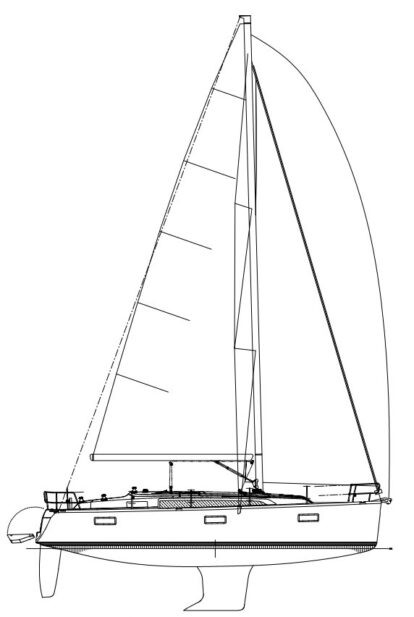
The rig is a Seldén aluminum mast with an in-mast furled, fully battened main. It has lots of roach at the top and good sail shape even when reefed.
discusses
Solar panels are integrated into the coachroof and give about 400 W of power, flush and with no cable in sight.
recommends
One of the most surprising things about sailing the 370 is how big it feels. Below there is a spacious galley, two good-size cabins and a really large head, because the beam is carried back into the cockpit.
recommends
The galley has a small recess that is very useful in a big sea, as they found out. You can wedge yourself in there and do a lot.
discusses
In a steady 20 knots of wind under jib the new 370 reached 11.6 knots. The presenter calls it effortless, says she is nice on the rudder, and says he could still control her when surfing.
discusses
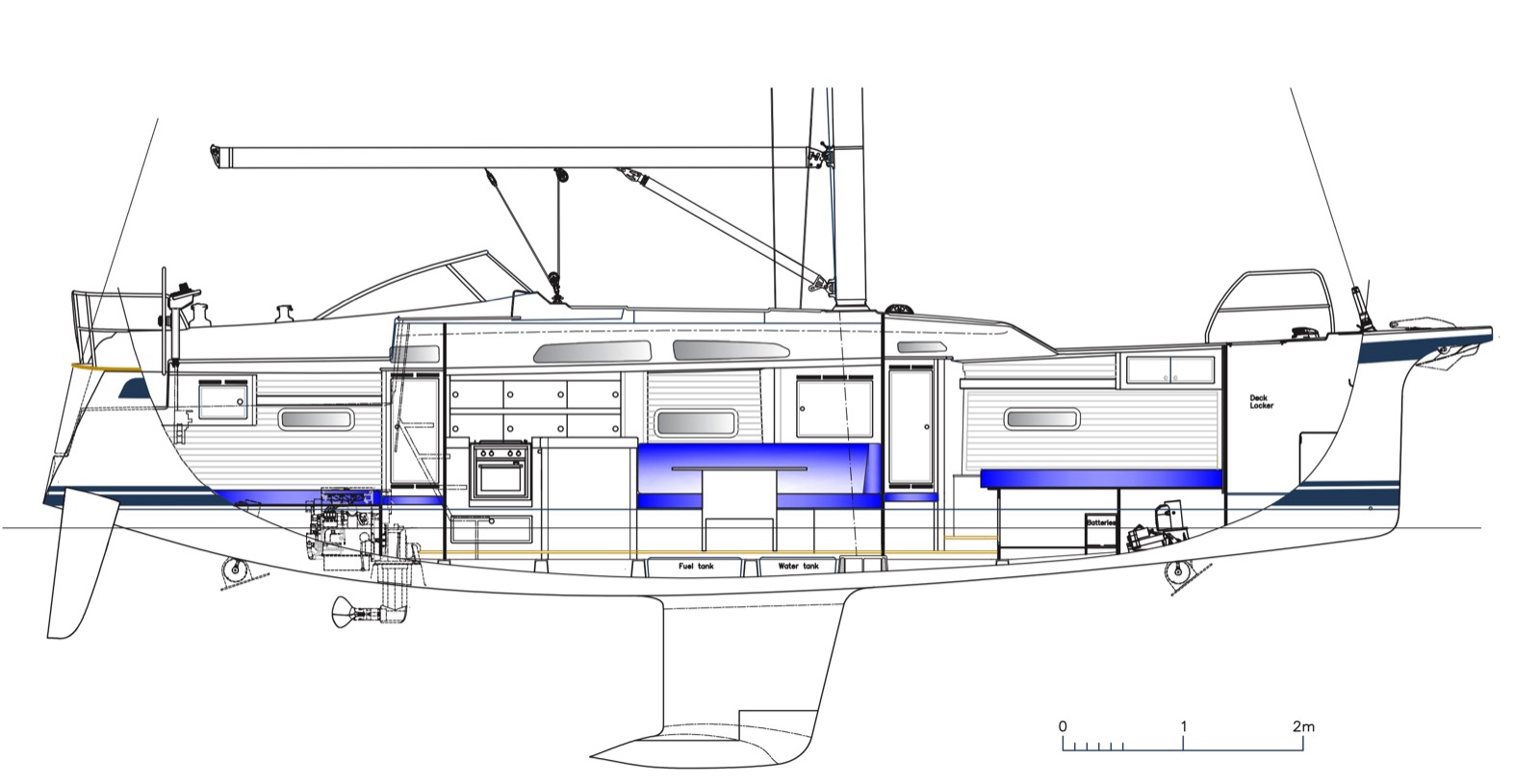
The bilge is 35 cm deep, about one foot two inches. Even with easy chairs in the saloon of a 37-footer, the yard has not compromised on fresh water and fuel volume.
discusses
Under the island berth sit two Victron lithium batteries, 7,680 watt hours in total or 600 Ah at 12 volts. The bow thruster and anchor winch run off this bank, which leaves big storage and less weight in the bow.
discusses
The engine is a four-cylinder Volvo Penta D2-50, 51 horsepower, with a saildrive. The engine room is generous, with access through a side panel from the aft cabin as well as from the stairs from the cockpit.
discusses
The genoa track is on the coachroof for the first time on a Hallberg-Rassy. The presenter says this gives very nice upwind performance because you can point slightly higher, and it looks clean and uncluttered.
discusses
For the first time on a 37-footer the mainsheet track is moved out of the cockpit, so the mainsheet is trimmed in front of the windscreen. This leaves the cockpit open and free of the mainsheet when guests are aboard.
discusses
The new 370 first got wet in August 2025. It is a sort of successor to the 372, with more freeboard, hull windows, bigger windows in the superstructure, twin rudders and a bowsprit.
recommends
After two to three hours aboard on a day of about 2 degrees outside, there was no condensation and the boat was toasty warm. The reviewers put it down to the foam and insulation in the construction.
discusses
The builder explains that stiffeners run from below the sole boards all the way up to the deck, with hull stiffeners from the forward end of the boat. This stiffens the hull so much that high bulkheads are no longer needed and the interior stays open.
discusses
The keel bolts are in two rows the whole way to the very front and the very end of the keel. The keel is a steel fin with a lead bulb, with a choice of normal or shallow draft.
discusses
Sailing in an archipelago with variable wind, under jib at 34 to 35 degrees apparent in 6 to 9 knots of true wind, the boat made 5.2 to 5.6 knots.
warns
The reviewer's main complaint is the cockpit. The perch at the wheels is fine, but sitting on top of the swim platform did not feel quite right, and his colleague worried about losing things from his pockets over the side.
discusses
In about 25 knots from the northwest, the crew had two reefs in the main and three reefs in the headsail and made eight to eight and a half knots over the ground. The skipper says the boat handled it amazingly.
recommends
A crew member says she sails really well and is easy on the helm. He also likes the fit and fixtures and says the forward cabin is really big.
recommends
The skipper likes the small rope lockers next to the winches. He says the galley is functional and secure when heeled, with a place to tuck yourself in.
discusses
Magnus Rassy shows a backstay tensioner with a 1 to 32 purchase, which gives full control over the rig.
discusses
Rassy says the 370 has a waterline close to 37 feet, nearly the full hull length, and that this gives extra interior space and better sailing performance.
discusses
The mast and interior have been moved aft, and the engine is turned 180 degrees so the propeller sits in front of the engine, which frees interior volume.
discusses
The standard engine is a four-cylinder 50 horsepower diesel. The boat has a pump that draws from the deepest point of the diesel tank, so sediment and water can be pumped out.
discusses
The mast is deck-stepped on a steel support with a wooden cover. Rassy says it is absolutely watertight, with no leaks and no rigging noise like a keel-stepped mast.
discusses
Deck ventilators have ping pong balls inside that float up and close them when water comes on deck. Rassy says that after much green water on deck not a drip has come below.