circumnavigation-provensinglehandedfin-keellarge-cruiserencapsulated-keelhull-repairkeel-repairbilge-pump-repairtank-repair

Kelly Peterson 44

Yu Ching Marine, Taiwan · 1976–1983 · Cutter rig

Kelly Peterson 44
LOA43.83'
Beam12.92'
Draft6.33'
Displ.15.0t
Rigcutter
Hullfiberglass

Bluewater Evidence · Bluewater Capable

55% confidence

Extensively covered in named, specific long-distance cruising accounts (Jack Kimball's 'After 45,000 Miles' in Blue Water Boats Magazine, Sharon Smallwood's Brilliant II in Cruising Helmsman, Zuzana Prochazka's Sea Esta in Latitudes and Attitudes) and a documented reef grounding survived intact. The overview's claim that many have circumnavigated is not backed by a named skipper or boat, so this stops short of the proven tier despite the existing tag.

Known Issues

ChainplatesseriousPassageBoats editorialAll years, 1976-1983

Original chainplates develop crevice corrosion at the point where they pass through the deck.

Inspection: Confirm chainplates have been replaced. Even replaced chainplates are worth double-checking.

Rudder (stainless frame)seriousPassageBoats editorialAll years, 1976-1983

The original rudder used a stainless-steel frame packed with plywood and sheathed in fiberglass. The stainless welds would invariably fail over time, leading to leaks.

Inspection: Confirm the rudder has already been rebuilt. Also verify the rudder support inside the canoe stern (around the bronze rudder gland) is solid fiberglass, not a wood plug covered with a thin layer of fiberglass.

Freshwater and diesel tanksmoderatePassageBoats editorialAll years, 1976-1983

Original freshwater and iron diesel tanks are prone to developing leaks with age.

Inspection: Check both tanks for evidence of leaks.

Repair: Freshwater tank leaks can sometimes be epoxy-repaired; other owners have fully replaced the tanks.

Overview

Doug Peterson, already making a name for himself on the racing circuit, drew the 44 for San Diego yacht broker Jack Kelly, who wanted a serious long-range center-cockpit cruiser for himself. The plan, so the story goes, was to build ten boats, sell nine to fund the tenth, and sail away on it. A couple hundred hulls later Kelly was still ashore, running a boat building business instead. Owners today report 180-mile days aren’t unusual, with useful performance across most points of sail, and the type has made its way to plenty of far-flung anchorages, especially through the South Pacific.

History

Yu Ching Marine, a Taiwanese yard in Kaohsiung, built over 200 genuine Kelly Peterson 44s between 1975 and 1983, finished out afterward in the United States or wherever they landed. Kelly also commissioned a stretched 46-foot version from a different yard, Queen Long Marine, built 1980-1990. A third Taiwanese yard, Formosa Yachts, built its own extended 46-footer between 1979 and 1986, close enough to the original that the cruising community nicknamed the line “Cheaterson” boats. Sea Magazine’s Peter Bohr dug into the story in May 1987: Kelly had scrapped his original molds over quality problems and commissioned a second set, and somewhere in that gap the line drawings went missing. Within months, two lookalike boats from other Taiwanese builders turned up on the U.S. market. Some claim Yu Ching alone built several hundred more hulls beyond the original 200, though that figure is hard to confirm, and it’s likely Queen Long and Formosa built some 44s alongside their 46s. Variants under other names, Spindrift 46 and Hillyer 46 among them, share the same basic Peterson hull with different interiors. Counting the genuine boats and the copies together, total production across all yards is sometimes put north of 600.

Design and Construction

Hulls are hand-laid fiberglass mat and roving in polyester resin, nearly an inch thick at the bilge, tapering to 3/4 inch at the waterline and a half inch at the deck. The integral keel carries 10,000 lb of iron ballast packed in concrete, and the original rudder used a stainless-steel frame packed with plywood and sheathed in fiberglass, a design whose welds tend to fail over time and let water in. The deck-to-hull joint is a lip-and-tongue arrangement with a wood brace fiberglassed in and a teak cap rail screwed through it, an area prone to leaks where long genoa-track bolts pass through the bulwark into the cabin. Decks are plywood-cored under non-skid gelcoat as standard, with teak decking offered as an option. One well-documented account describes a Kelly Peterson going aground on a South Pacific reef, being dragged across it for over a hundred feet, and sailing away afterward, a real test of the boat’s construction. Rigs were shipped loose and stepped locally, so hardware varies by destination; California-delivered boats commonly got LeFiell spars and Navtec rigging. Kelly kept an American overseer at the Taiwan yard who flagged construction issues for correction on the next hull, and boats from the Formosa and other copycat yards can differ meaningfully in build quality from genuine Yu Ching hulls, so most owners weigh a boat’s present condition over which yard built it.

Under Sail

Peterson’s racing background shows in how the 44 sails: her theoretical hull speed is 8.3 knots, and owners report reaching it across most points of sail in the right conditions, with 180-mile days well within reach. Despite long steering runs from the center cockpit, helm feedback is reportedly good, and she’s manageable shorthanded even in a blow, with a comfortable motion at sea that suits long passages.

Buyers Notes

Original chainplates develop crevice corrosion where they pass through the deck; confirm they’ve been replaced, and double-check even replaced ones. Verify the rudder support inside the canoe stern, around the bronze rudder gland, is solid fiberglass rather than a wood plug thinly glassed over. The original stainless-steel rudder frame is prone to weld failure and leaks, so confirm the rudder has been rebuilt. Check both the freshwater and iron diesel tanks for leaks, epoxy repair is possible for the freshwater tank, but some owners have replaced both outright. Check steering chain and cable for corrosion.

Configuration

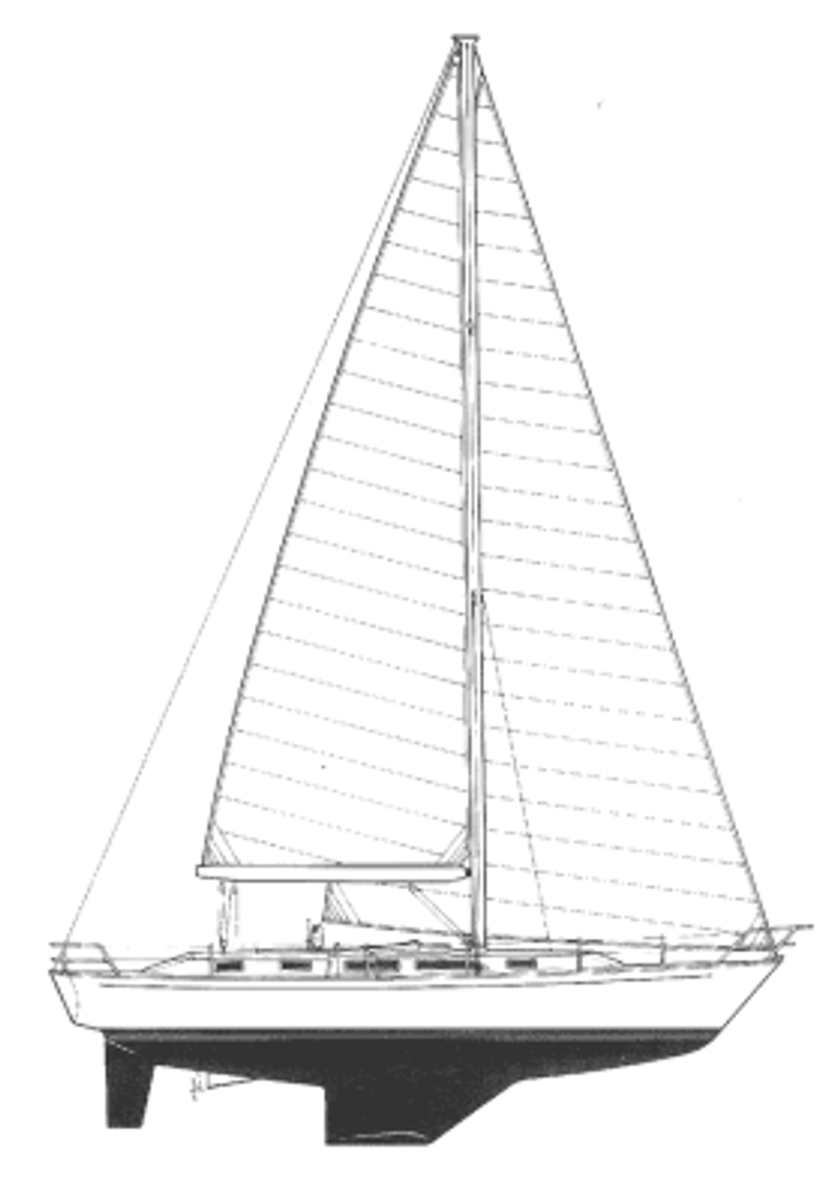
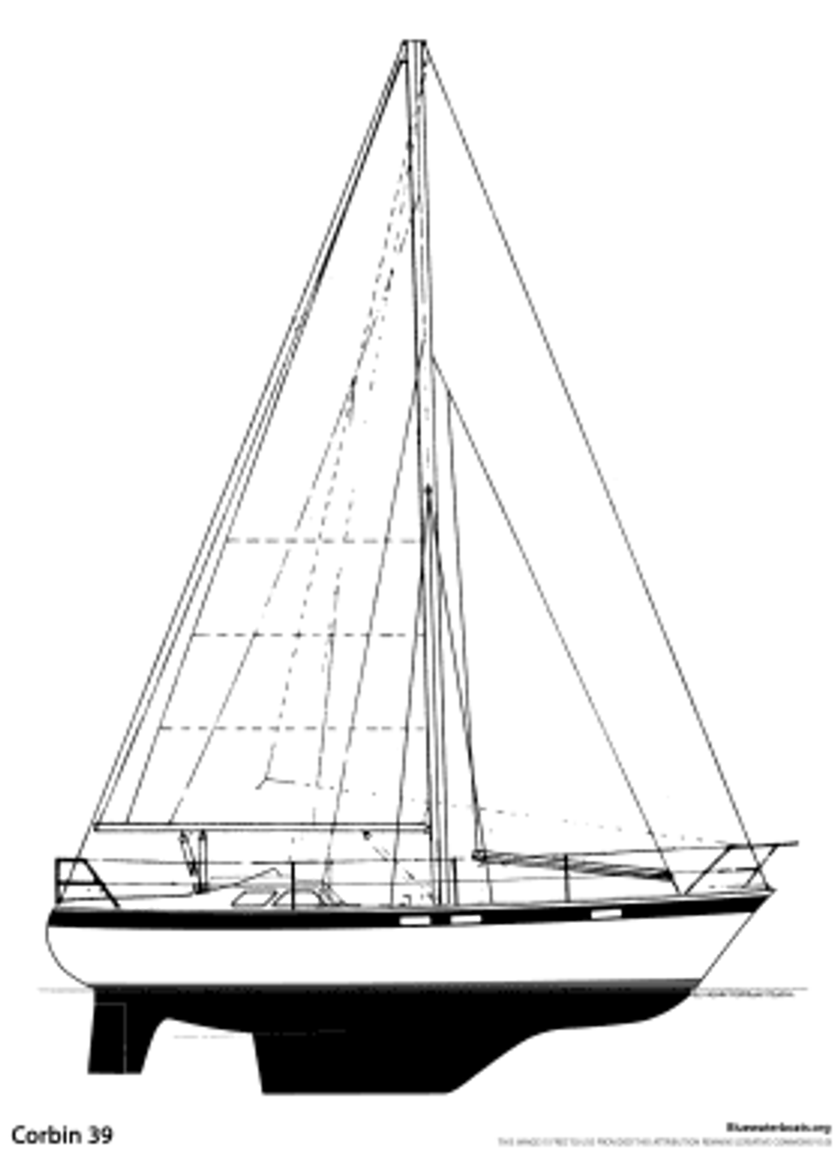
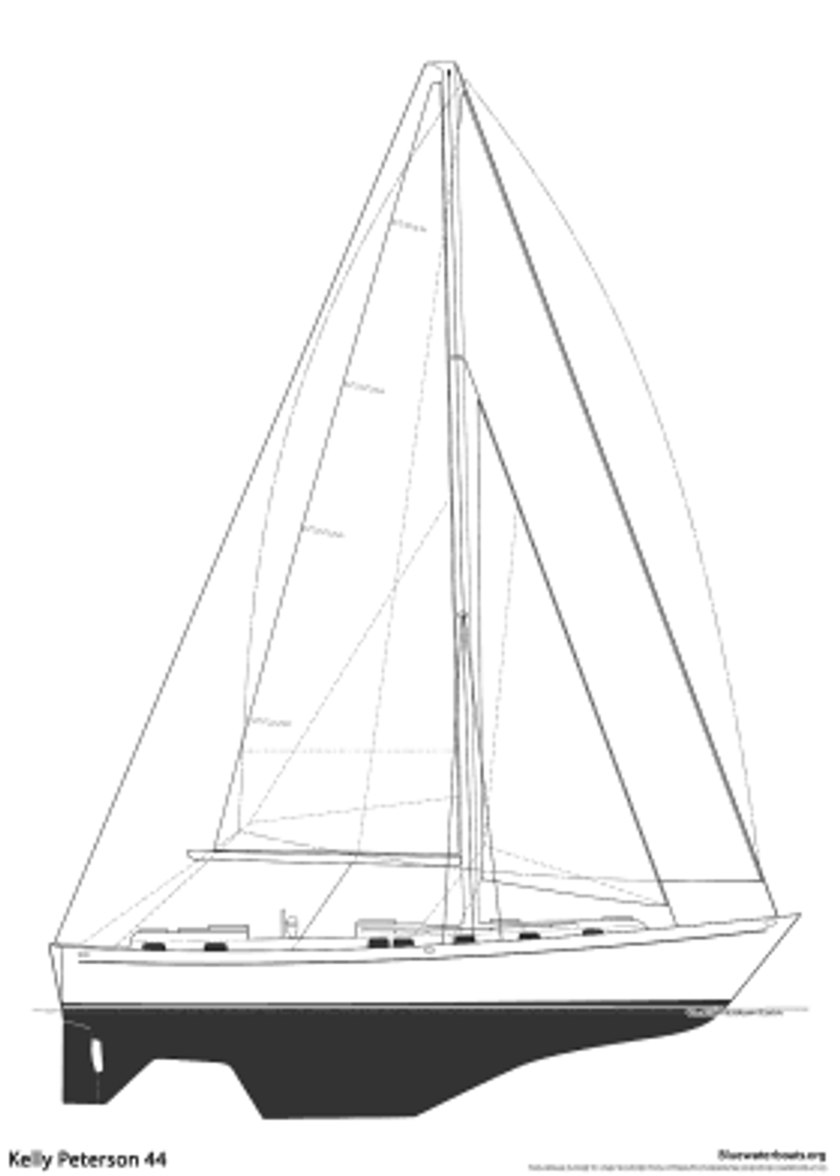
The Kelly Peterson 44’s most distinctive feature is her near-vertical transom, essentially a double-ender with the stern lopped off. Below the waterline, a cutaway fin keel with a long run reduces wetted surface for light-air performance while keeping her tracking well, and a full-length molded-in skeg protects the rudder and the aperture-mounted prop during a grounding. About a third of her 30,000 lb displacement is ballast, slung low on a 6’4” keel, which combined with a clean bow entry gives her a soft motion. The center cockpit sits under a low cabin trunk that helps keep the center of gravity down, with seating for eight at anchor, wide side decks behind 4” bulwarks, and high lifelines. A twin-spreader cutter rig carries just over 1,000 sq ft of sail, plenty for her displacement and manageable shorthanded; the mast steps at 60 feet above the waterline with 3/8” standing rigging. Original boats ran full-length mainsails to the end of the 17-foot boom, which produced excess weather helm, so later boats trimmed the foot by 30 inches.

Layout and Interior

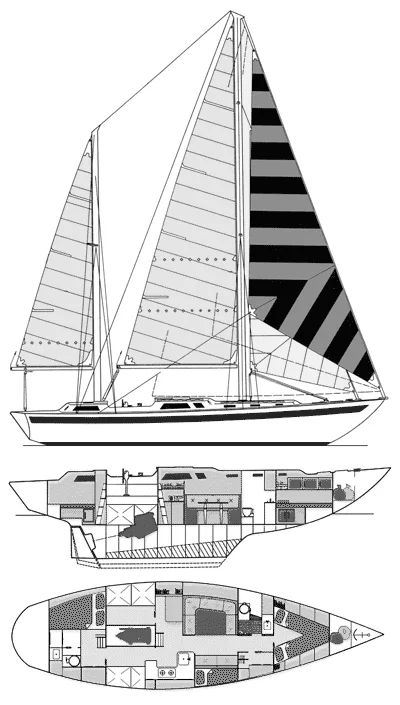
The interior runs three cabins including the saloon, lit by three large hatches and twelve portlights. The forward cabin has a vee berth with full standing headroom and an ensuite head with shower. The saloon carries a straight settee to starboard and a two-position dinette table to port that converts into a second double berth, with the keel-stepped mast passing through the middle as a secure handhold underway. The galley, offset to port of the companionway, is U-shaped with a gimbaled stove, large-capacity refrigeration, and a centerline double stainless sink that drains well on either tack; the chart table and electrical panel sit opposite to starboard. A passageway on the starboard side, tight enough that some call it a crawl space, leads aft past a large engine room to the master stateroom, which has a full double berth, a private head, and its own access from a second companionway in the cockpit. Engine and bilge access is good; most boats carry a 62 hp Perkins 4-152, with some fitted instead with an 80 hp Ford Lehman.

Documented repairs and system-specific fixes reported for the Kelly Peterson 44, drawn from known-issue write-ups and video transcripts.

Known Issues with Repair Notes

Freshwater and diesel tanksmoderatePassageBoats editorialAll years, 1976-1983

Original freshwater and iron diesel tanks are prone to developing leaks with age.

Repair: Freshwater tank leaks can sometimes be epoxy-repaired; other owners have fully replaced the tanks.

Repairs Documented on Video

⚙ hull⚙ keel⚙ bilge pumps

A viewer said he bought a Kelly Peterson 44 after watching the channel: "That's a badass boat, dude. Let me tell you what I know about Kelly Petersons. I had a guy come into the marina and he had split the Kelly Peterson right in front of the keel, where the keel attaches. They think what happened is they came down on top of a container or a big log, and the force of that pulled the front of the boat up enough that it split open the hull, a big crack just gushing water in. The guy was probably 70 or 75, and he routed every single pump he had, the forward shower pump, the anchor shower pump, the macerator pump, the sink pump, the freshwater pump, every pump on the whole boat, the bilge pump obviously overboard, and he just barely saved the boat. He had to make an emergency haul out. The Kelly Peterson had almost two inches of solid glass right there where the keel and the hull meet, I can't believe it ripped like that. That's only the third boat I've ever heard of being ripped like that. Funny enough, it was repaired and then sold to a buddy of mine, he's in Panama here with me."

What sailing channels say about the Kelly Peterson 44, quoted from video transcripts with a link to the exact moment. Opinions belong to the speakers; the written review above stays independent of them.

repairs⚙ hull⚙ keel⚙ bilge pumps

A viewer said he bought a Kelly Peterson 44 after watching the channel: "That's a badass boat, dude. Let me tell you what I know about Kelly Petersons. I had a guy come into the marina and he had split the Kelly Peterson right in front of the keel, where the keel attaches. They think what happened is they came down on top of a container or a big log, and the force of that pulled the front of the boat up enough that it split open the hull, a big crack just gushing water in. The guy was probably 70 or 75, and he routed every single pump he had, the forward shower pump, the anchor shower pump, the macerator pump, the sink pump, the freshwater pump, every pump on the whole boat, the bilge pump obviously overboard, and he just barely saved the boat. He had to make an emergency haul out. The Kelly Peterson had almost two inches of solid glass right there where the keel and the hull meet, I can't believe it ripped like that. That's only the third boat I've ever heard of being ripped like that. Funny enough, it was repaired and then sold to a buddy of mine, he's in Panama here with me."

discusses

On the history of the Kelly Peterson 44 they just bought: "It's an international going boat. It's gone around one and a half times that I know of. It most recently sailed from San Francisco to Tasmania, through the South Pacific. So there's a bit for us to do, because it has sailed that distance and we want to get it to go again."

discusses

First impressions after the survey and sea trial: "I'm really happy with the way the engine and everything is set up. The electrics are very good. The plumbing is horrible. We're going to redo that. But everything up on deck just looks great. This is very much a sailor's boat. The Kelly Peterson 44, there's no keel bolts, it's a molded keel. Skeg-hung rudder, they've got a good reputation for speed, eight knots, so we can knock out 200-mile days."

The Question I Get Asked MOST OFTEN | Sailing Truth Show
33:30
Repair · hull, keel, bilge pumps

The Question I Get Asked MOST OFTEN | Sailing Truth Show

Sailing Zingaro

A viewer said he bought a Kelly Peterson 44 after watching the channel: "That's a badass boat, dude. Let me tell you what I know about Kelly Petersons. I had a guy come into the marina and he had split the Kelly Peterson right in front of the keel, where the keel attaches. They think what happened is they came down on top of a container or a big log, and the force of that pulled the front of the boat up enough that it split open the hull, a big crack just gushing water in. The guy was probably 70 or 75, and he routed every single pump he had, the forward shower pump, the anchor shower pump, the macerator pump, the sink pump, the freshwater pump, every pump on the whole boat, the bilge pump obviously overboard, and he just barely saved the boat. He had to make an emergency haul out. The Kelly Peterson had almost two inches of solid glass right there where the keel and the hull meet, I can't believe it ripped like that. That's only the third boat I've ever heard of being ripped like that. Funny enough, it was repaired and then sold to a buddy of mine, he's in Panama here with me."

We're back!
16:29

We're back!

Free Range Living

On the history of the Kelly Peterson 44 they just bought: "It's an international going boat. It's gone around one and a half times that I know of. It most recently sailed from San Francisco to Tasmania, through the South Pacific. So there's a bit for us to do, because it has sailed that distance and we want to get it to go again."

+1 more indexed moment in this video

  1. [1]SpecificationsSailboatData.com - Kelly-Peterson 44- Draft, LOA, LWL, beam, displacement, and ballast cross-referenced here
See something wrong? Suggest a correction

Corrections need evidence: a link or citation we can check. Sourced suggestions get reviewed and credited in the entry's change notes if applied.

Owner knowledge counts: name the boat and year so we can attribute it.