Overview
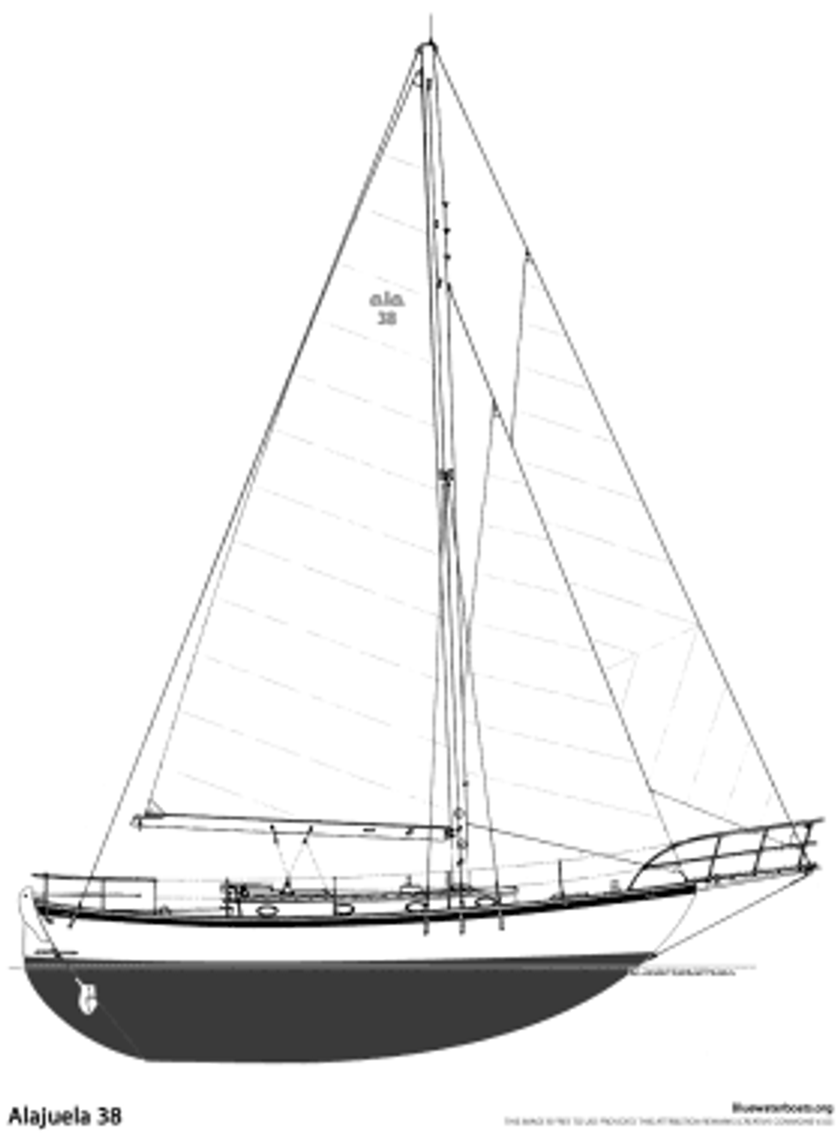
The Alajuela 38 is a fiberglass development of the William Atkin double-ended family that includes Ingrid and Goucho. Co-founder Rod Jermain’s account says he and Mike Riding chose an Ingrid-based starting point, then reconsidered shapes and structure that had been intended for wood once they committed to fiberglass. The production boat is therefore related to Ingrid without being a direct change of building material.
The main specification now uses the 38-foot hull length. SailboatData lists 46 feet overall when the bowsprit and boomkin are included, and it separately records 38 feet on deck. Showing 46 feet as the boat’s hull LOA made comparison with other models misleading.
Dimensions and Conflicting Records
The hull has a 32-foot 7-inch waterline, 11-foot 6-inch beam, and 5-foot 7-inch listed draft. The class figures are 27,000 pounds of displacement, 10,000 pounds of ballast, and 880 square feet of reported sail area. An early 1973 brochure instead listed 26,000 pounds, 11,000 pounds of ballast, and 932 square feet. The later class data is used in the panel, while the early figures remain part of the record.
SailboatData dates the production span to 1974–1985 and counts 72 boats. Other accounts place the first completed boats later and give totals between 70 and 81 depending on bare hulls, kits, and owner-built examples. A precise count should wait for a hull register that distinguishes those categories.
Hull, Rig, and Variants
The Alajuela is a cutter, not the ketch shown in the earlier frontmatter. It has a long keel and transom-hung rudder. The Mark I uses long projecting spars at both ends. The Mark II introduced a shorter aluminum wishbone bowsprit, more cabin height, fiberglass cockpit coamings, an aft propane locker, and revised hatches. SailboatData also credits a different Mark II rig to Raymond Richards.
Factory-completed boats, hull-and-deck kits, and examples built from related plans can differ substantially. The published class specification should not be assigned to a wood or ferrocement Ingrid derivative simply because the hull shape looks similar.
Under Sail
The 32.58-foot waterline is long for a traditional 38-foot double-ender, and the reported sail area is substantial for the displacement. The long keel should track steadily, while the fine entry and flatter after run described by the archived review are intended to reduce some of the drag and bow-burying tendencies associated with older forms.
The old review credits Wathena with second place in the 1976 Newport to Ensenada race and repeats John Kretschmer’s favorable comparison with the Westsail 32. A primary race result and the original Kretschmer article have not yet been attached, so this rewrite does not treat either claim as verified passage evidence.
John Neal’s current Mahina list gives the Alajuela 38 only 1/5. He still calls it seaworthy, but regards the long bowsprit and boomkin as dated. That is a useful counterweight to nostalgic reviews: seaworthiness and practical short-handed handling are separate judgments.
Construction and Interior
The archived source describes a heavily laid solid-fiberglass hull, plywood-cored deck, bonded wood interior rather than a molded liner, and extensive custom bronze hardware. Those details should be checked against factory documents or on the individual hull. Kit boats especially can vary in bulkhead bonds, system installation, tankage, and finish.
The narrow beam and long ends leave less interior volume than the 46-foot spar length suggests. The arrangement is meant for passage use, with a compact cockpit and conventional berths and working spaces below. Mark II cabin-height changes can make a noticeable difference for taller sailors.
What to Inspect
Identify the exact version and completion yard first. Inspect both projecting spars and their stays, the transom-hung rudder, chainplates, deck core, mast support, hull-to-deck joint, tanks, and all owner-completed structural work. Check whether the actual rig matches the Mark I or Mark II measurements.
No named ocean crossing is currently documented here. The design has credible offshore ingredients and a strong construction reputation, but the Mahina rating and the variable kit history justify keeping confidence moderate.