Overview
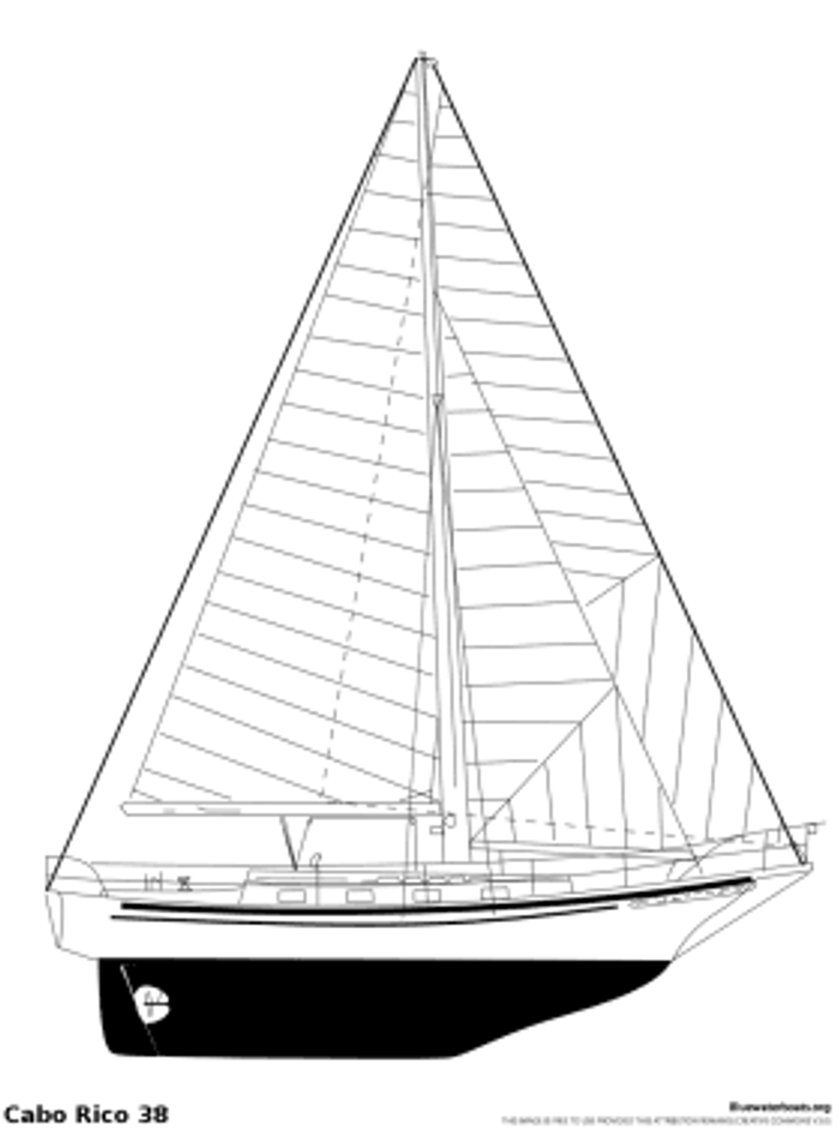
Cabo Rico built its first boats from a corner of a British Leyland automotive plant in Costa Rica, a hobby of plant manager John Schofield that grew into a genuine bluewater yard. The Cabo Rico 38, designed by Bill Crealock and introduced in 1977, became the company’s flagship, developed from Crealock’s earlier, less numerous Tiburon 36 and finding real popularity just as Taiwanese builders began to dominate the US market.
History
Costa Rican craftsmen hand-laid the first hull in 1977, and for a long stretch of the company’s history the 38 was effectively its only product, built in an enormous range of interior configurations: two heads, single-cabin, v-berth layouts, and more. A popular pilothouse version arrived in 1990. Edi and Fraser Smith acquired the company in 1987 and expanded the line to 34 through 50 feet, but the 38 remained the core product through roughly 200 hulls built over more than two decades. The Costa Rica factory closed in September 2009 amid the broader economic downturn, and the Florida sales corporation followed it into bankruptcy in 2010.
Design and Construction
The full-keel underbody follows the lineage of Crealock’s earlier Tiburon design, configured as a true cutter with a bowsprit-mounted foresail, a low, sweet sheerline, and traditional trailboards and teak trim. Construction is fiberglass hull and deck with end-grain balsa coring (used for insulation rather than structural necessity), and modern hulls use vinylester resin in the first three layers specifically to resist osmotic blistering. Ballast was originally iron, switching to lead around hull 40, cast in seven separate pieces and glassed over. The Costa Rican craftsmen took real pride in their joinery, and it shows: older interiors are finished in honey-colored teak with barely a spot of visible gelcoat below. Engine access on most hulls is through the companionway, though later models moved the engine forward under a centerline galley.
Under Sail
Practical Sailor’s survey describes genuinely good manners at sea: the rudder resists stalling into uncontrolled round-ups, and heel comes off easily thanks to the cutter rig, giving a comfortable, secure motion in a moderate-displacement full-keel hull. She won’t out-point a fin-keeled racer, but owner reports vary from modest to surprisingly quick, especially once the wind builds. The clearest evidence of real offshore capability: Mike and Linda Nixon’s Voyager (hull #77) crossed the Gulf of Mexico from Florida to Alabama through a winter storm, 25 to 30 knot winds and 8 to 10 foot seas in the final 36 hours, and came through it, in Nixon’s words, “like she was made for it.”
Buyers Notes
Teak decks, common on 1980s and earlier hulls, are a real liability if neglected: water works along the fastener holes into the plywood core beneath, and repairs can run to $25,000 or more, so an ultrasonic moisture-meter survey is worth doing before buying. On early hulls specifically, check bulkhead tabbing and through-hull bonding directly, since Practical Sailor’s survey found both inconsistent on some early examples. Confirm whether a specific hull has been converted from iron to lead ballast (the switch happened around hull 40) and which engine-access configuration it has.