Overview
The Caliber 33 built a loyal following on the strength of packing a genuinely large interior into a compact hull. Company co-founder Michael McCreary designed her, launched in 1985 aimed at performance-minded cruisers, and the design continued to evolve throughout the short production run that followed.
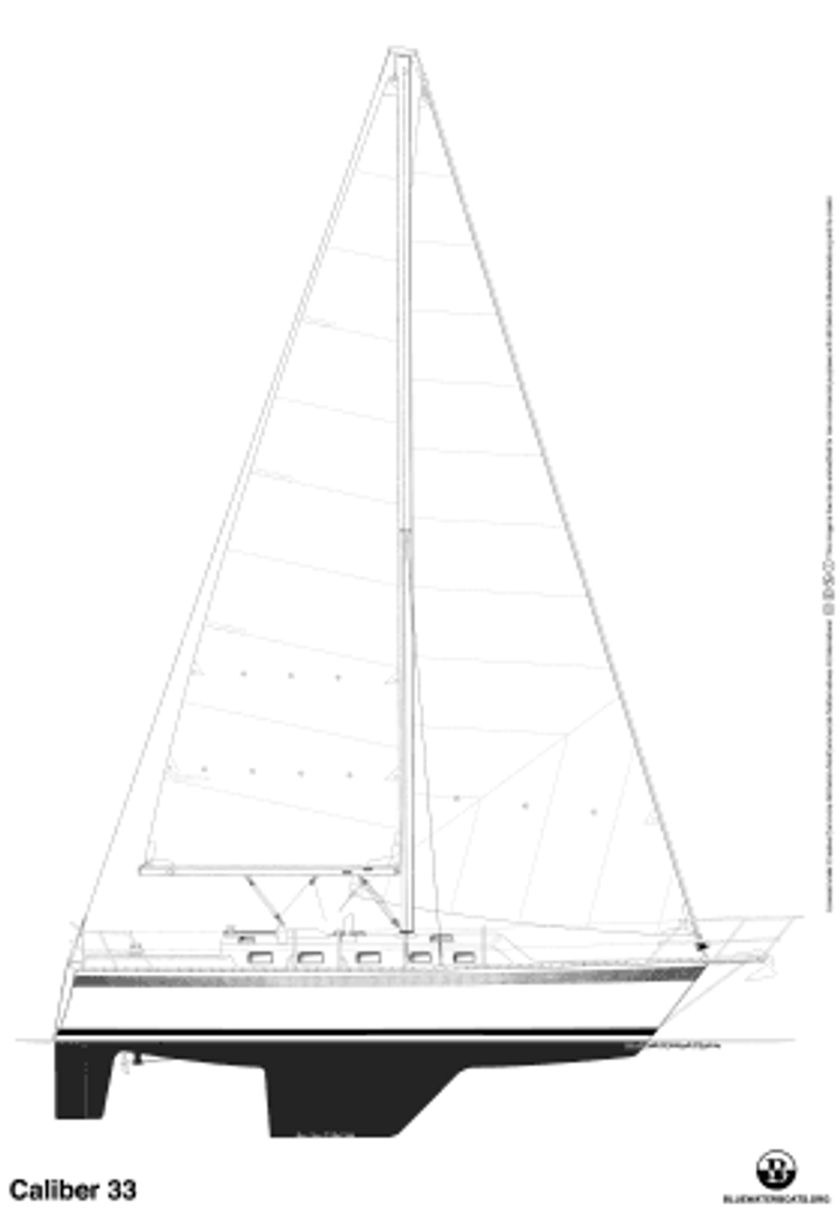
Caliber built the 33 with East Coast shoal cruising in mind: four and a half feet of draft standard, with an optional shoal-draft version drawing just four feet for owners who needed to go even shallower.
Her lines split the difference between traditional and modern: a nearly flat sheer with angular styling up top, and a genuinely contemporary underbody below, flat forward sections leading down to a straight-edged fin keel, with the rudder skeg-hung well aft. Carrying beam well aft, in the modern style, pays off belowdecks with real room, enough for a cruising couple to live aboard comfortably with generous stowage for a 33-footer. Practical Sailor’s own sail trials back up the stiffness that layout suggests: with a ballast-to-displacement ratio around 48 percent, one test boat held to just 20 degrees of heel single-reefed with a partial genoa in 20 knots of true wind.
History
Brothers Michael and George McCreary founded Caliber Yachts fresh out of college in 1980, McCreary the naval architect handling design while his brother ran the business side, working with a tight budget from the start. Their first boat, the Caliber 28, was a solidly built coastal cruiser that set the tone for everything that followed and sold well enough to justify a follow-up.
That follow-up, the Caliber 33, launched in 1985 into a genuinely difficult economy for boatbuilders, and succeeded anyway; Practical Sailor credits build quality as the reason. Caliber built fewer than 70 hulls at its small Clearwater, Florida plant before the 33 evolved into the stretched Caliber 35 in 1990, gaining a reverse transom and further refinements.
A later variant, the Caliber 35 LRC, arrived in 1995 with the “long range cruiser” suffix, part of a broader naming update that also added the tag to the Caliber 40 and introduced a smaller Caliber 30 LRC sibling, likely a marketing decision more than a design one. Across the 33, 35, and 35 LRC, total production tops 100 boats.
Construction
Nothing about the design is radical, but build quality shows throughout. The hull is solid fiberglass with no prefabricated liner, the kind of shortcut common on production boats in this price range; each bulkhead instead gets two to four hand-laid layers of fiberglass cloth set in resin, which keeps every part of the structure genuinely accessible. Floor timbers run substantial and closely spaced through the bilge, and the trademarked “Quad-Seal” hull-deck joint uses a copolymer tape gasket that George McCreary credits for the boat’s dry reputation: “we almost never get leaks, and when we do it’s usually from deck hardware.”
Decks use a plywood core (heavier than balsa, and more vulnerable if water gets in) under fiberglass, with the hull-deck joint sealed in polyurethane adhesive and through-bolted onto an aluminum toe rail, a strong, quiet structure with none of the creaking common to lesser-built boats. A few areas are worth checking on an older hull: the original bowsprit and anchor platform were under-built and later reinforced with schedule 160 pipe, the prop shaft has occasionally worked loose from its engine coupling, and several owners report exhaust staining on the transom. Allan Barry, who owns a 1987 hull in Marion, Massachusetts, took part in Practical Sailor’s own sail testing and described handling as agile and nimble, with weather helm showing up only above 18 knots and easily managed by shortening sail.
Links, References and Further Reading
» Jack Horner’s review of the Caliber 33/35» Sailing Magazine’s review of the Caliber 33, by John Kretschmer