Overview
Andrew Vavolotis, a sailor and engineer, founded Cape Dory Yachts in 1963 in New England, starting small with a 15-footer, and built the company’s reputation on sturdy, simple, easy-handling boats meant to be genuinely safe at sea. Among Cape Dory’s offerings above their popular sub-30-foot pocket cruisers, the 36 stands as the yard’s next most popular design, likely a function of doing double duty well: a real offshore boat that’s equally at home on a weekend coastal run.
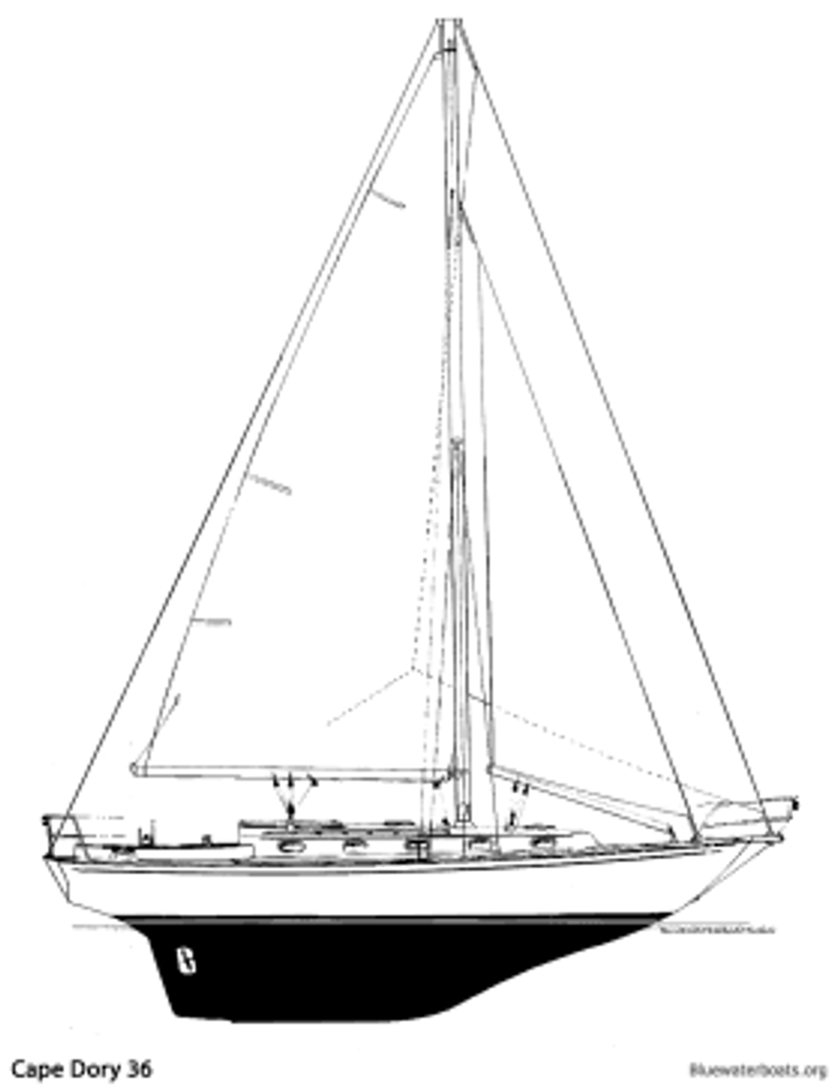
Carl Alberg drew her, a designer whose influence predates the performance-cruiser era Bob Perry and others ushered in through the 1970s and ’80s. Alberg worked from the Scandinavian Folkboat tradition, which trades some interior volume and initial stability for seakindly, well-mannered handling, and the Cape Dory 36 carries that lineage forward: narrow beam, low freeboard, generous overhangs, and a full keel cut away at the forefoot. Sailing Magazine’s own review of the design credits Alberg’s stated philosophy directly, long keels with attached rudders, narrow beam, slack bilges, and easy sailplans.
Her rig backs up the offshore intent: a proper cutter configuration built for serious work, though she’s just as nimble and manageable for coastal sailors. A comparatively shallow five-foot draft opens up bay cruising that deeper full-keel boats can’t reach. Belowdecks feels tight by contemporary standards but workable for a cruising couple on a long passage, with six total berths available when entertaining guests for the weekend.
Under sail she tracks well upwind, with an initial tenderness that lengthens her effective waterline as she heels before she stiffens up, and low freeboard that trades some dryness for that seakindly motion. Off the wind she tracks well too, except in a quartering sea, and some hobby-horsing shows up in chop.
Interior joinery and overall build quality have held up as genuinely top-notch across the run, with a meaningful deck and interior update in 1987. Practical Sailor’s own look at an early hull found one real weak point worth flagging: original builder Andy Dory reportedly regretted not stiffening the deck supports more, and over 300 original fastener holes contributed to leaks on at least one well-documented hull. Cape Dory closed its New England operation in 1991, and Robinhood Marine bought the 36’s molds to continue semi-custom production with further refinements. In total, 165 Cape Dory 36s were built.
One owner’s experience shows what the design can do offshore once well maintained: John Stone bought hull #61, Far Reach, in 2001 and rebuilt her extensively, new keel work, a taller mast, and a stronger overall structure than she left the factory with in 1982. Since then he’s logged roughly 11,000 nautical miles, mostly offshore and mostly singlehanded, including three round trips between North Carolina and the Virgin Islands. A separate, unnamed claim of “a couple of circumnavigations” turns up in period sailing press, but with no vessel or skipper named, it stays unverified here rather than counted as evidence.
Links, References and Further Reading
» Cape Dory Owners Association, Cape Dory 36 brochures and further information.» Cape Dory 36, A Survey, Nautical Quarterly No. 18, Summer 1982» Robinhood 36 article “Legacy”, Latitudes and Attitudes magazine, May/June 1997