Overview
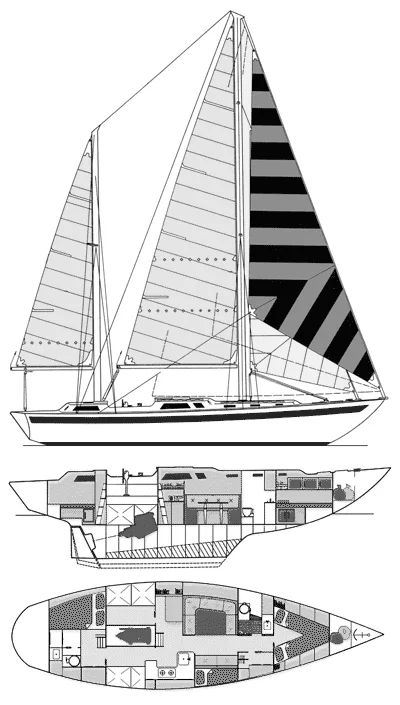
Marius Corbin founded Corbin Les Bateaux in 1977 to build a boat meeting his own requirements: about 40 feet, comfortable, good performance to windward and in light air, strong enough for circumnavigation, and built to a high standard. He commissioned Montreal naval architect Robert Dufour, who had already designed and built a one-off 39-footer called Harmonie, to adapt that boat into a flush-decked, higher-freeboard production design. The first Corbin 39 came out of the resulting mold in 1979.
History
Corbin built 129 hulls of the original Mk1 design through late 1982, when a factory fire destroyed the deck molds. Rather than stop, Corbin used the opportunity to address shortcomings owners had already flagged, producing an updated Mk2 topsides with a larger cockpit, a higher pilothouse, and a bowsprit with bobstay. Moulded-hull production continued to around 1991, with roughly 200 hulls total. Only about 15 were fully factory-finished; the other 185 were sold as kits in varying stages of completion, which explains the wide variation in interior layout and equipment from boat to boat despite an unchanged hull.
Design and Construction
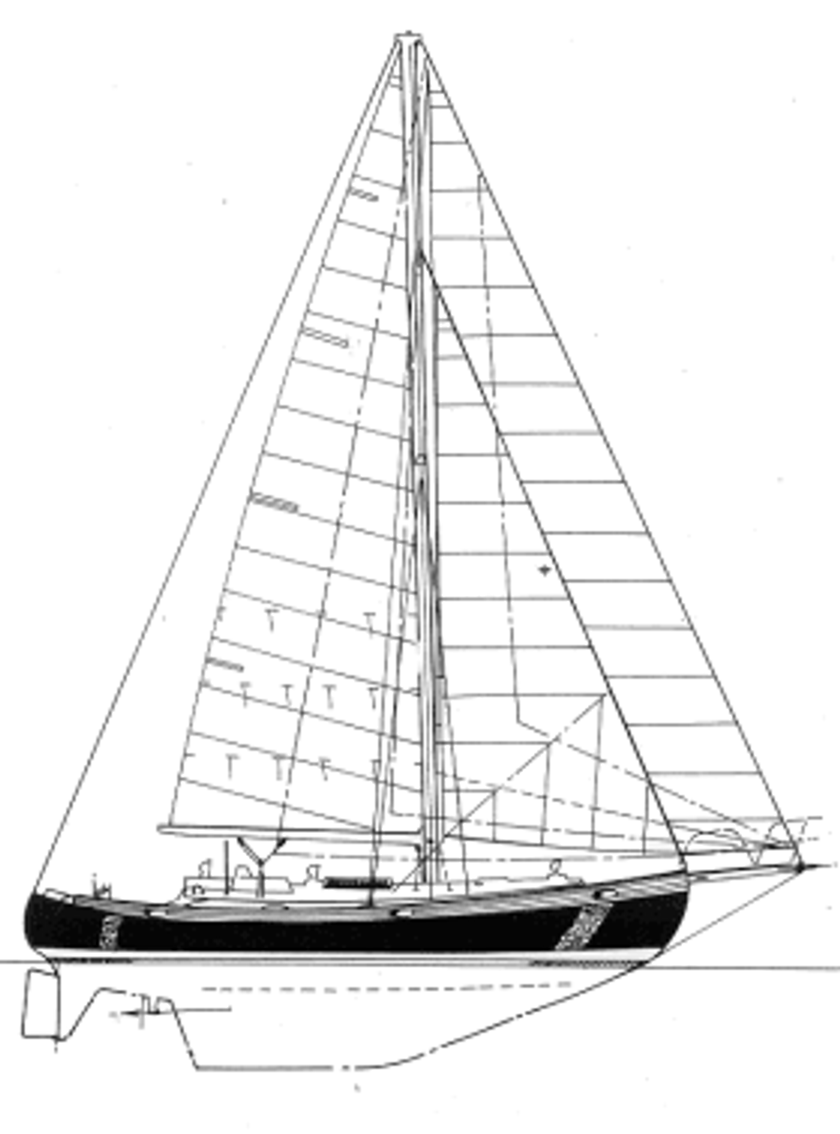
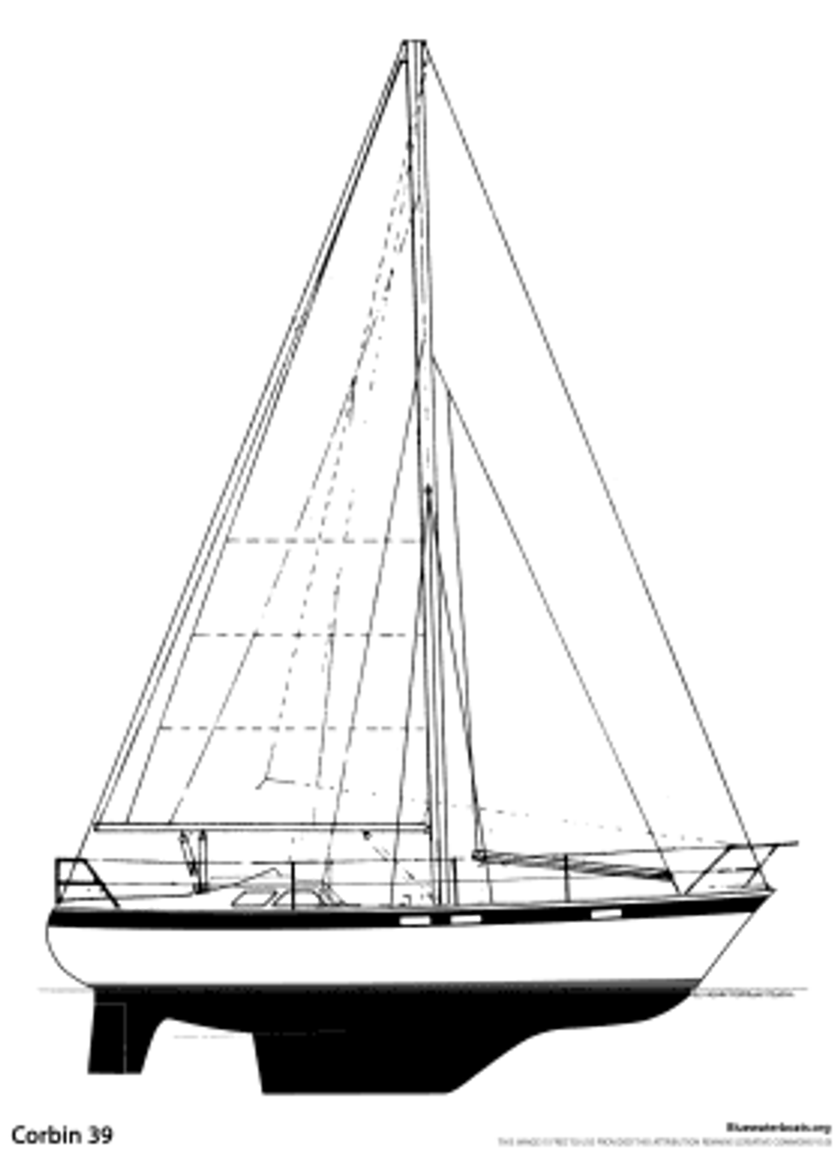
The hull is a double-ender in the Scandinavian offshore tradition, related in spirit to boats like the Westsail 32: a long fin keel, skeg-hung rudder, high freeboard, and a buoyant Scandinavian stern for load-carrying capacity. Corbin built to an 11-layer schedule of mat and roving, solid fiberglass below the waterline and Airex-cored above it, with decks cored in 3/4-inch marine mahogany squares bonded on both sides to limit water migration from any deck-fitting leaks. The keel is an integral part of the hull molding, encapsulating 9,000 lb of lead ballast with no keel bolts at all, a detail the owners’ association states unambiguously. Total displacement runs 23,000 to 26,000 lb depending on options installed, with 22,800 lb as the baseline figure most commonly cited. Draft is 5.5 ft. Corbin proposed the boat as a cutter, but sloop, ketch, and even Solent rig variants were built to order.
Under Sail
Owners report a comfortable, sea-kindly motion with a well-damped roll, quiet underway even in high winds, and good manners under sail once properly trimmed; Ted Brewer’s calculated comfort ratio of 37.7 is borne out by owner experience per the association’s own account. Weather helm could develop on some Mk1 sloop/cutter boats above about 15 knots, corrected by design changes in the Mk2. No specific named ocean crossing is documented in current sources, but builder Marius Corbin’s own description (“we get postcards from all over the world”) and the owners’ association’s statement that many Corbin 39s have circumnavigated point to a real, if not individually documented, offshore track record.
Buyers Notes
Because most hulls left the factory as kits finished by their owners, condition and equipment vary enormously between individual boats regardless of hull number; a survey needs to treat each one on its own merits rather than assume consistency. Post-1982 Mk2 boats have a larger cockpit and a mast moved forward to reduce weather helm, and a bowsprit improves sail balance further. Engine access is notably good for a boat this size on both Mk1 and Mk2 layouts. The Corbin 39 Association (corbin39.org) maintains an extensive hull-by-hull index and is the best resource for model-specific research.