Overview
Bill Crealock drew the Dana 24 for Pacific Seacraft in the early 1980s, and she reached the water in 1984 as what the designer himself called a “wonderful entry level, genuine go anywhere cruising boat.” At just over 24 feet on deck, she remains one of the smallest boats in this catalog with a serious offshore pedigree: solid construction, a shallow enough draft to duck into anchorages bigger yachts can’t reach, and lines trim enough that some owners tow her home on a trailer between trips.
She isn’t a bargain. Pacific Seacraft never built the Dana cheaply, but owners tend to point to lower maintenance and slip costs as the tradeoff for going small. Practical Sailor’s own sea trial, hull #39, a 1986 boat owned by Chris Humann, tested on San Francisco Bay, found her happiest as a lively daysailer in a breeze or an easily singlehanded coastal cruiser: closehauled at 5.7 to 5.9 knots in 12 to 15 knots of wind, and 6.8 knots on a broad reach in 13.5 knots.
History
Pacific Seacraft had a track record with small boats well before the Dana. Co-founder Henry Mohrschladt designed the company’s first boats, the Pacific Seacraft 25 and the Orion 27, and the company picked up the Flicka 20 design around 1977, which became a genuine hit. By the early 1980s, with Flicka selling well, Pacific Seacraft wanted a larger companion in the same spirit and brought in Bill Crealock, already well known for seaworthy offshore designs, to draw it.
The Dana 24 launched in 1984 and sold a respectable 222 boats over its first run, before demand cooled as the booming mid-1990s economy pulled buyers toward bigger boats. Crealock had a theory about that shift: “The taste went to bigger boats for a while and smaller boats just got put aside. The size of boats people get seems to vary with the square root of the Dow Jones average.”
Practical Sailor dates the pause precisely: production ran 1984 to 1998, paused for three years, then resumed in 2001 and continued until Pacific Seacraft’s 2007 bankruptcy and sale to new owner Stephen Brodie. The Dana molds weren’t part of that sale; they went instead to Seacraft Yachts, a Seattle dealership that picked up production again starting with hull #351. Combined production across both builders now exceeds 250 boats, and the design itself has barely changed since 1984.
Configuration and Layout
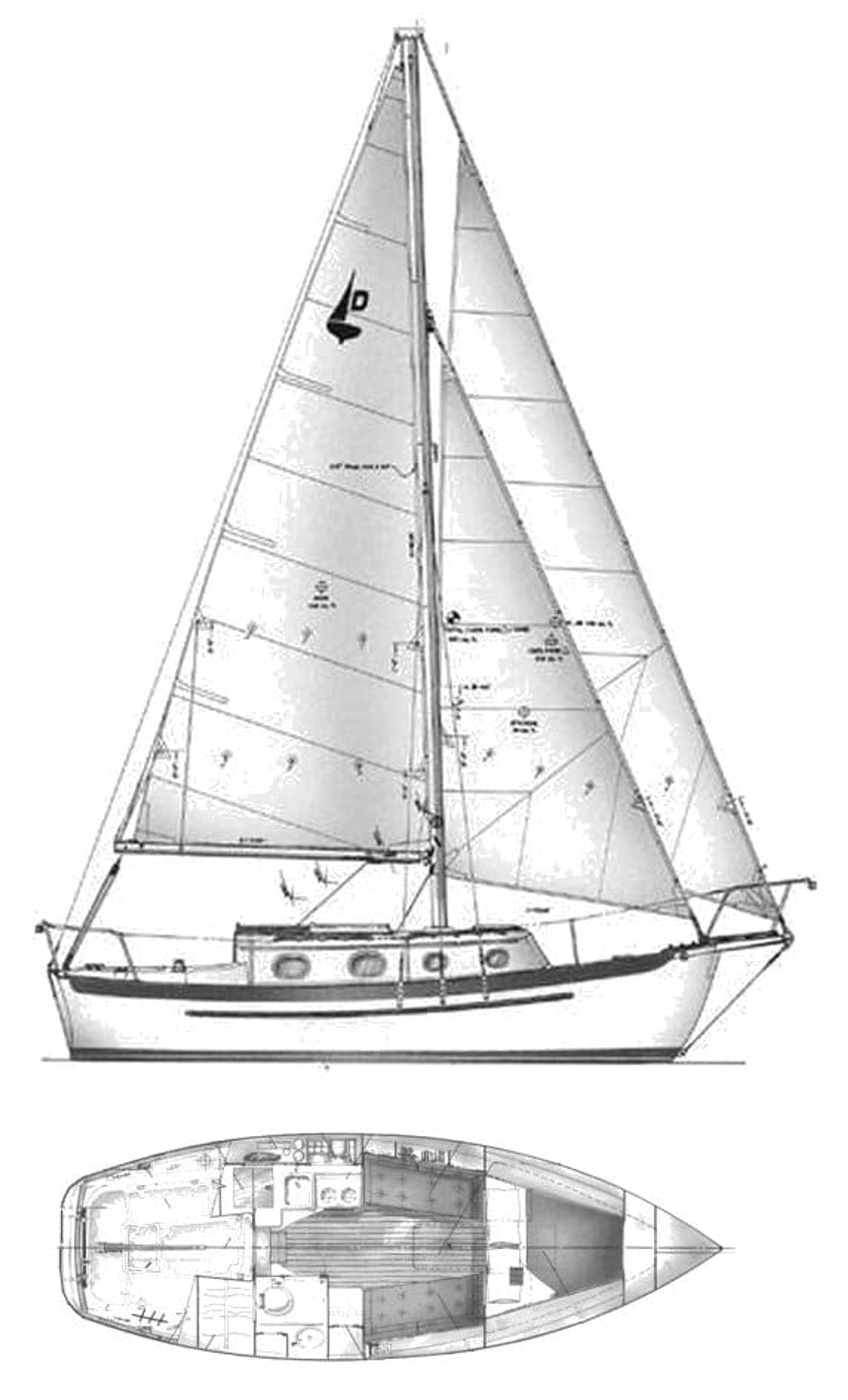
Below the waterline she carries a full keel with a cutaway forefoot and a keel-hung rudder. Above it, a plumb bow with a teak bowsprit platform and an elegant sheer give her real presence for her size, though the compact hull trades away the double-ended stern that marks most Crealock designs for a wider, near-vertical transom. She’s rigged as a cutter, and some boats have been set up for singlehanding with halyards and sheets led aft to the cockpit.
At 6’3”, each cockpit seat is a workable sea berth on its own, with big lockers beneath and a watertight sole hatch for engine access. Below, headroom runs 6’1”, and Crealock made good use of the 8’7” of beam: the layout feels noticeably roomier than her length suggests, finished below in oiled teak joinery over a teak sole inlaid with holly. The galley to port has a gimballed two-burner stove, a good sized insulated icebox, and a deep hand-pump sink, with a flip-down stove cover adding counter space. To starboard, an enclosed head compartment holds a shower pan, hanging locker, and its own hand-pump sink. Sleeping berths include a 6’8” by 6’9” V-berth forward and two 6’6” settees; a slide-out dining table with a hinged center fits around the interior support post.
Construction
Practical Sailor’s teardown of a 1986 hull found 5/8-inch solid fiberglass below the waterline, laid up with ISO-NPG gelcoat and vinylester resin over 3-ounce mat and three layers of 2415 bi-axial roving, with a plywood-cored fiberglass transom. The deck carries a 1/2-inch Baltek AL-600 balsa core. Ballast is 3,200 pounds of pre-cast lead, bonded in internally rather than bolted externally. All through-hull fittings are solid bronze, and chainplates are through-bolted to the hull with full backing plates. Since 1989, hulls have shipped with eight rectangular bronze portlights in place of the earlier round ones, and the outer laminate has used osmosis resistant vinylester resin from that year forward as well.
Practical Sailor flagged a few real gripes worth checking on any hull: a loose loop of wire connecting the mast base lighting and VHF that can work free and invite a short or a leak, a cramped head at 32 by 21 inches, a nav station that measures only 18 by 13 inches, and a fuel fill positioned on the companionway step, functional plumbing but a poor spot for a spill. The deck-stepped mast also drew comment as worth extra scrutiny before taking the boat offshore.
Under Sail
She’s a seakindly, well mannered boat with a nearly 42 percent ballast ratio doing real work for her stability, in keeping with the Crealock philosophy that comfort and lower crew fatigue add up to faster, safer passages. Practical Sailor’s numbers back up the reputation: 5.2 to 5.4 knots closehauled at 20 degrees of heel, with some lee drift, 3.5 to 4 knots on a beam reach in light air under a 110% headsail, and a 6.2-knot hull speed. She’s happiest in a breeze, pointing well and settling into a comfortable reach; downwind her full keel tracks straight with less roll than most boats her size. Her one acknowledged weakness is heaving to: high freeboard forward combined with the deep forefoot cutaway means her bow gets knocked off too easily to hold a stable slick.
Buyer’s Notes
No significant structural weaknesses have turned up across the design’s four-decade production run. Most of what Practical Sailor flagged, the mast-base wiring loop, the tight head and nav station, the fuel fill placement, are inconveniences rather than safety issues, worth a look on survey rather than reasons to walk away. An active owners’ community keeps a Yahoo Groups mailing list running for anyone doing further research before buying.
Links, References and Further Reading
» Dana owners group on Yahoo » An owner’s in-depth review of the Dana by Benjy » Article on the Dana by Heather Frickmann » Review of the Dana from 48 degrees North by Richard Hazelton » Dana 24 video review by Lattitudes and Attitudes, Seafaring Magazine » Twenty Small Sailboats to Take You Anywhere by John Vigor , (Ch11, p65-70) an in depth look at the Dana 24. ISBN:978-0939837328