Overview
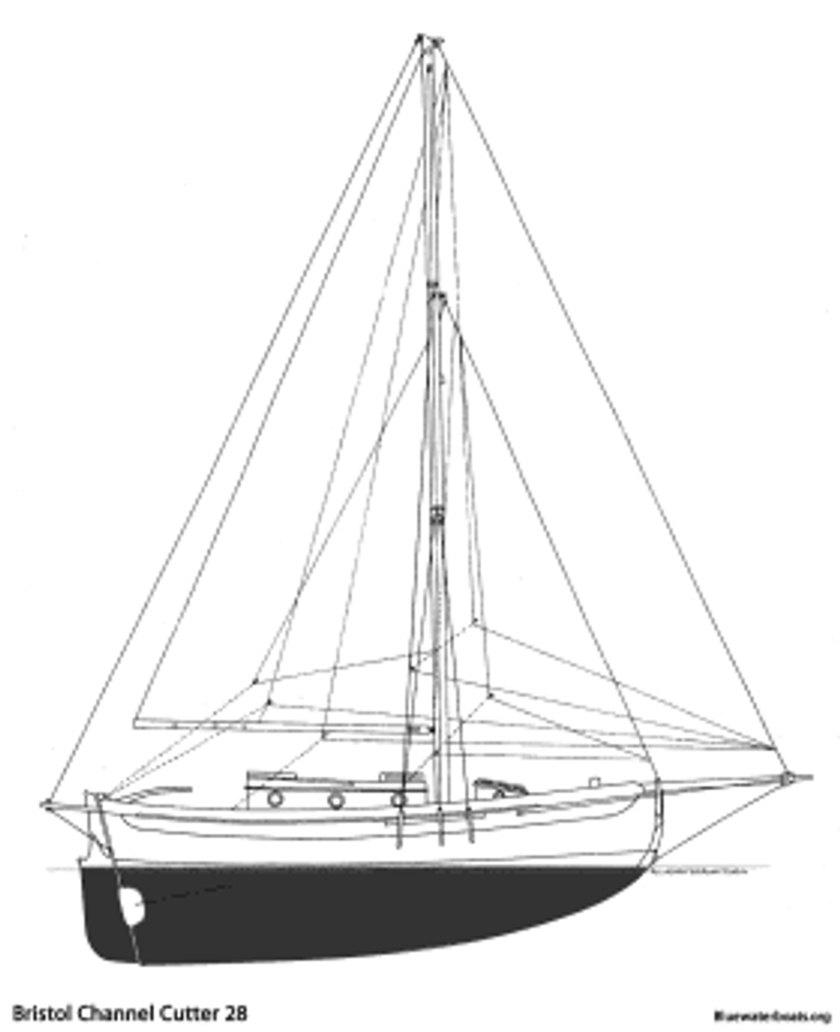
The Bristol Channel Cutter 28, introduced in 1975, is a pinnacle of rugged, practical small-boat cruising with respectable performance to match. Designer Lyle Hess built a cult following among small-boat voyagers, popularized above all by Lin and Larry Pardey’s cruising books aboard his 24-foot Seraffyn and 29-foot Taleisin; the Bristol Channel Cutter was in large part Hess answering sailors who wanted their own “Pardey” boat.
Her credentials back up the reputation: a Bristol Channel Cutter won the Newport to Ensenada Race outright in 1978 and took her class in 1979, and in the 1980s and 1990s Roger Olson sailed his own Bristol Channel Cutter, Xiphias, some 50,000 miles across two oceans over thirteen years. (Seraffyn and Taleisin’s own well-known 40,000-mile circumnavigation and five Tasman Sea crossings belong to Hess’s earlier wood-built personal boats, not this fiberglass production model, worth noting since the two are often mentioned in the same breath.)
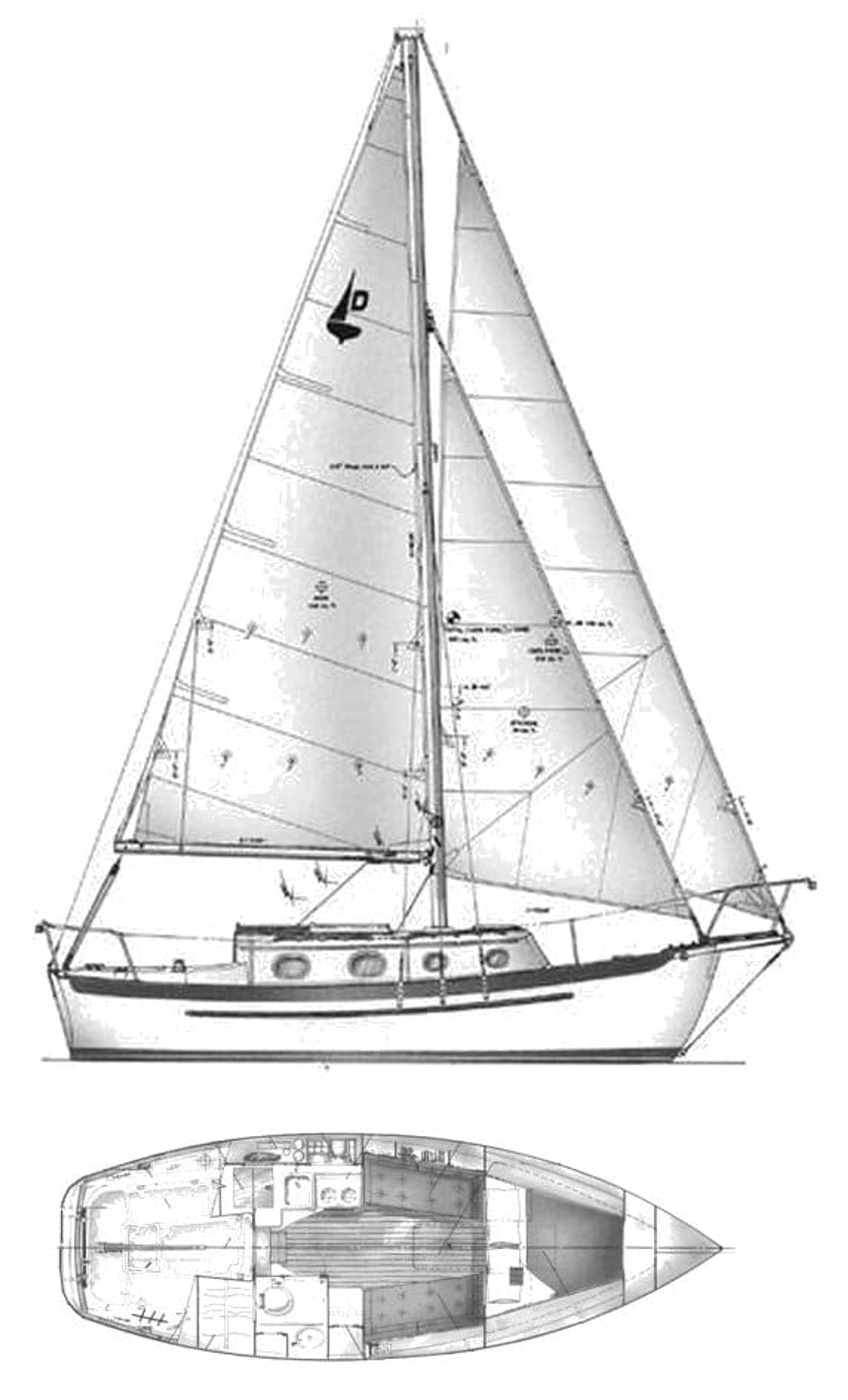
The oversized bowsprit and boomkin are the first thing most people notice, letting her carry a lot of canvas for her displacement. Underwater she looks conservative and traditional: wineglass sections and a full keel without the forefoot cutaway many designers use to improve nimbleness. Look closer, though, and real performance thinking shows up, a fine bow entry with maximum beam carried well aft helps her point, and flat after sections with minimal deadrise aid stability under sail. Every inch of the layout is deliberately considered, to the point that even small owner modifications can have knock-on effects elsewhere. True to her purpose, there are no anchor-only staterooms, all four berths (two settees, a pilot berth, and a quarter berth) are proper sea berths, and stowage is abundant throughout.
History
The story goes that a friend asked Lyle Hess for a small traditional boat capable of crossing oceans. Hess answered with his own take on the 19th-century pilot boat: heavy displacement, a long waterline, wineglass sections, hard bilges, and a rig that could carry serious canvas while still working fast on any point of sail. His first design was a 28-footer, later scaled down to a gaff-rigged 24-footer to ease his friend’s cost concerns; that boat, Renegade of Newport, launched in 1950. By the 1960s the design had caught Larry Pardey’s interest, and Hess drew up a Marconi-rigged, carvel-wood version for him: Seraffyn, launched in 1968.
The Pardeys’ books and articles, built around their tagline “go small, go simple, go now,” drew real attention to Hess’s work, and he answered the resulting interest with a 28-foot fiberglass design built by the Sam L. Morse Company: the Bristol Channel Cutter, launched in 1975. Morse sold the company in 1992 to Hess fan George Hylkema, who brought on Roger Olson, fresh off his own 50,000-mile world cruise aboard Xiphias, to help refine the boat. Olson bought the company outright in 1995 and sold it again in December 1998 to its fourth and final owner, Sumio Oya. By 2007 Sam L. Morse Company was struggling: demand for classic small boats had cooled, larger vessels were where the profit was, and newer production techniques elsewhere made it harder to compete. After its 126th hull, Oya handed the molds and building rights for both the Bristol Channel Cutter and the Falmouth Cutter 22 to Cape George Marine Works, at cost of relocation only, to protect the design’s reputation rather than for profit. Sam L. Morse briefly considered a larger Hess design before closing but couldn’t raise the capital. The two companies overlapped through August 2008, building two more boats together before Morse shut down and Cape George carried on alone, adding another hull as recently as January 2011.
Beyond the roughly 129 American-built boats, an estimated 30 to 45 more hulls came out of a Vancouver, BC yard called Channel Cutter Yachts, unlicensed copies built with no design royalties paid to Hess, but reportedly to a similarly high standard.