Overview
The Hinckley Bermuda 40 is a William Tripp Jr. keel-centerboard design from Henry R. Hinckley & Co. in Maine, built in three marks on the same hull from 1959 to 1991; sailboatdata.com records 203 built across the run. Its place in this catalog rests on its ocean racing record: 2 different boats of the design have finished the Pacific Cup from San Francisco to Hawaii or the Newport Bermuda Race in the official results.
Design and Construction
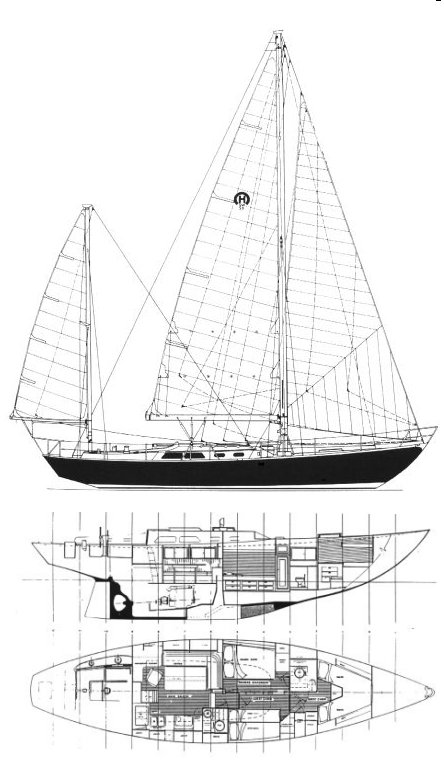
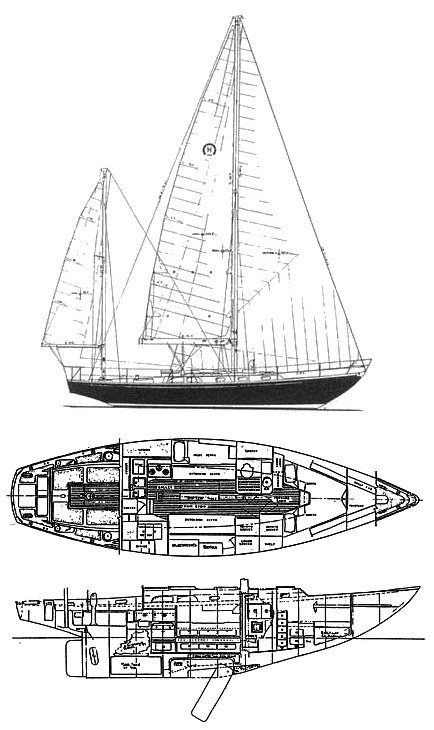
sailboatdata.com lists the underbody as keel/cbrd., 40 ft overall on a 28.83 ft waterline, with 11.75 ft of beam and 8.6 ft of draft. Displacement is about 20,000 lb with 6,500 lb of ballast, and the masthead yawl carries about 681 sq ft. Good Old Boat’s Paul Ring reports that the hull is solid fiberglass throughout the run, with a hull-to-deck joint that has a 6-inch overlap, while the deck went from solid glass to balsa coring and finally to PVC foam in the last few boats. The ballast is external lead and the bronze centerboard is raised by a worm gear because a wire pendant would be more prone to breaking. Practical Sailor adds that all deck hardware is through-bolted and tapped into the deck, and that Hinckley built what it calls a wooden boat inside a fiberglass hull.
Ocean Racing Record
Actaea (Michael M. Cone) finished the Newport Bermuda Race (2006). Alice Kay (Richard Hartley) finished the Newport Bermuda Race (2006). Fandango finished the Marion-Bermuda Race in 2005. Amethyst finished the Marion-Bermuda Race in 2017.
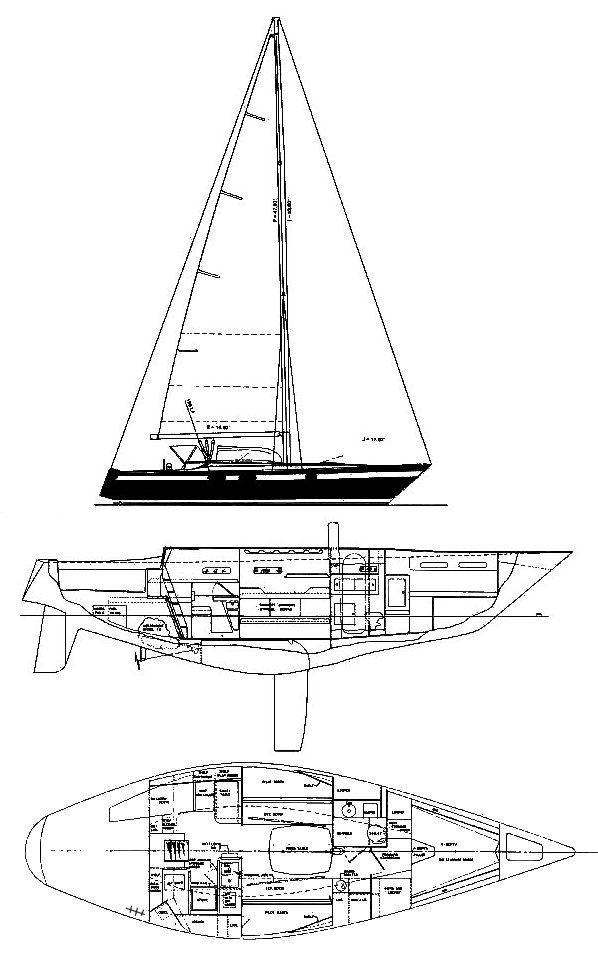
The yawl rig was the only option on the Custom and Mark II, and a sloop rig arrived with the Mark III. Good Old Boat says the mast was raised a little over 2 feet in the late 1960s, the bronze centerboard was given an airfoil shape, and a later change added 1,000 pounds of ballast to balance a taller mainsail. Under sail, Good Old Boat says the B 40 does not go to weather as well as modern designs, nor tack as nimbly, but the full keel and centerboard make it easy to balance on reaches. Practical Sailor’s owner survey reported that it heels early to about 15 degrees and then stiffens, and that with the mizzen and centerboard one owner could almost eliminate weather helm with appropriate sail trim. Backing under power can be an adventure with the attached rudder.