Overview
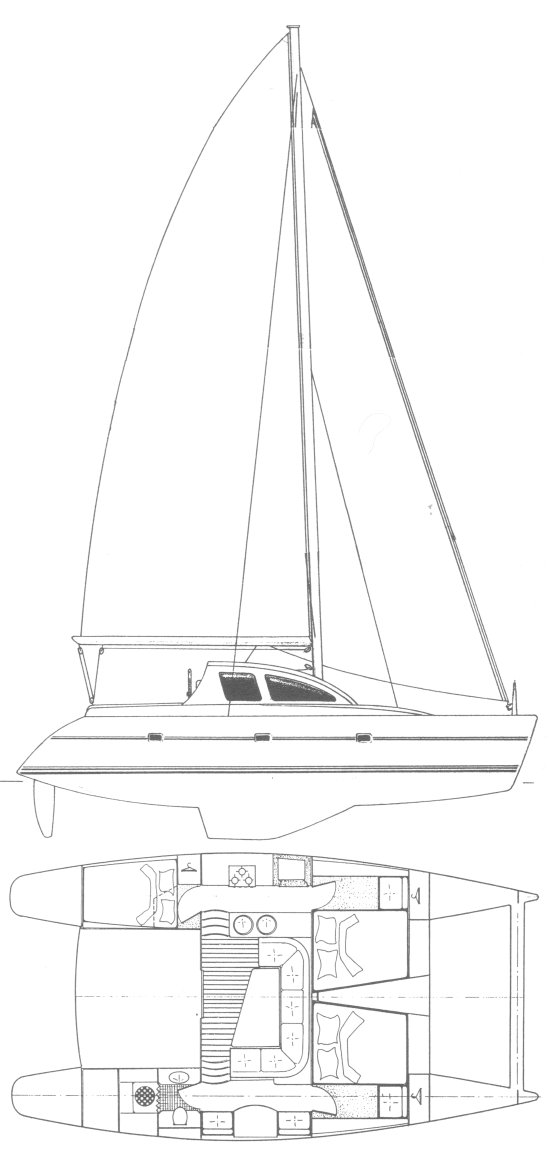
The Lagoon 37 was one of the earliest production boats to carry the Lagoon name, designed by the French catamaran specialists Van Peteghem and Lauriot-Prevost and built from 1991 to 1998. It was produced both in France, initially under Jeanneau’s new Lagoon catamaran division and later Construction Navale Bordeaux, and in the United States by TPI Composites, with 41 total hulls completed before the Lagoon line moved on to later designs.
Design and Construction
At just under 12,000 lb displacement on a 20 ft beam, the hulls are balsa-cored fiberglass laminated in isophthalic resin, with raked stems and reverse transoms carrying swimming-platform steps. Twin fixed fin keels and twin internally mounted, wheel-steered spade rudders replace the daggerboard or centerboard arrangements used on some contemporaries. Twin diesels, either Perkins or Yanmar depending on the build, handle docking and maneuvering, a genuine practical advantage over a single-engine catamaran when threading a marina. Cruising World’s Quentin Warren reports Baltek end-grain balsa core in hulls and deck. The hull element, including both floats and the bridge deck structure, is laid up essentially as one monocoque, and the deck is bonded to an inward hull flange with a two-part urethane adhesive. The rig is stepped on the cabin top and carried by a 28-inch stainless-steel compression post anchored to solid ash glassed into the junction of three structural bulkheads.
Under Sail
Reviewer Chris Caswell wrote that the design “doesn’t give up any windward ability,” reporting steady nine-knot sailing with bursts to 15 knots, notably strong performance for an early-1990s cruising catamaran. Naval architect Robert Perry called it a “clean and refined cat with careful attention paid to styling,” while noting the profile looks high and top-heavy from some angles. Warren found the 37 responsive and sea-kindly, with inboard genoa sheeting and long fin keels giving good tracking to weather. He sailed one in the light-air 1993 Marblehead-Halifax race and finished third in class on corrected time. In 15 to 25 knots at about 120 degrees apparent she reached speeds well over 10 knots. Below, the galley is in the port hull, with two queen-size doubles forward and a smaller double aft in the starboard hull.
Buyers Notes
As an early-production catamaran now three decades old, survey twin-engine and twin-rudder systems carefully, since redundancy on paper does not remove the maintenance burden of doubled mechanical systems. Confirm which builder (Jeanneau/CNB in France or TPI in the US) built a specific hull, since equipment and finish details can differ between the two production runs.