Overview
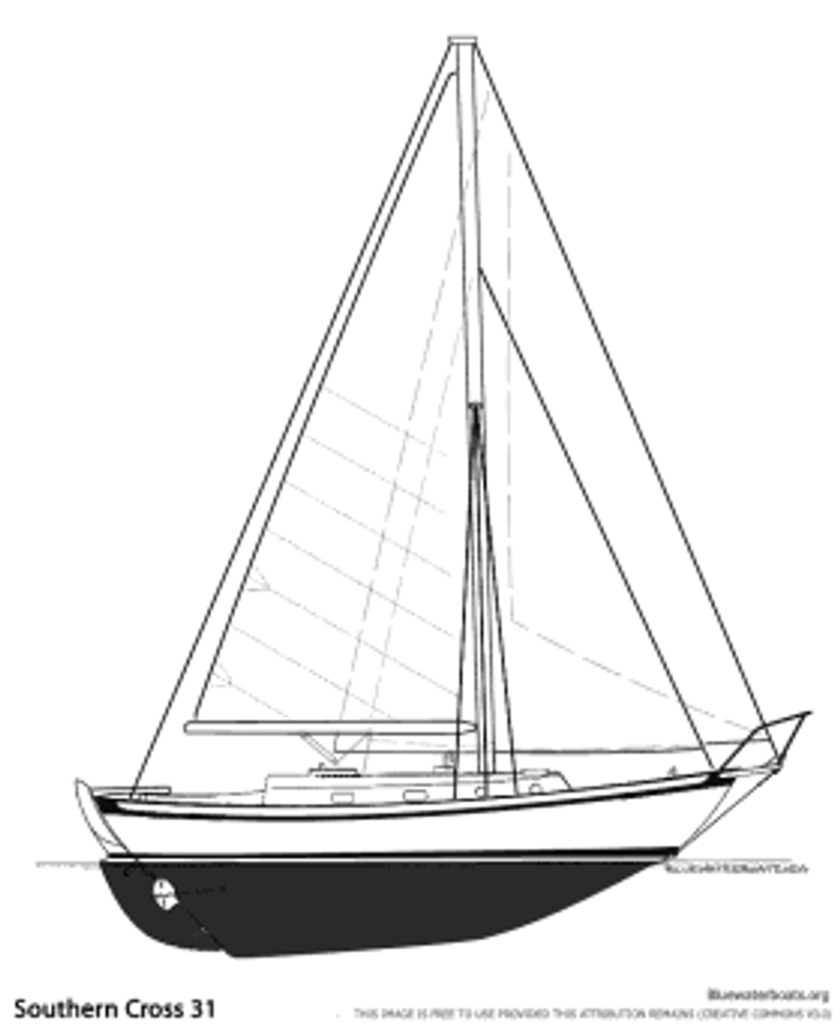
Thomas Gillmer designed the Southern Cross 31 for C. E. Ryder in Bristol, Rhode Island. The model name refers to its 31-foot hull length. SailboatData gives an overall length of 34 feet 6 inches when the bowsprit and stern projection are counted, which is the figure now used in the catalog. Its waterline remains 25 feet.
Production began in 1975. SailboatData lists about 150 built, while the previous review used 130. Some boats were sold as hull-and-deck kits, so neither number should be treated as a count of identical factory-finished yachts.
Hull and Construction
Gillmer retained a long keel and transom-hung rudder but pulled the forefoot aft from a pure Colin Archer form. Robert Perry’s design review explains that the flatter buttocks, firmer bilges, and fuller ends were intended to improve initial stability and reduce pitching. The rudder stays accessible and protected behind the hull, with a boomkin carrying the backstay clear of it.
Good Old Boat describes an Airex-cored fiberglass hull. The foam core adds insulation and reduces condensation, but an old cored hull still needs moisture checks around through-hulls, chainplates, and repairs. The deck and cabin are balsa cored. Surveyors should examine deck hardware, the mast area, chainplates, hull penetrations, and any place where later owners opened the laminate.
Owner-completed interiors create another inspection boundary. Atom Voyages warns that finish quality varies. Bulkhead tabbing, furniture attachment, wiring, plumbing, and locker construction should be assessed independently of the molded hull.
Rig and Performance
The cutter rig uses a short bowsprit and a boomkin. Published sail-area figures look inconsistent until their definitions are separated. SailboatData reports 447 square feet, while the 100-percent foretriangle and main dimensions calculate to about 496 square feet. Sailing Magazine uses the larger figure. PassageBoats retains 447 as the reported area and records the convention difference here.
At 13,600 pounds on a 25-foot waterline, the displacement-to-length ratio is about 389. Perry expected slow light-air sailing from the modest rig. Good Old Boat reports that the prototype placed third in its class in the 1977 Marion to Bermuda Race, which shows that the boat could keep moving in a real offshore event. That result is useful context, but the source does not name the vessel or crew.
The long keel should favor directional stability, while the narrow 9-foot 6-inch beam and heavy displacement limit interior width and acceleration. A useful trial should test tacking in light air, reefed balance, heaving-to, and self-steering.
Passage Evidence
Pat Henry sailed a Southern Cross 31 on a solo circumnavigation from Acapulco, departing in 1989 and returning on May 5, 1997. Latitude 38’s West Coast Circumnavigators list and a Good Old Boat profile of designer Thomas Gillmer both name the vessel, skipper, and route independently; the Gillmer profile also quotes Henry describing 28-foot seas and 60-knot winds sustained for more than a day, a genuine qualifying offshore condition rather than a coastal passage. Latitude 38 separately records Jim and Barb McConn’s 2004-2009 circumnavigation aboard the Southern Cross 31 Spanish Stroll.
The earlier circumnavigation-proven tag was removed at a point when this
passage record had not yet been found; it predates the sourcing above. The
famous first fiberglass-yacht circumnavigation belongs to Gillmer’s Allied
Seawind, a related but different design, and that record does not transfer to
the Southern Cross 31 on its own; Henry’s and the McConns’ voyages are the
model’s own record.
John Vigor included the design in Twenty Small Sailboats to Take You Anywhere, and his Good Old Boat summary rates it highly for safety at sea, corroborating context alongside the named voyages above.
Accommodation
Two standard layouts were offered. One used a standing navigation station over a large locker; the other substituted a quarter berth. SailboatData lists about 6 feet 2 inches of headroom, 34 gallons of fuel, and 47 gallons of water. Atom Voyages notes eight opening ports and two hatches, a practical ventilation advantage on a small cruiser.
The interior is best suited to two adults, with occasional additional crew. Offshore stores, safety equipment, and water will consume much of the available space. The small cockpit and simple layout can be useful at sea, provided lockers, companionway boards, and heavy items have positive restraints.
Buyers Notes
Identify whether the interior was yard or owner finished. Inspect core moisture, bulkhead tabbing, chainplates, mast support, bowsprit and boomkin attachments, rudder hardware, and old through-hulls. Check that later engine, tank, and electrical work is accessible and properly supported.
The Southern Cross 31 has a conservative hull form and credible expert reviews. Its age, kit-built examples, and modest light-air power make individual condition more important than the general reputation of the design.