Overview
Robert Perry drew the boat officially called the Flying Dutchman 35 for developer Bob Berg, and the Baba 35 name became the one owners kept. Ta Shing began production in Taiwan in 1979. The design sits between the Baba 30 and Baba 40, with the same double-ended cruising style and a noticeably larger interior than its hull length suggests.
Production records do not agree. SailboatData counts 72 boats. The archived review gives 75, including seven pilothouse versions, and explains that serial numbers contain a large unused block. This page leaves both figures visible rather than treating the hull-number range as a simple production count.
Hull and Rig
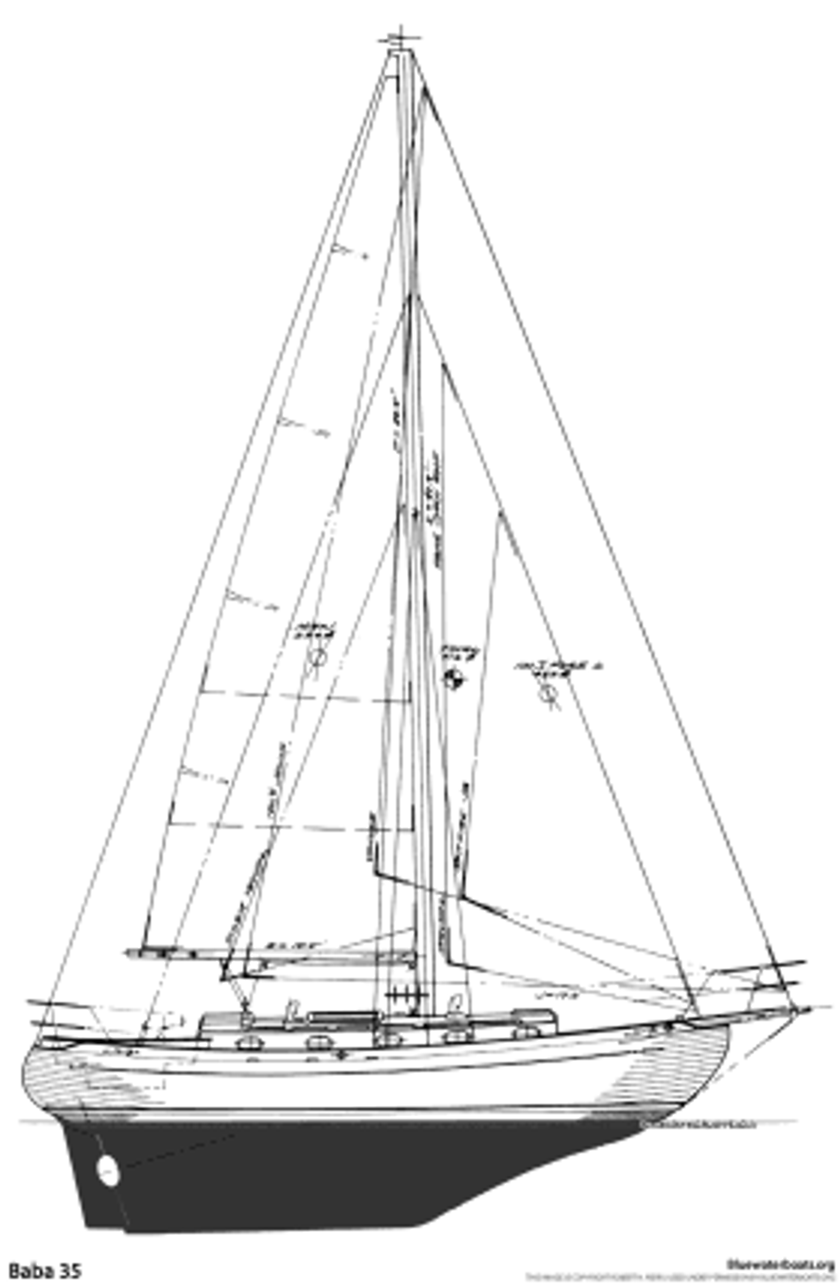
The Baba is 34 feet 10 inches on deck, 29 feet 7 inches on the waterline, and 11 feet 2 inches in beam. It draws 5 feet 6 inches and displaces 21,140 pounds with 8,000 pounds of ballast. SailboatData reports 758 square feet, while the archived review lists 716. The larger figure matches SailboatData’s published main and foretriangle measurements and is now used in the specification panel.
Perry drew a long keel with a moderately cut-away forefoot rather than blending the hull and keel into a deep wineglass section. The rudder is protected aft and the bowsprit carries the cutter headstay. Perry’s own book notes that an alternate shorter rig was developed for later boats, so replacement sails and tuning numbers should be checked against the actual spars.
Under Sail
The class data describes a heavy cruiser with more sail power than many boats of similar displacement. The long keel should favor tracking and a steady helm, while its area and the boat’s weight work against quick acceleration. Sail balance matters because the cutter can carry several combinations, and the tall and short rigs will not behave identically.
The archived review reports 130-mile trade-wind days, good reaching, limited hobbyhorsing, and comfortable heaving-to. Those are useful owner observations, but no underlying logs or named boats are attached. They should guide a trial sail rather than serve as measured class performance.
Interior and Variants
Ta Shing’s joinery is a major part of the model’s appeal. Common layouts put the galley aft to port, the navigation area or quarter berth aft to starboard, opposing saloon seating amidships, and the head and sleeping cabin forward. Boats were fitted with several saloon and forward-berth arrangements.
The archived source dates a group of interior changes to about 1983, including a relocated head, revised galley sinks, and lighter interior finish. A small pilothouse run also exists. Confirm the exact layout, rig, and deck arrangement from the individual hull rather than assuming all Baba 35s match one brochure.
Documented Offshore Attempt
Good Hope, hull 42, entered the 2022 Golden Globe Race with Gaurav Shinde. The official race profile identifies the boat and now marks the entry retired. This is stronger evidence than a general statement about offshore suitability, but it is not a completed circumnavigation or even a completed race passage. The current rating reflects that distinction.
What to Inspect
The archived review flags corrosion in mild-steel fuel tanks mounted low in the boat. It also points buyers toward chainplates, balsa-cored deck areas, and aging teak decks. These concerns need a survey on the actual hull; the source does not provide a fleet-wide failure rate.
Inspect the bowsprit and its stays, chainplates, deck core around fasteners, tank condition and removal access, mast support, rudder attachments, and hidden bulkhead tabbing. Determine which rig is fitted before ordering sails. Ta Shing’s reputation and Good Hope’s race preparation are useful context, but neither replaces evidence from the boat on the hard.