Overview
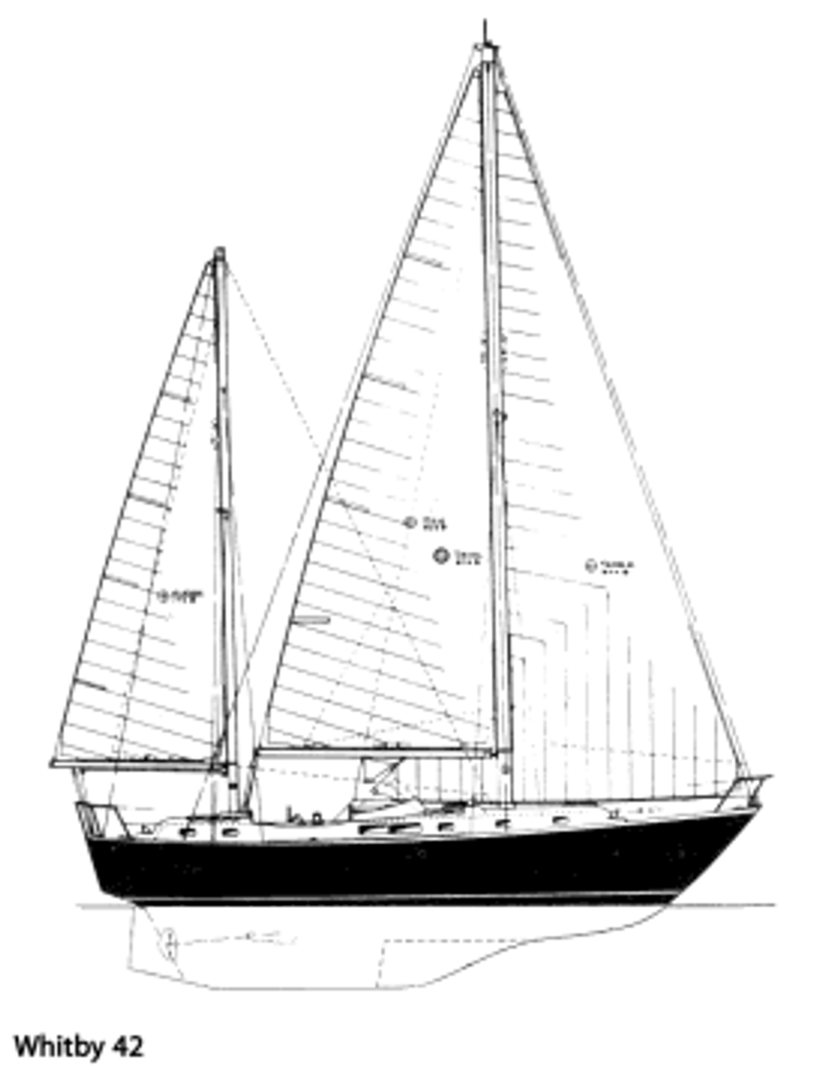
Ted Brewer drew the Whitby 42 in 1973 at the request of Whitby Boat Works owner Kurt Hansen, who specifically wanted a shallow-draft, full-length-keel ketch. The result became the most commercially successful of Brewer’s designs, a roomy, heavy-displacement center-cockpit cruiser prized more for its accommodations and shoal draft than for outright sailing performance.
History
The first hull came out of Whitby Boat Works in Ontario, Canada in 1973; the yard, owned by Kurt and Doris Hansen, had previously built the Alberg 30 and Alberg 37. Roughly 200 Whitby 42s were built in Canada through the early 1980s, with construction quality improving steadily over that run. Production then shifted to Fort Myers Shipbuilding in Florida, where the design continued alongside two evolved sisterships: the Brewer 12.8 (also called the Brewer 42), which substituted a cutter rig for the ketch, added a modified keel with a “Brewer bite” and often a centerboard, and used the resulting weight savings for more ballast and stability, and the Brewer 44, a stretched version of the 12.8. The Fort Myers-built boats generally have a reputation for the highest construction quality of the line.
Design and Construction
The hull uses balsa-cored topsides, typical of Canadian builders of this era, with alternating layers of mat and woven roving in polyester resin below. A molded liner stiffens the hull and provides interior structure, at some cost to hull access for inspection and repair. The standard rig is a ketch, though sloop and staysail-ketch-with-bowsprit configurations were also offered. A 67 hp Ford Lehman diesel was the original standard engine, giving genuinely useful range and power for the boat’s size.
Under Sail
Performance under sail is a real weakness relative to the boat’s rugged looks: a full keel with an attached rudder and comparatively rounded buttocks make the Whitby 42 more tender than its heavy displacement suggests, and boats without a bowsprit carry pronounced weather helm. That said, independent sources describe it as capable in the trades, with a 5 ft draft that opens up shoal anchorages a deeper-draft cruiser can’t reach. No specific named ocean crossing is documented in current sources, though the design is generally described as having made real offshore passages despite construction caveats that keep it from being a first choice among dedicated bluewater sailors.
Buyers Notes
Survey priorities worth knowing about directly: the water tanks are fiberglass with an aluminum top plate, an unusual combination worth inspecting for corrosion at the seam; the fuel tank sits deep in the keel bilge, harder to access than a more conventional location; the hull-to-deck joint was often secured with stainless rivets rather than through-bolts on earlier boats, though many were later upgraded; and the mizzen mast lacks a solid glass radius at its base on some hulls, a known compression point. Boats fitted with a bowsprit carry noticeably less weather helm and better light-air balance than those without.