Overview
Joe Adams’ 13 Metre ranks among his best-known designs, well recognized across Australia despite feeling remarkably contemporary for a boat drawn in 1978. Adams took an unusual approach with his Metre series: the 13 is essentially a 36-foot yacht stretched out to 43 feet overall, producing a hull narrow enough to stay slippery through the water while opening up real room below, without giving up much of a 36-footer’s affordability.
She’s genuinely versatile: nimble enough for round-the-buoys racing, with a long career as an offshore racer behind her, and equally capable as a seakindly cruiser offshore. Most examples carry a centerboard, which lifts to sharpen downwind performance and lets her draw barely over a metre for gunkholing into shoal anchorages. Owners consistently describe her as easy to handle and genuinely fun to sail.
History
Joe Adams drew the 13 Metre around 1977-78, following soon after the smaller Adams 10 Metre. Designer Graham Radford, who spent ten years as a partner at Adams Yacht Design across that period, describes the 10 Metre as the first boat in the “Adams Metre” range: light-displacement, narrow-beamed performance cruisers.
Radford, interviewed by bluewaterboats.org about the design brief behind the 13, put it this way:
“It was really just a small but long cruising boat. Not a big volume boat, it’s narrow, it’s long, it’s got the accommodation volume of a 36 footer but in 43 feet of length … The centerboard was to give it very shallow draft for cruising. That style of centerboard we used on quite a few designs from little boats right through to 56 footers. It’s proved very popular and has done a lot of sea miles.”
Joe Adams originally drew the 13 for himself, and by all accounts put real care into getting the design right. A syndicate of five owners, Adams included, funded the molds, each covering a fifth of the cost; once their five boats were built, the molds changed hands and have done so several times since.
The first hull, Fanny Adams, went to a Sydney owner who raced her offshore. Since then, an estimated 80 boats have come off various builders’ lines, with the last known hull completed in 2002. The molds now belong to Peter Rigby of Adams Yacht Sales, which remains open to new orders.
Despite her cruising brief, the 13 built a genuine offshore racing record, including a long string of Sydney-Hobart entries, and she still turns up competitive in that fleet today.
Configuration and Layout
She doesn’t look like an average bluewater cruiser, and she isn’t meant to: narrow and sleek with a nearly straight sheerline, cutting against the grain of typical late-1970s cruising design. Her displacement and beam read like a 36-footer’s, but she stretches to 43 feet overall with a waterline pushing 41 feet.
That stretch was the whole point: extra length adds interior room without adding the weight or rigging cost of a genuinely bigger boat, so a cruising couple gets more space to live in while build and running costs stay closer to a 36-footer’s. The tradeoff pays off directly in speed.
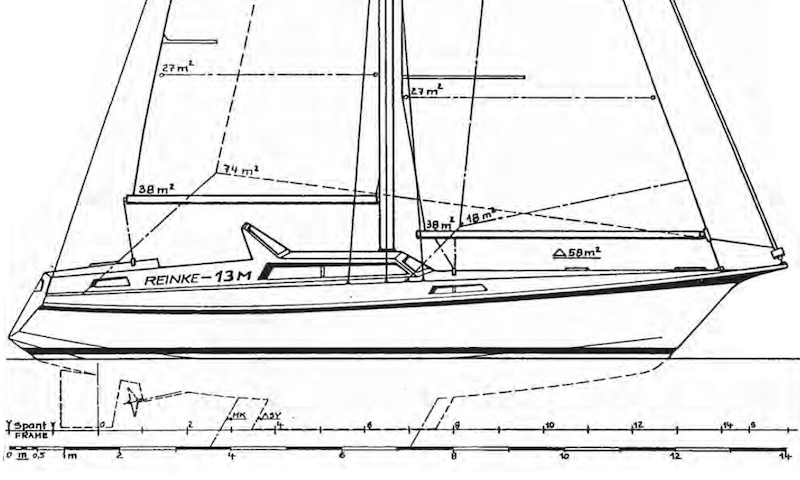
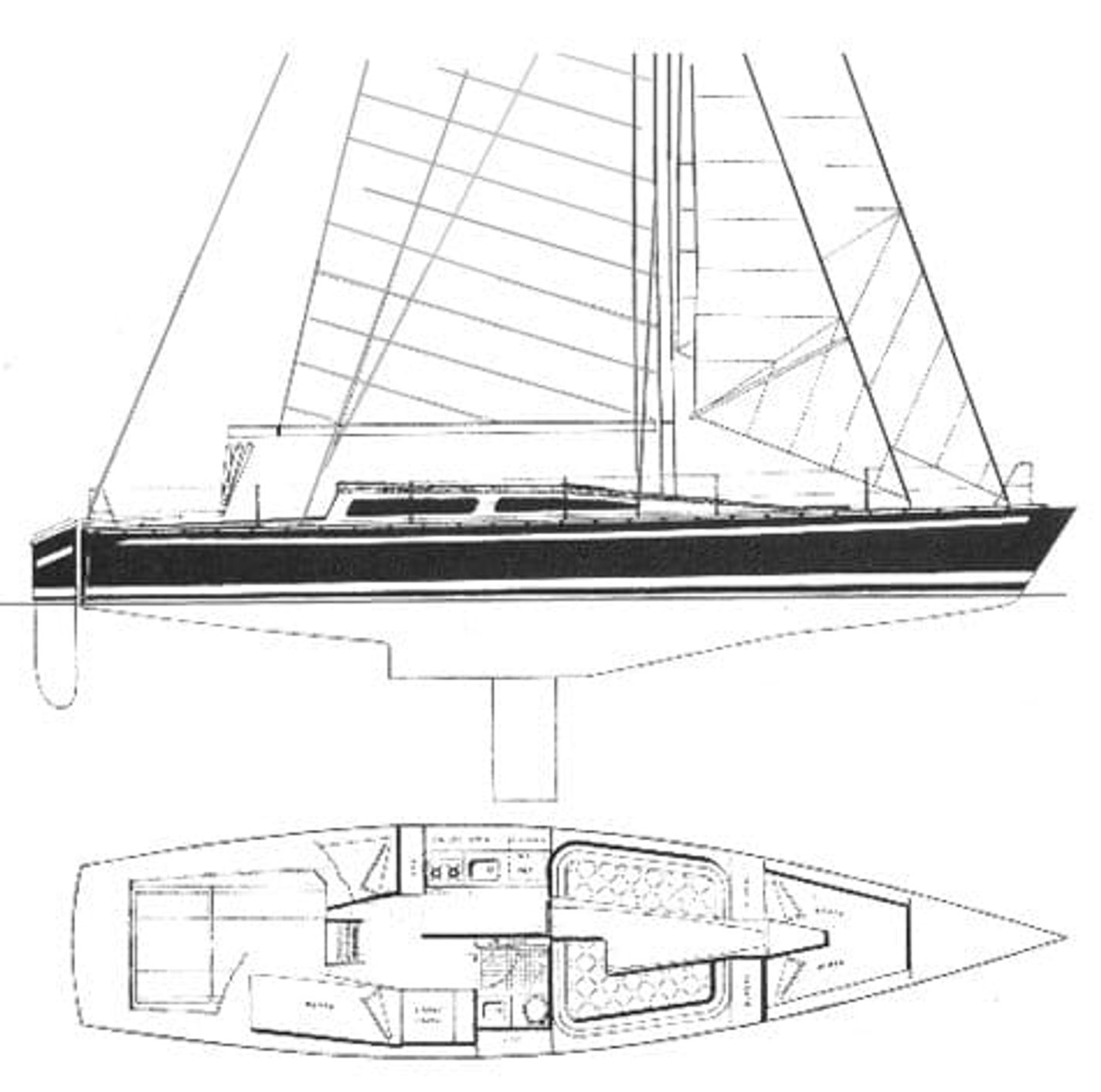
She carries a fractional cutter rig with a generous 1,075 square feet of sail, a transom-hung rudder on a tiller for simplicity, and a keel/centerboard combination that lifts to cut wetted area running downwind and draws just 1.04 meters for close-in anchoring. The mainsheet and traveller sit dead center in the cockpit, which some owners find gets in the way underway; several have relocated the sheeting further forward to open the space back up.
An “E” variant built for offshore racing swaps the centerboard for a fixed keel, moves the rudder under the hull behind a proper skeg, and adds wheel steering along with an extended, open-transom cockpit.
Interiors vary considerably from boat to boat, common across the Adams range, since many hulls were sold as bare hull-and-deck packages and finished by professional builders or owners themselves. The typical layout sleeps four to six under 5’11” of headroom: a saloon forward of the centerboard case, set apart from the working end of the boat, two large aft quarter berths that may be singles or a double, room for two more in the saloon if needed, and a V-berth forward with either two singles or a double. A large enclosed head and shower sit alongside the centerboard case.
Construction
The hull is fiberglass sandwich over an Airex foam core. Decks are fiberglass as well, most over end-grain balsa coring though some used Airex foam instead. The stub keel is solid GRP skin around molded lead ballast, encapsulated in fiberglass, with structural floors fitted afterward.
Under Sail
She’s easy to handle, genuinely nimble, and owners consistently report her as fun to sail. Her motion stays comfortable and seakindly, and crossing oceans in her can reportedly take less out of a crew than a standard 36-footer would. Her narrow hull and light displacement make her easily driven, small enough that many owners get by with a tiny auxiliary, a 20-horsepower two-cylinder diesel or even smaller.
She’s particularly quick off the wind with the centerboard up, a real asset given how much offshore cruising mileage tends to happen downwind. The tradeoff is stability: ballast carried relatively high in the stub keel makes her tender and costs her some windward performance, and she needs reefing earlier than her generous sail area would suggest.
Rigged as a cutter for serious passage-making, she’s commonly sailed inshore as a simple sloop under a modestly sized headsail. She’s happiest on a broad reach, where most of that sail area works to good effect without needing to reef.
Buyers Notes
Links, References and Further Reading
» A History of Graham Radford’s time at Adams Yacht Design on Radford’s official site.