Overview
The Amazon 37 is a Grahame Shannon design built in steel by SP Metalcraft, a yard Shannon co-founded with Dieter Pollak in British Columbia, Canada, starting in 1984. It is one entry in a small family of steel cruisers from the same design house, the Amazon 29, 35, 37, 44, and 45, most of which were low-volume or one-off builds; the 37 was the closest thing the line had to a production run, with independent sources converging on roughly 8 hulls completed rather than sailboatdata.com’s higher figure of 17.
Shannon’s background is a genuine, verifiable technical one rather than a stylist’s: he is best known as the creator of AutoSHIP, hull-design software that became a widely used standard among naval architects, and he apprenticed at Bruce Roberts Design Group (designer of several other steel and aluminum cruisers) before starting his own firm around 1980. This catalog’s own Roberts Tom Thumb 24, also a Shannon design from that period, carries his own first-person account of that apprenticeship and of designing the Amazon 29, the smallest and least successful member of the same Amazon family this 37 belongs to. A sourced but uncorroborated credential worth noting: an archived designer page (sailboatdata.com content, via a Wayback Machine snapshot of the now-dead sailboat.guide) states Shannon was part of the America’s Cup design team for America3’s 1995 defender Mighty Mary, and separately part of the design team behind the Walker Bay 8, one of the most widely produced dinghies ever built. No second independent source has turned up naming Shannon on that Cup team, so treat it as plausible and sourced rather than fully confirmed.
The wider Amazon line has a real, if indirect, credibility marker beyond the designer’s own background: in 2014, offshore sailor Randall Reeves gave the sister Amazon 44 “Nomadness” a detailed technical inspection while shopping for a boat capable of his Figure 8 Voyage, a solo double-circumnavigation of the Southern Ocean and the Americas. He found her “strongly built” with a thoughtfully engineered systems layout. Reeves did not end up choosing an Amazon for that voyage, and this evaluation concerns a different, larger hull, not the 37, but it reflects real due diligence on the design family’s construction quality by someone with serious offshore stakes in getting that assessment right.
Design and Construction
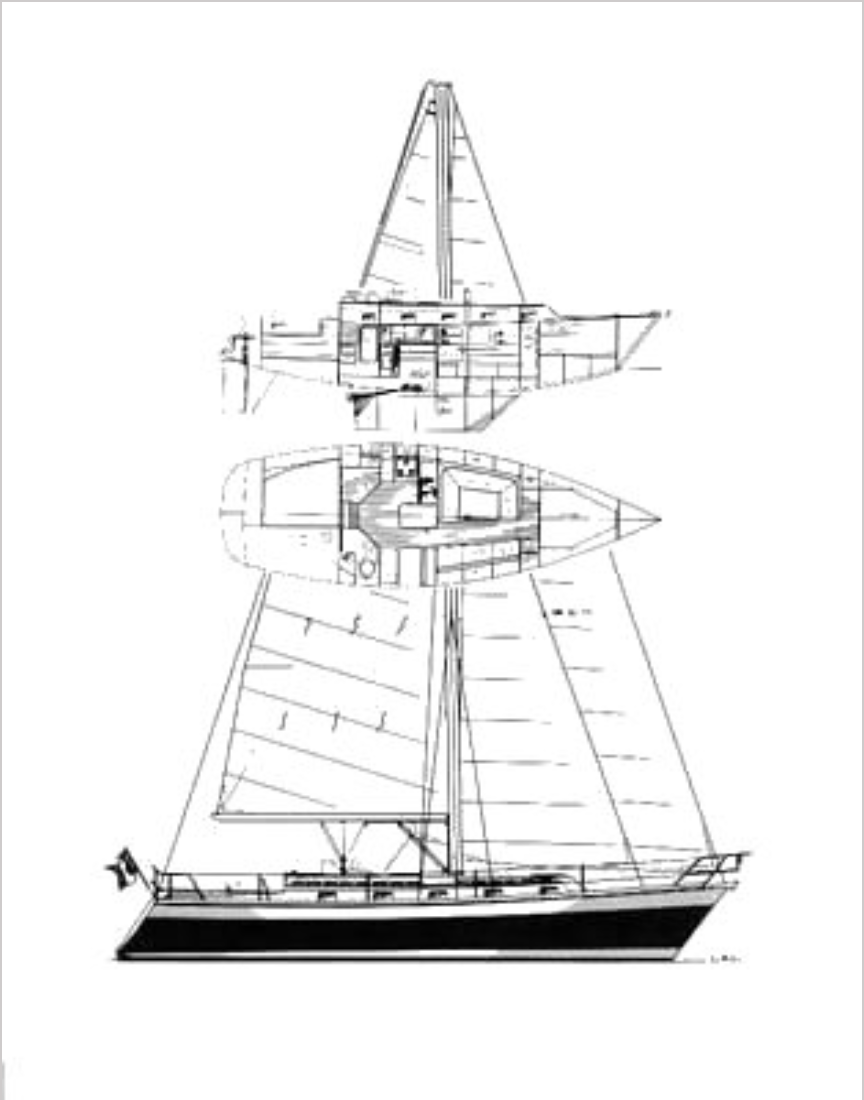
The 37 carries a fin keel with the rudder mounted on a skeg, a cutter rig, and a 5 ft 6 in draft, on a hull built entirely of welded steel rather than the fiberglass that dominates most of this catalog. At just over 20,000 lb displacement and a ballast ratio of 34 percent, it is built to a conservative, offshore-oriented brief typical of steel cruising designs from this era, prioritizing structural toughness over light-air speed. A distinctive feature the designer’s own site calls out across the Amazon family, including this model, is a stepped transom detail that the designer says was widely copied by other builders afterward.
The standard auxiliary is a Perkins 4-108, a 50 hp naturally-aspirated diesel that was a common workhorse choice for steel and fiberglass cruisers of this era. Tankage runs to 80 gallons of fuel and 120 gallons of water, generous enough for real offshore passages rather than coastal cruising alone. Hull speed works out to 7.76 knots on the 33.5 ft waterline.
Under Sail
A capsize screening figure of 1.76 and comfort ratio near 33 describe a stiff, offshore-capable hull with a settled motion. Owners discussing the 37 specifically on an online forum describe her as “seaworthy but relatively heavy displacement, and many would say undercanvassed,” consistent with those numbers: capable rather than quick. No independent, named-vessel account of an Amazon 37 completing an ocean passage was found across two research passes; the designer’s own site credits the wider Amazon series generally with “many circumnavigations,” which stays marque-level reputation rather than documented evidence for this specific hull.
Buyers Notes
Real owner-community sentiment on this specific model, from a 2011-2012 discussion among a prospective buyer and two posters with hands-on experience, is worth reading before pursuing one: corrosion, especially around the ports, was flagged as a real and ongoing concern as the boats age, the builder has been out of business for years, and steel hulls in general carry resale-value headwinds in the North American market. One experienced poster’s summary: “not a bad boat, but you can certainly do better.” None of this means the design is unsound, the same thread calls the boats genuinely seaworthy, but budget for a steel-specific survey (coating condition, plate thickness readings, tankage and through-hull condition below the waterline) rather than a generic fiberglass one, and go in with realistic expectations about resale liquidity given how few were built. Sail area is not documented in any source found across two research passes; get it from the actual rig or sail inventory of any specific hull under consideration. Given the conflicting production-count figures, confirm any specific hull’s build year and history directly rather than assuming either the ~8 or the 17 figure describes the total run precisely.