Overview
The Valiant Esprit 37 has carried three names across its production life: introduced by Valiant Yachts in 1977 as the “Esprit 37,” built by a new company called Nordic Yachts, then renamed “Valiant 37” after Uniflite acquired Valiant around 1980, before eventually evolving into the Valiant 39 with a 2 ft bowsprit added to the rig. Robert H. Perry designed it as a smaller companion to the already-successful Valiant 40, applying the same hull formula to a 37 ft platform with a sleeker cabin trunk and a brighter interior.
History
Valiant Yachts commissioned the design in 1976, three years after the Valiant 40’s launch, looking to diversify into smaller boats. Rather than build it at Uniflite (already producing the 40), Valiant chose Nordic Yachts, a new company headed by Steve Nordvelt, whose father had founded Uniflite. Around 1980, Uniflite itself acquired Valiant and moved Esprit 37 production in-house, renaming the boat the “Valiant 37.” Uniflite-era hulls share the same non-osmotic blistering problem documented on the Valiant 40, caused by a fire-retardant Hetron resin reacting with the fiberglass layup; the issue was resolved industry-wide around 1982-84 with a switch to isophthalic resin, by which point Valiant had changed ownership again and moved production from Seattle to Texas. The design was eventually superseded by the Valiant 39, which added the bowsprit, a boxier deck molding matching the Valiant 40/42, and a revised interior. Roughly 50 hulls were built under the Esprit 37/Valiant 37 name.
Design and Construction
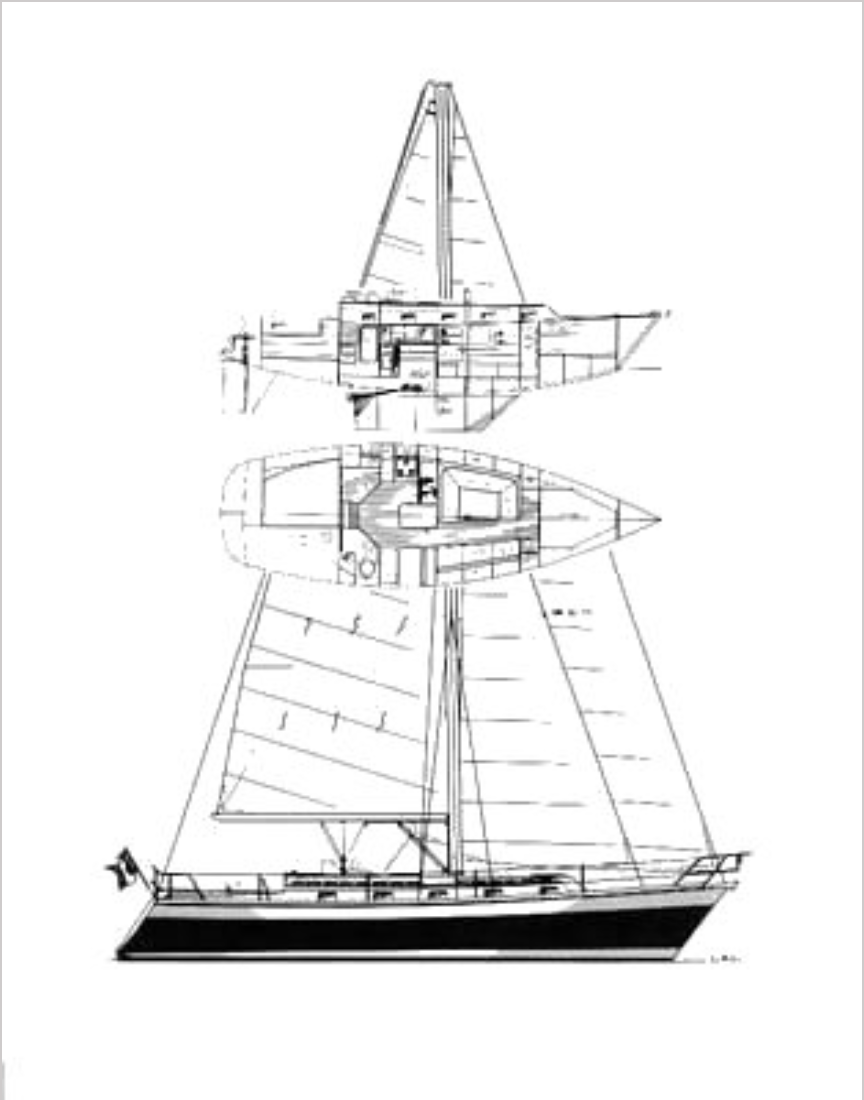
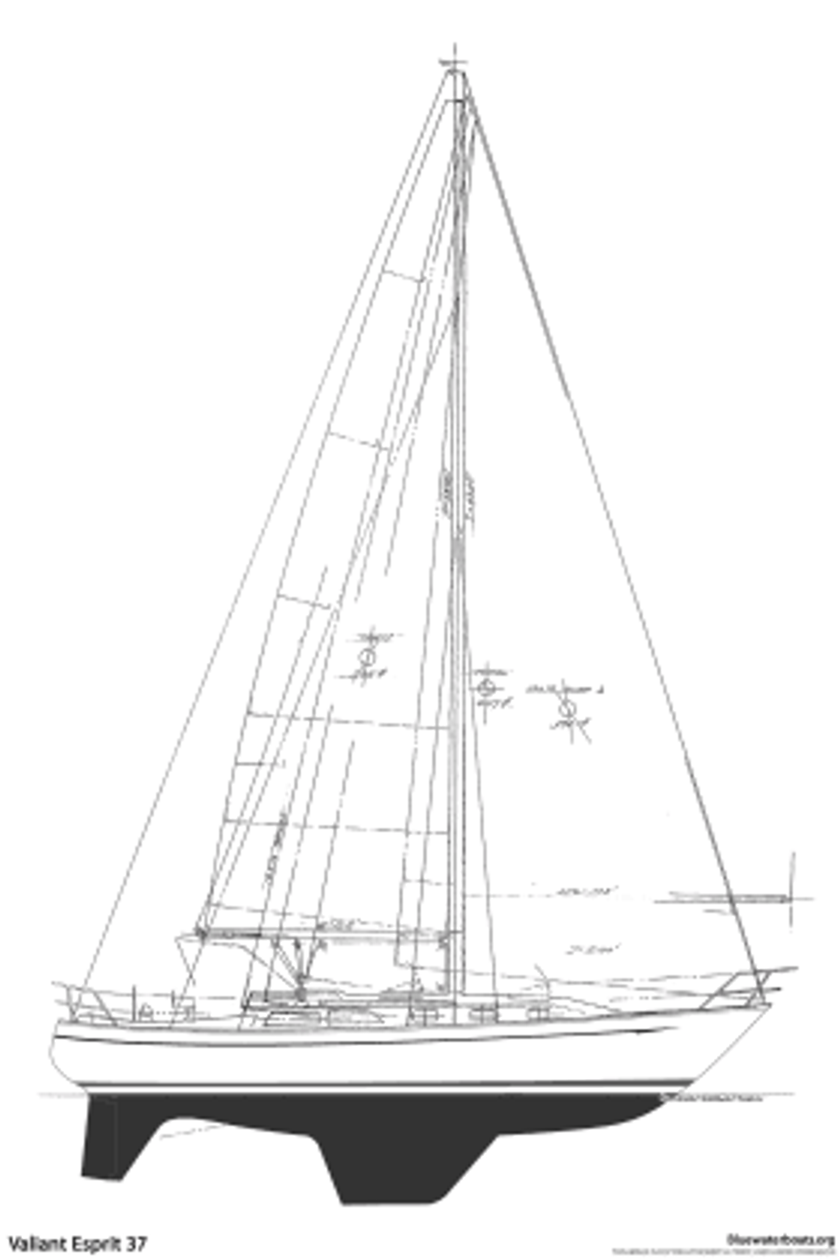
Below the waterline, a cruising fin keel and skeg-hung rudder replace the Valiant 40’s fuller sections with a flatter run, making the 37 noticeably more nimble through a tack. On deck, a sleek raked cabin profile departs from the 40’s boxier trunk, and a relatively tall rig with a high-aspect mainsail on a short boom reflects the IOR racing influence of its era; aft-led shrouds restrict how far the boom can swing on a run, a real tradeoff for the upwind performance that rig geometry buys.
Construction follows Valiant’s standard hand layup, 1.5 oz fiberglass mat between layers of 24 oz woven roving, with a half-inch closed-cell foam liner above the waterline for thermal and acoustic insulation and reduced condensation. The deck is balsa-cored fiberglass, through-bolted to the hull, with aluminum backing plates on deck hardware. Early hulls used stainless wire rigging; later boats offered rod rigging as an option. Nordic-built hulls vary somewhat boat to boat, including the exact bulkhead placement in the V-berth.
Below deck, the layout is well thought out for its size: a U-shaped galley to port opposite a quarter berth and navigation station to starboard, an L-shaped settee forward to port that converts to a double, and a single-berth settee opposite. The saloon table seats six and folds away against a bulkhead, though the keel-stepped mast intrudes slightly into that space. The head, between the saloon and the V-berth, has its own shower stall with pressurized hot and cold water. Engine access under the companionway steps is good; the boat came standard with a 30 hp Westerbeke, and many owners have since repowered with a 37.5 hp Beta for more usable power.
Under Sail
Owners report the 37 as nicely balanced, quick through a tack, and comfortably dry in the cockpit, closer-winded than most cruising boats of its era thanks to its high-lift rig, though the restricted boom swing costs it some speed on a dead run. Bob Perry himself has noted it can outrun a Valiant 40 in light air. An unnamed owner reported 115-mile days over a 22-day passage in light 12-knot trade winds, beating a 42 ft medium-displacement cruiser by 7 days, an anecdote worth noting but not independently verified. In heavier conditions, the boat carries the same composed, comfortable motion associated with the rest of the Valiant line.
Buyers Notes
Uniflite-built hulls (roughly 1980-82) are the ones affected by non-osmotic blistering; Nordic-built early hulls and later boats built after the isophthalic resin switch (around 1982-84 onward) are not. Weak chainplates on earlier boats are worth checking for leaks and delamination. Aluminum fuel tanks, and aluminum water tanks on some boats, have not aged well and should be inspected for corrosion. Boats with rod rigging benefit from a rigger’s inspection for stress cracks, and any repowered engine installation should be checked, since some larger-engine conversions moved the companionway forward at the cost of cabin space. Few Esprit 37/Valiant 37 hulls come to market at any given time, so comparisons across listings should account carefully for year, condition, and equipment.