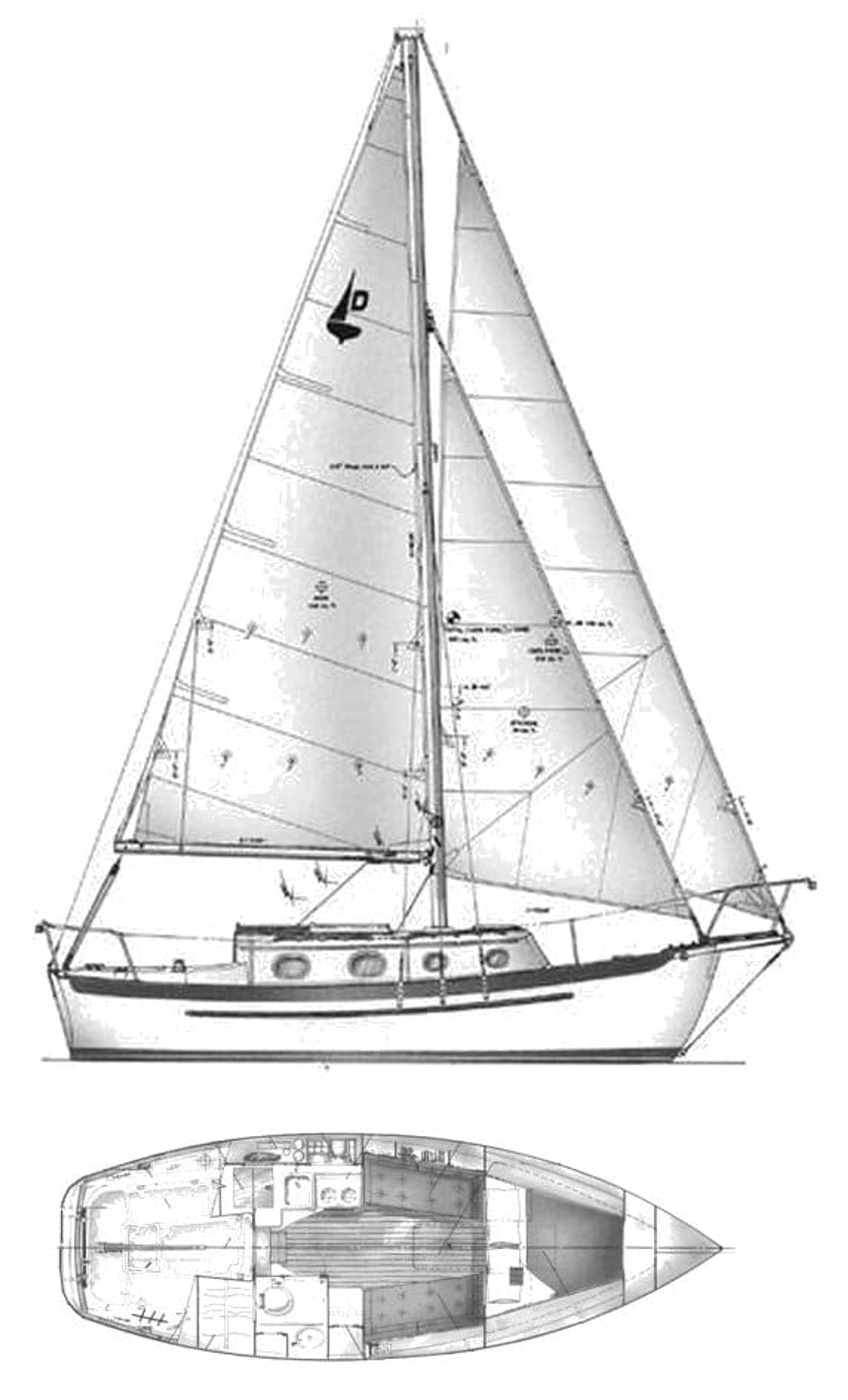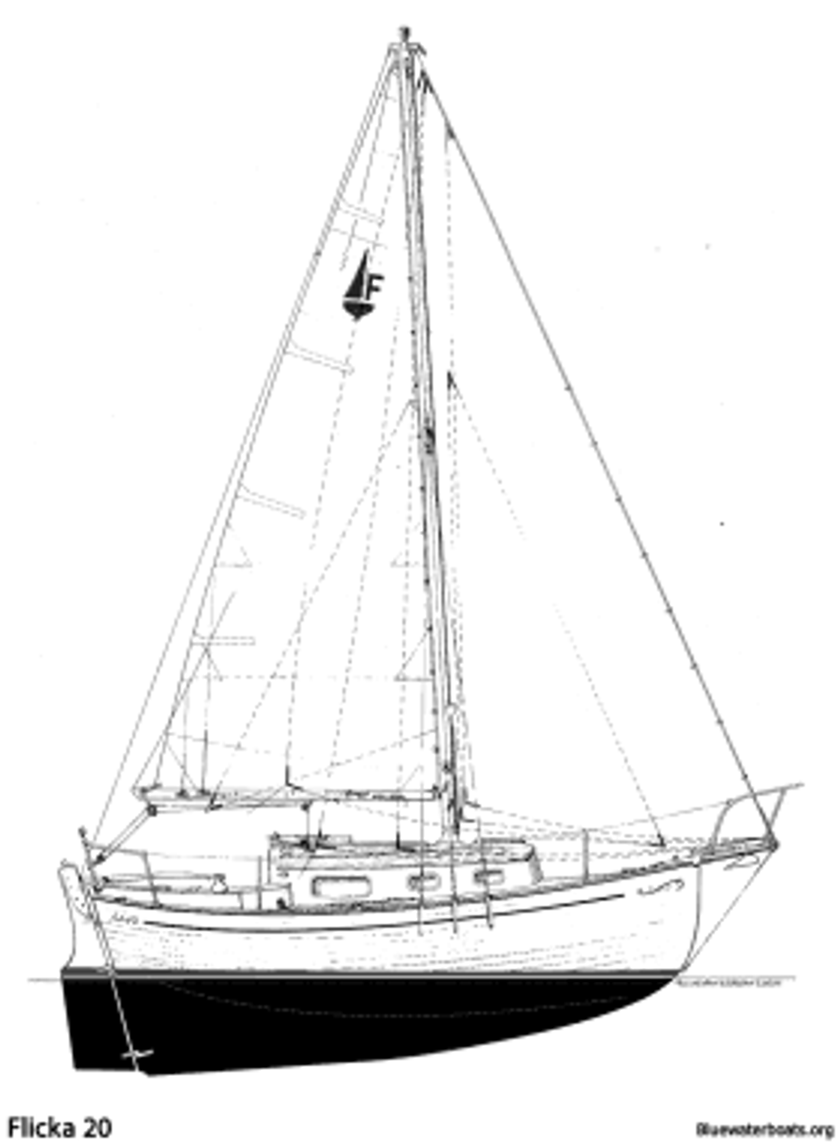
Overview
At just 20 feet on deck, the Flicka is about as small as a genuine bluewater cruiser gets. She has crossed oceans, weathered severe storms, and survived reef groundings with minimal damage, yet is compact enough to trailer home between passages. Designed by Bruce Bingham after the lines of 19th-century Newport workboats, the Flicka was originally a home-build design before reaching production first through Nor’Star and then Pacific Seacraft.
History
Bingham’s line drawings first appeared in Rudder magazine in March 1972, but the design traces back to the 1950s, when he sketched two derelict wooden workboats he found on a river near Wickford, Rhode Island. Locals called them Newport boats, in service since 1840 fishing the stormy waters of Block Island Sound, and prized for bringing their crews home safely. Bingham reworked their lines into the Flicka, keeping her at 20 feet specifically to stay affordable for home builders; over 200 sets of plans sold in the design’s first five years, mostly built in fiberglass though at least one in carvel-planked wood. Nor’Star Marine began producing GRP hulls in 1975, subcontracting completion to Westerly Marine; that partnership produced what many consider the most beautiful Flickas built, before Nor’Star closed in 1977. Pacific Seacraft bought the tooling in 1978 and built the design until 1998, completing 434 hulls with the brand’s characteristic hand-crafted interiors, modifying the cabin trunk crown and relocating the deck hatch along the way. Pacific Seacraft itself went bankrupt in 2007; the Flicka molds and tooling were later bought at auction and briefly revived, though a 2001 relaunch attempt never filled its minimum order and the design has not returned to production since.
Design and Construction
Because the Flicka began as a home-build design, early hulls vary widely in material and finish. Pacific Seacraft’s production boats are hand-laid fiberglass, early hulls in polyester resin, later ones in osmosis-resistant vinylester, bonded to a single fiberglass interior pan lined in teak. The deck is balsa-cored fiberglass, with plywood coring specifically under through-deck hardware. Pacific Seacraft used quality bronze fittings and mounted outboard chainplates through the hull onto stainless steel backing plates; after 1980, enclosed heads with holding tanks became standard, and later boats added bronze portlights and an inboard engine. The mast steps in a stainless tabernacle, a genuinely practical touch that makes trailering and quick raising or lowering straightforward.
Under Sail
Given her short waterline, heavy displacement, and small rig, the Flicka sails better than her numbers suggest: Good Old Boat describes her tracking upwind “as though on rails,” often hands-off for long stretches. Pacific Seacraft cites 5-knot passage averages as unremarkable, with owners reporting 4 to 5 knots typically and over 6 on a good reach. Light air is her weak point, many owners carry a drifter for it, and her bluff bow and wide beam can make for a wet ride to windward. With wineglass sections and a 32.7 percent ballast ratio she’s tender by modern standards and can develop weather helm, but her motion is generally kind and she has a real reputation for keeping her crew safe in a genuine blow.
Buyers Notes
Check the hull-to-deck joint at the teak bulwark cap for leaks, a documented weak point. If the original Yanmar 1GM diesel is still installed, inspect the exhaust port for corrosion, a known issue that can eventually require a new cylinder head. Given the design’s home-build origins, confirm construction quality and material directly on any non-Pacific-Seacraft-built hull rather than assuming factory standards.