Overview
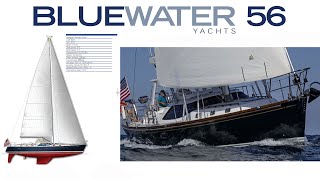
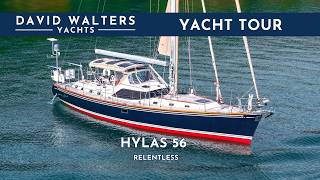
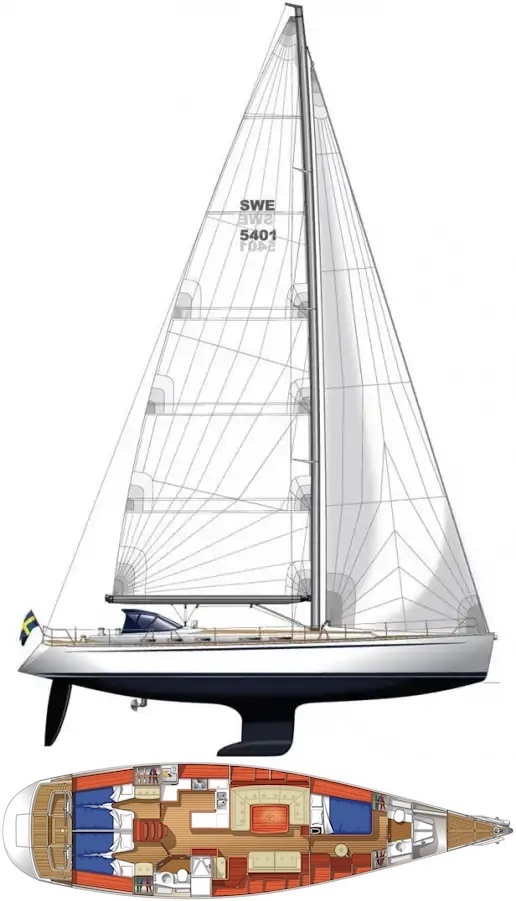
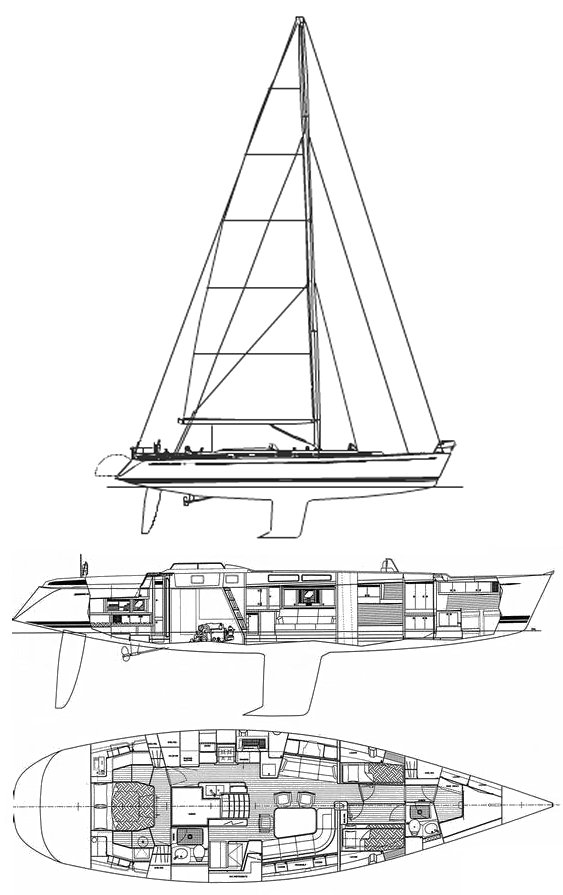
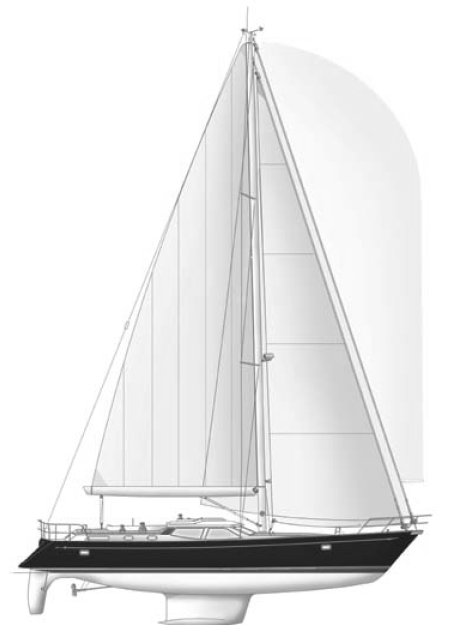
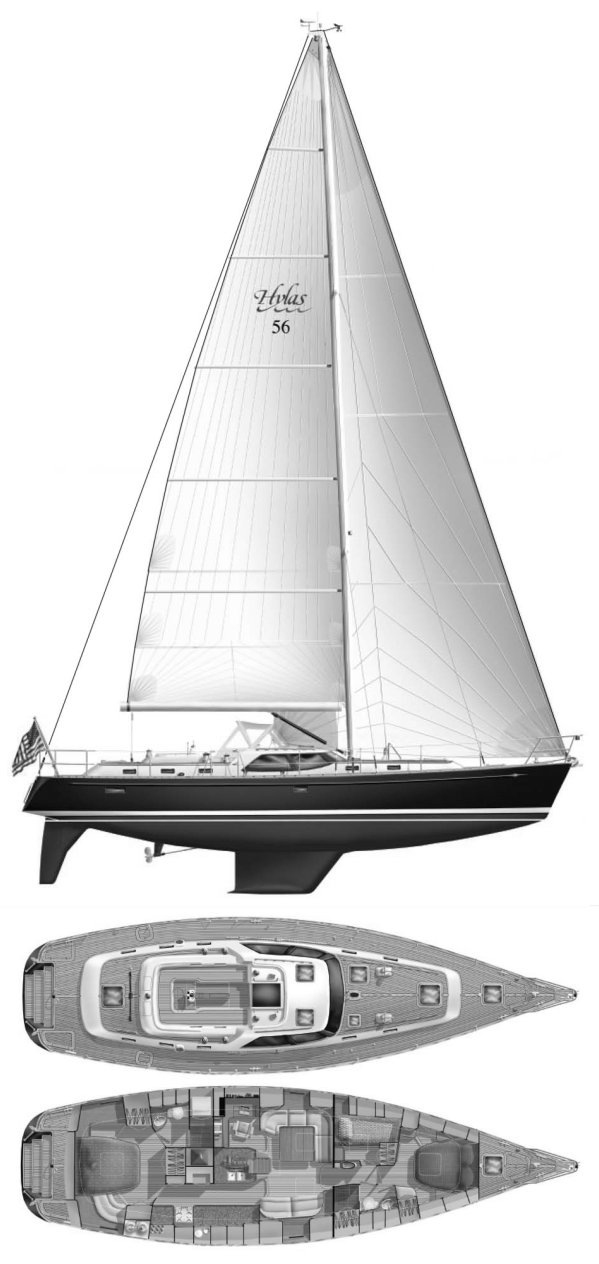
The Hylas 56 is a German Frers center-cockpit sloop built in Taiwan for Hylas Yachts from about 2011, the successor to the Hylas 54. Blue Water Sailing found it fast, powerful and set up for extended cruising.
Design and Construction
The hull is hand-laid glass with alternating layers of Twaron aramid in vinylester resin, an isophthalic gelcoat and two epoxy barrier coats below the waterline. The keel is a lead cruising fin with a small bulb drawing 7 ft 4 in, or a keel-centerboard drawing 6 ft 4 in up, and the large rudder sits on a half skeg integral with the hull for protection from flotsam and groundings. There are two watertight bulkheads, including a forward collision bulkhead.
Under Sail
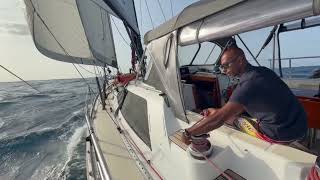
On test she close-reached at 8.5 knots under reduced sail and reached at 10 knots, 11 in the puffs, with minimal leeway. Electric winches and furling make the large sail plan manageable. Under power a 150 hp Yanmar stopped her in under three boat lengths. Cruising World’s Boat of the Year judges, sailing in 6 to 8 knots, found she gathered speed and held it; the in-mast furling main on their boat jammed at first and then worked well. They judged the accommodations safe at sea, with good handholds, brace points and lee cloths, and the systems unusually easy to reach. Blue Water Sailing’s reviewer sailed her in a rain-swept easterly on the Chesapeake with building square waves. Close hauled she settled at about 48 degrees true off the wind making 8 knots at about 15 degrees of heel, with little leeway and a stable ride. He described the helm as positive but light, with the boat tracking well with square waves under the broad transom, and gave her limit of positive stability as 125 degrees. Under power the 150 hp Yanmar moves a displacement of 50,200 pounds, and with the large rudder on a half skeg she circled in about a boat length and a half.
Buyers Notes
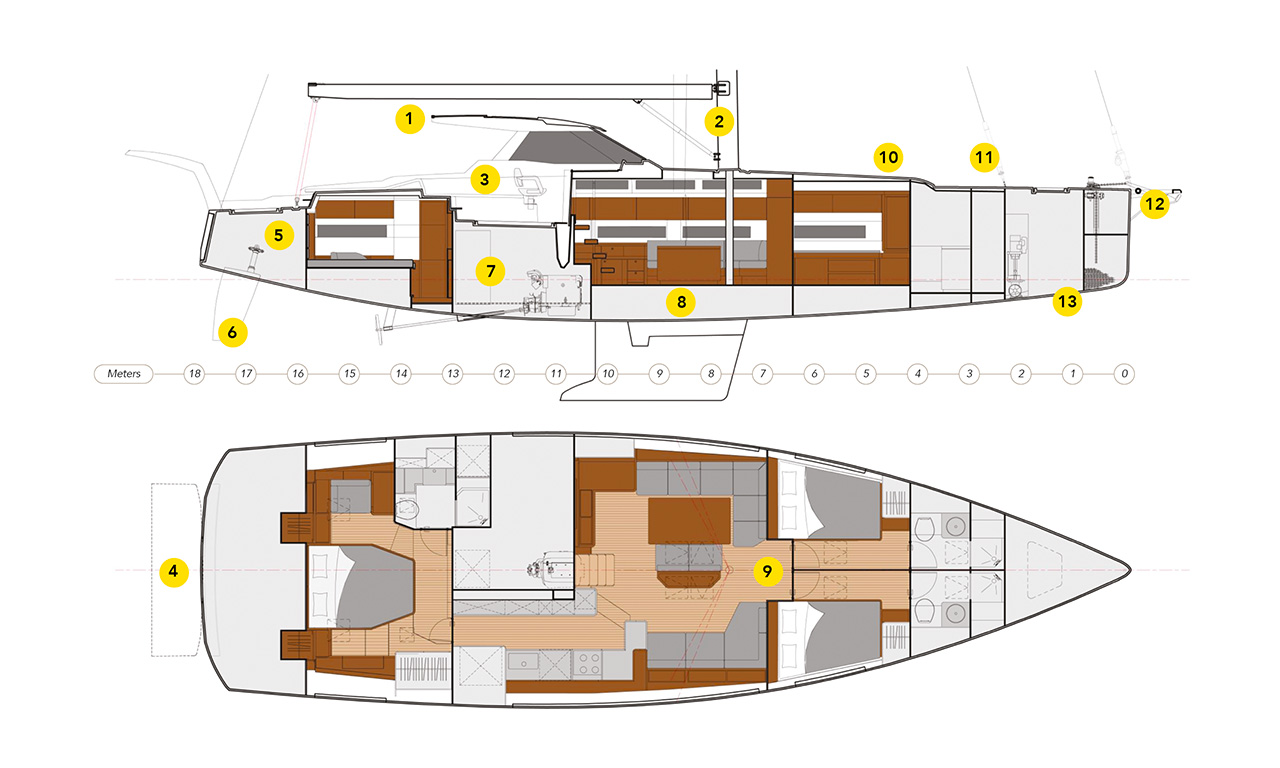
Tankage is 280 gallons of fuel and 275 of water. The rig has fore and aft lowers and Sta-Lok terminals, and the bow carries two permanent anchor rollers. Blue Water Sailing’s reviewer says the standing rigging is discontinuous Hasselfors wire with mechanical Sta-Lok fittings, both the main and the genoa have primary and backup halyards, and the anchor locker is divided for two complete rodes. The diesel has a manual crankcase oil pump, two Racor fuel filters that can be linked or bypassed, and a set of sensors and alarms. At low revs the tankage is good for close to 1,000 miles at about 6 knots, and the standard bank is four AGM 8D batteries giving 840 amp hours of house storage.
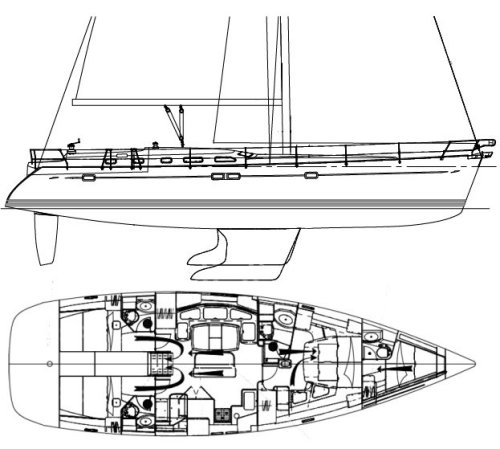
Below, the saloon has a dinette to port and a settee to starboard that will make a good sea berth, and the galley sits in the passageway to the master stateroom, with its sinks on the centerline over the engine compartment so they drain on both tacks. The master suite aft has a raised centerline double berth, the large forward guest cabin has a double centerline berth, and a command center with a wraparound desk or chart table sits just aft of the dinette. The reviewer notes that all floor pieces have positive latches so they will not come loose in rough water.