Overview
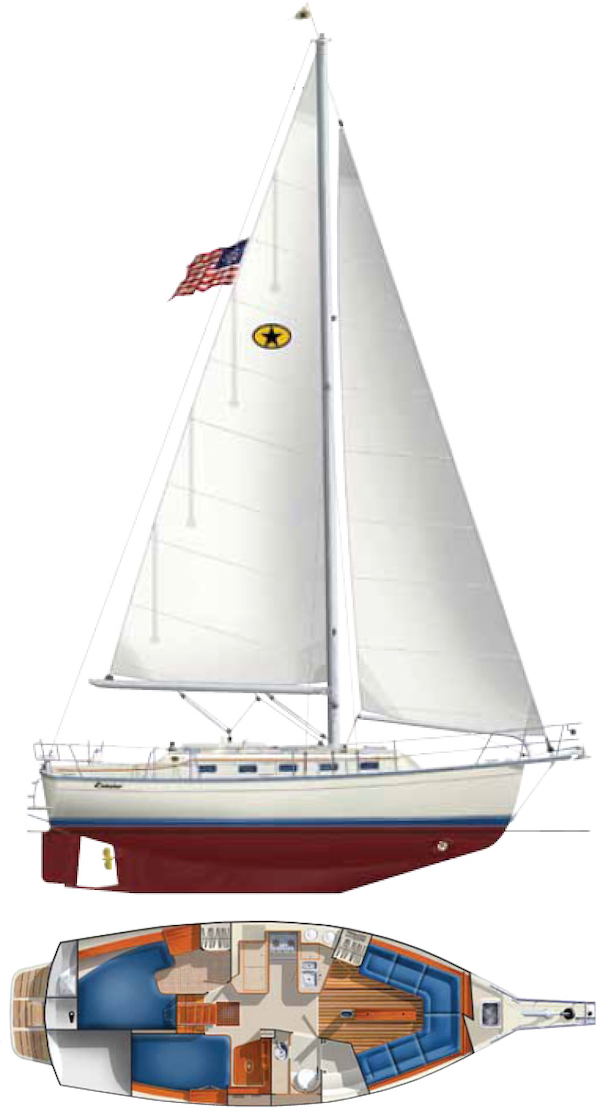
The Island Packet Estero is a Bob Johnson design introduced around 2010, a 36-foot shoal-draft cruiser with the interior space of a larger boat. It trades the usual Island Packet V-berth and cutter rig for a forward saloon and a self-tacking rig.
Design and Construction
The hull is a solid fiberglass laminate over Johnson’s patented full-foil keel, drawing 4 ft, with a low-aspect rudder; a long shoe runs from the keel to the rudder skeg to protect the propeller. Displacement is about 18,800 lb. The 60-gallon fuel tank is heavy-gauge 5052 aluminum, and the through-hulls are bronze, through-bolted to flanged seacocks. Sail’s reviewer describes a single-piece hull and keel with fully encapsulated lead ballast, a base interior molding bonded to the hull and bulkheads, chainplates bonded to the hull, and a flanged deck that is bolted and glued to the hull. Practical Sailor lists a balsa-free deck, 120 gallons of fiberglass freshwater tankage and a 35-gallon holding tank under the cabin sole, and notes the Estero drops the teak caprail that earlier Island Packets carried.
Under Sail
Both the jib, on a boom set from the bowsprit, and the in-mast-furling main are self-tacking. Practical Sailor saw a best sustained 6.3 knots at 110 degrees apparent in about 10 knots, tacked through 100 degrees, and found her unexciting in light wind. Under power she made 6.6 knots at 2,400 rpm. At full throttle, 3,400 rpm, she made 7.3 knots. The full keel tracks well on passage but makes close-quarters handling harder, and in reverse she walks strongly toward the side of the propeller rotation. Practical Sailor’s reviewers found the Estero happiest on a reach: she averaged 5.5 knots on a beam reach in 9 knots apparent and only 4 knots broad reaching at 135 degrees apparent, which led them to suggest an asymmetrical spinnaker for light-wind areas. They found she does not like to be pinched and gives an insistent weather helm when the main is over-trimmed, and that she responds slowly but positively to the helm. Sail’s reviewer noted the boom is high enough that even a tall crew should survive a gybe unscathed, but found the traveler cleats at the wrong angle and the jib boom takes up foredeck space.
Buyers Notes
Practical Sailor’s reviewers note shallow galley sinks, a saloon berth that needs two people and filler cushions, and a swim platform that slaps at anchor. The full keel makes close-quarters handling harder; a bow thruster helps. Practical Sailor puts the Estero’s introduction at 2010 and says the cutter-rigged IP 360, first built in 2012, uses the same hull with a conventional V-berth layout and 130 square feet of additional sail area. The galley sits just aft of the mast on the port side with an overhead hatch and opening ports, which Practical Sailor called the biggest advantage of the layout. Sail’s reviewer gave the Estero a Best Boats award for accommodations design, liked the 7 foot cockpit seats, and found the guest quarter berth shelf fixed only 13 inches above cushion height, which would roll a sleeper against it when heeled on starboard tack.