Overview
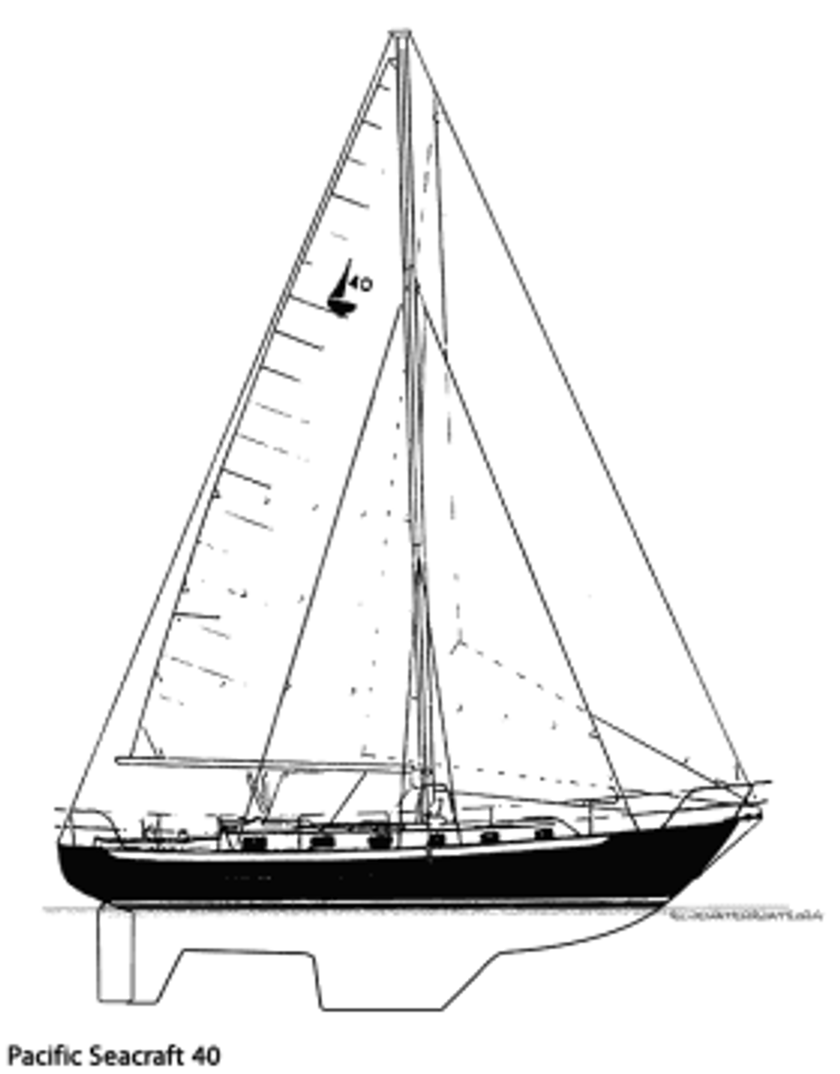
The Pacific Seacraft 40 is a William Crealock cruising design introduced in 1997. It sits between the builder’s 37 and 44, but it is not simply a stretched version of either boat. The builder describes changes to the hull shape and underbody intended to improve control and passage performance while keeping the family resemblance.
Length on deck is 40 feet 2 inches, while the pulpit and other fixed projections bring the published overall length to 42 feet 2 inches. The hull has a canoe stern, moderate beam, a fin keel, and a large skeg ahead of the rudder. A smaller ventral fin fills part of the gap between the main keel and skeg. Crealock’s stated priority was a boat that a small crew could control when conditions deteriorated.
Specifications and source conflicts
The builder and SailboatData agree on the principal dimensions, 24,000-pound displacement, 8,600-pound ballast figure, and 846 square feet of reported sail area. They also agree on a 6-foot 1-inch standard draft. Pacific Seacraft lists a 5-foot 2-inch shoal option.
Robert Perry’s contemporary design review gives slightly different figures. It lists 6 feet for the standard keel, 5 feet 1 inch for the shoal keel, and separate ballast weights of 8,700 and 8,800 pounds. It also gives 150 gallons of water, while SailboatData gives 140. These may reflect design-stage numbers, configuration changes, or measurement conventions. The disagreement should stay visible rather than being collapsed into one apparently exact answer.
Construction and layout
The preserved BlueWaterBoats material describes a hand-laid fiberglass structure with vinylester resin used for moisture resistance. It reports balsa core above the waterline and in the deck, with core omitted around some high-load penetrations. The hull and deck meet at bonded, through-bolted flanges beneath an exterior rail. The same source describes bulkheads attached to both hull and deck. These are useful construction notes, but a buyer still needs the laminate schedule and build details for the individual hull.
Below, the published arrangement puts a U-shaped galley near the companionway and a double quarter berth aft. Robert Perry noted that the mast position permits access to both ends of the dinette. Pacific Seacraft offered either a conventional V-berth or an island-style double forward. The choice affects usable sea berths, access, and stowage, so listings should be checked against the actual boat rather than a generic plan.
Under sail
The cutter rig divides the working sail plan, and the separated keel and skeg place the rudder well aft. The published displacement-to-length figure is on the heavy side. That points toward steady passage behavior rather than quick acceleration in light air, but ratios are only a comparison tool. Perry also noted that the mast’s position could make balance sensitive to sail combination. A useful sea trial should therefore include reefed configurations, staysail use, and self-steering rather than only full sail in flat water.
Gar Duke and Nicole Friend completed a four-year circumnavigation aboard the Pacific Seacraft 40 DreamKeeper, closing their outbound track in Banderas Bay in May 2011 after an earlier 3,000-mile passage from Puerto Vallarta to French Polynesia. Latitude 38 reported the completion, and a separate interview with the couple independently names the same boat, route, and outbound passage, a second, independent account of the same voyage rather than a restatement of the first.
Buyers Notes
Start by identifying the keel option and checking the actual ballast, tankage, and rig against the build record. Inspect the cored hull and deck around hardware and other penetrations, then examine the hull-to-deck joint, chainplates, mast support, steering, skeg, and rudder bearings. These are inspection points derived from the construction, not reported model-wide defects.
The 40 carries the loads and maintenance costs of a substantial cruising boat. Sail handling equipment, emergency steering, tank access, ventilation, and machinery service space deserve as much attention as the finish below. Records from the specific hull matter because the sources do not establish a final production year or show that every boat left the factory with identical systems.