Overview
John Brandlmayr designed the Spencer 35 as a semi-custom bluewater cruiser, and her offshore record backs up the brief: Hal Roth’s Whisper, probably the best-known Spencer 35 of all, carried the noted cruising author across multiple oceans and into several of his own books. Spencer Boats Limited built 64 hulls in Canada over a production run that stretched past two decades.
History
Spencer Boats started building molded fiberglass sailboats in 1958 with the Spencer 28, working out of a yard in Richmond, British Columbia, on Canada’s west coast. The line eventually grew to include models up to 53 feet, but the 35, introduced in 1962, became the best-known of the range.
Hal Roth’s cruising books, now considered classics of the genre, did a lot to build that reputation, chronicling his and wife Margaret’s voyages aboard Whisper, a Spencer 35 built for them in 1966.
John Brandlmayr, who co-founded the company and designed most of the Spencer line, died suddenly in 1974; his business partner Phil Hantke followed a few months later. Brandlmayr’s wife Pat, who had been part of the business from the start, kept the company running for the next decade with help from their son Grant, later a naval architect in his own right, and the yard’s skilled crew.
Spencer Boats didn’t survive the early-1980s downturn that closed many builders of the era, and production of the 35 ended in 1983.
Under Sail
For a traditional-looking hull, she’s surprisingly nimble and responsive. Moderate displacement, a narrow beam, and slack bilges make her tender initially, but she stiffens up firmly by 25 to 30 degrees of heel, backed by a capsize ratio of 1.68.
She behaves well on every point of sail, with some roll downwind in a heavy following sea, and doesn’t point as high as more modern designs. Upwind performance is respectable and she stays smooth through chop, though her low freeboard and heel angle can make for a wet ride. Her motion comfort ratio of 32 reflects a genuinely seakindly boat, not built to win around the buoys but a strong long-distance performer, evidenced by Haulback’s overall win in the 2002 Singlehanded Transpac.
Configuration and Construction
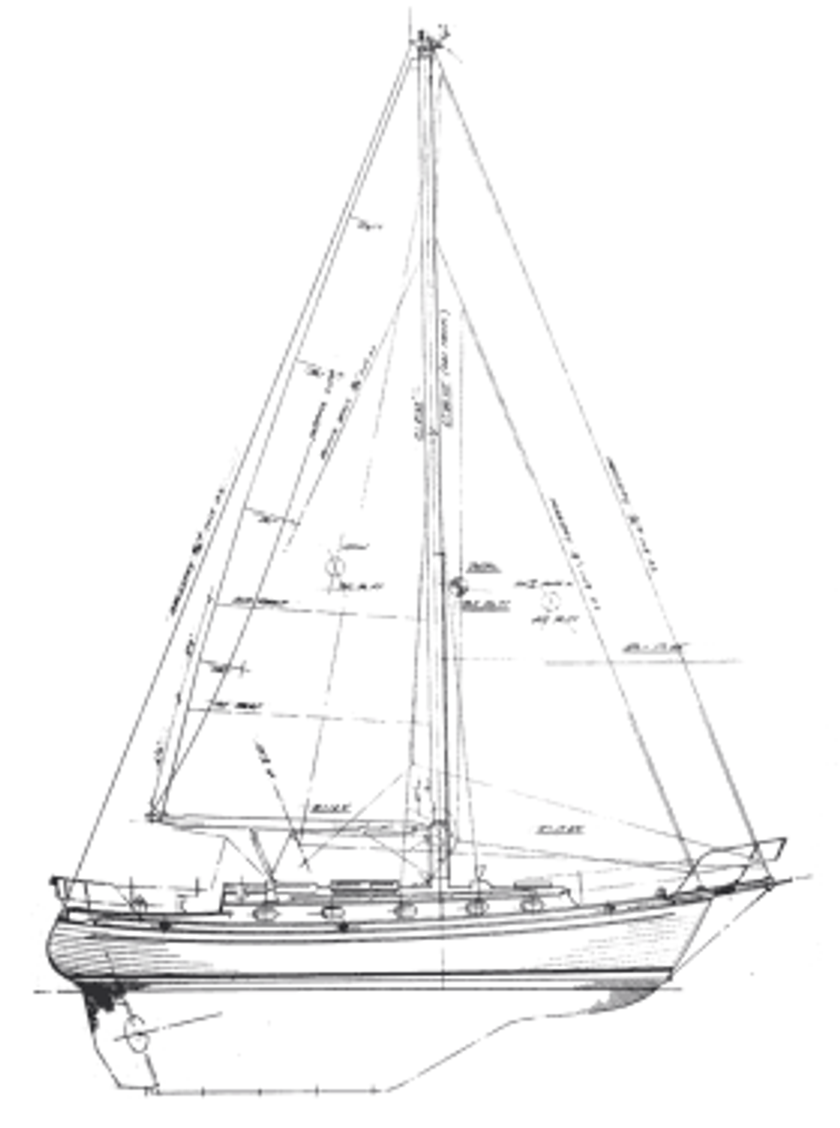
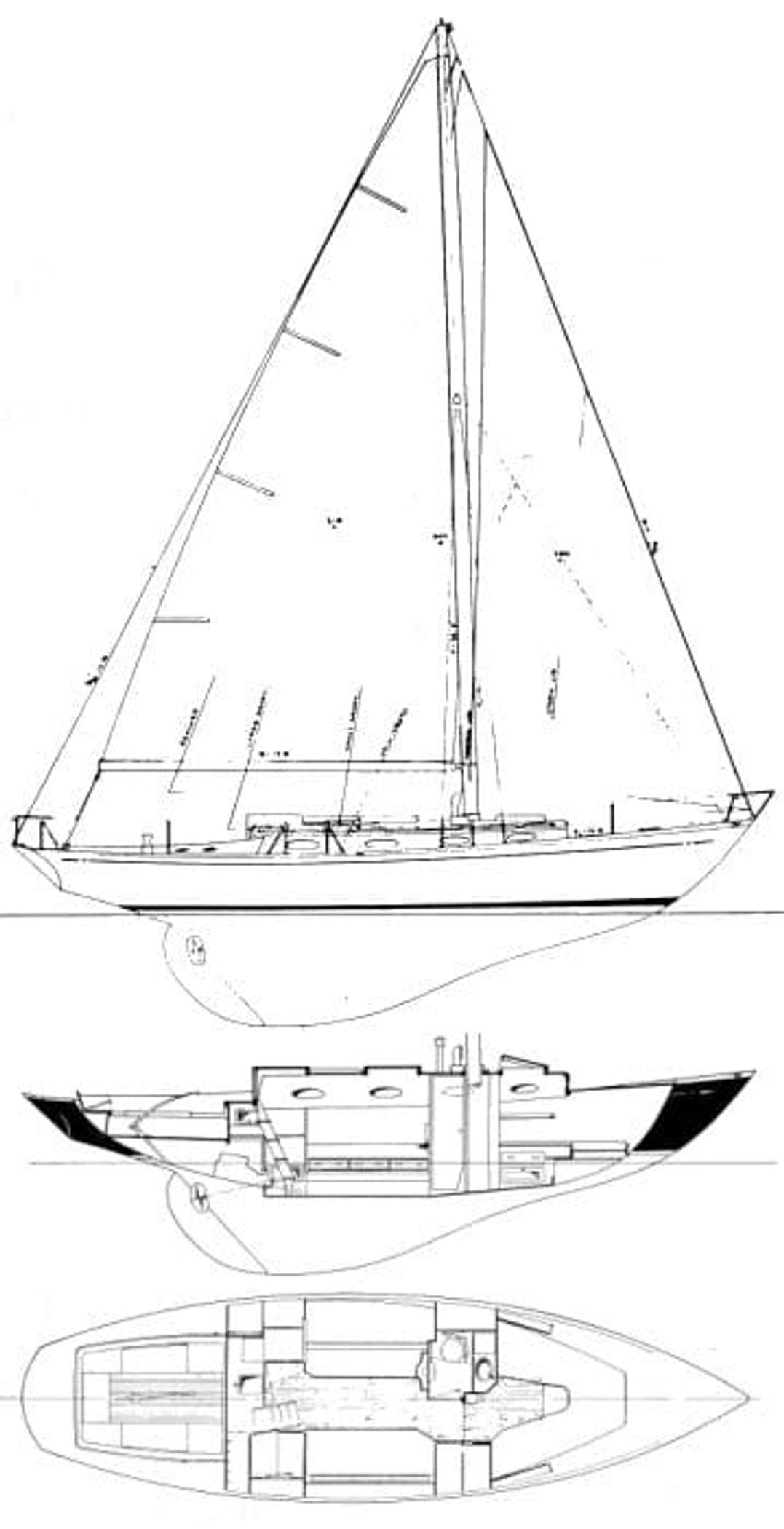
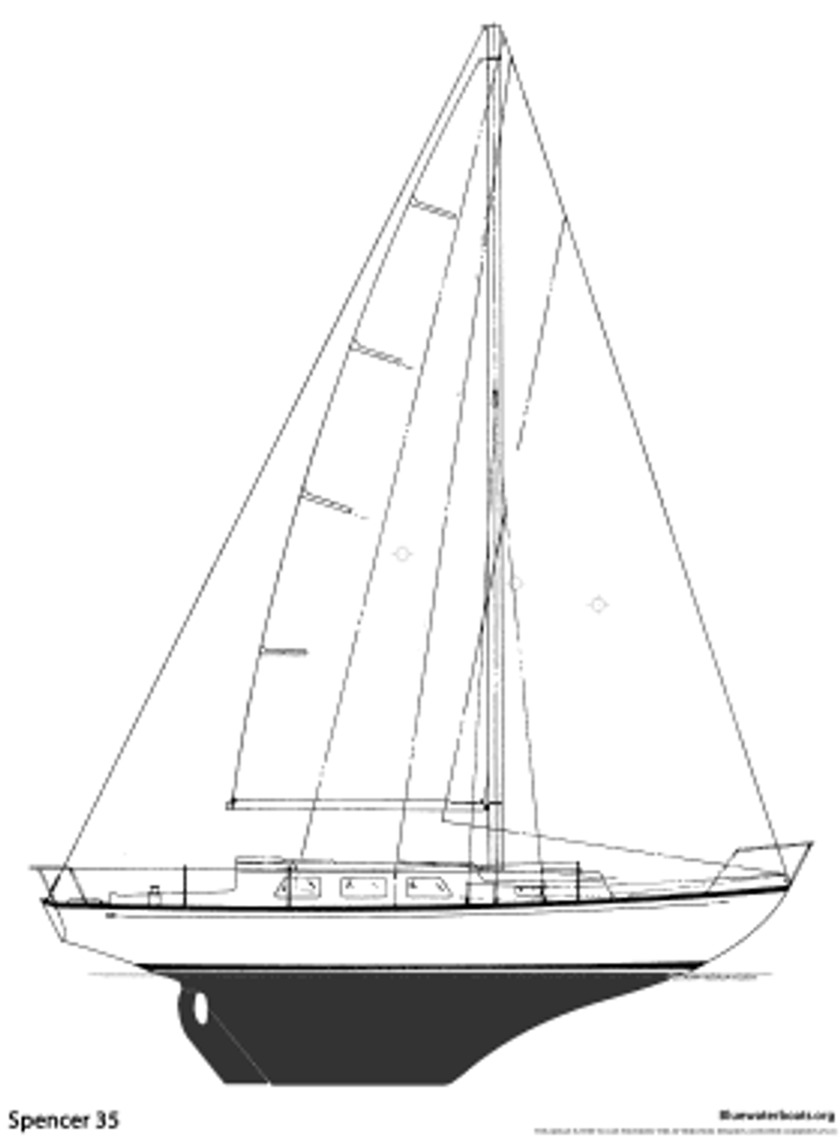
She’s a handsome, traditional design: 35 feet overall, 12,000 pounds displacement, a full keel cut away at the forefoot, and a rudder hung directly off it. Her beam runs a narrow 9’6”, and her 25-foot waterline lengthens substantially under heel. Wineglass sections and roughly 4,500 pounds of encapsulated lead ballast (though Good Old Boat’s own saildata gives a slightly lower 4,200 pounds) fill out the underbody. Standard rig was a sloop, with cutter and ketch options; tiller steering was standard, though a wheel shows up occasionally.
Spencer-built yachts have a strong reputation for construction quality. Bulkheads and deck were bonded to the hull while it was still in the mold, keeping the hull true and undistorted, and the hull-deck joint is heavily glassed into a genuinely monocoque structure. Bulkheads bond to both hull and deck, and the furniture bonds to the hull too, adding further stiffness.
The wineglass sections leave usable bilge volume, which is where both the fuel and main water tanks live, keeping that weight low and freeing up storage above the cabin sole. Tanks are molded fiberglass, glassed permanently into place.
The Spencer 35 Mark II, introduced in 1974 (with some updates showing up on earlier hulls too), changed the design meaningfully: prompted by what Hal Roth learned aboard Whisper, the cabin grew 30 inches aft, shrinking the cockpit into something better suited to ocean cruising while opening up real room below. The Mark II also picked up a redesigned rudder and a higher-aspect rig.
Construction changed too: the Mark II moved to an Airex-cored hull rather than the original’s solid fiberglass, part of Spencer’s early adoption of cored construction, which has reportedly held up well over time. Coring runs from a few inches below the sheerline down to the turn of the bilge, solid glass below that point, with end-grain balsa in the deck. The Mark II also swapped the earlier teak toerail for a heavier fiberglass one.
Layout and Interior
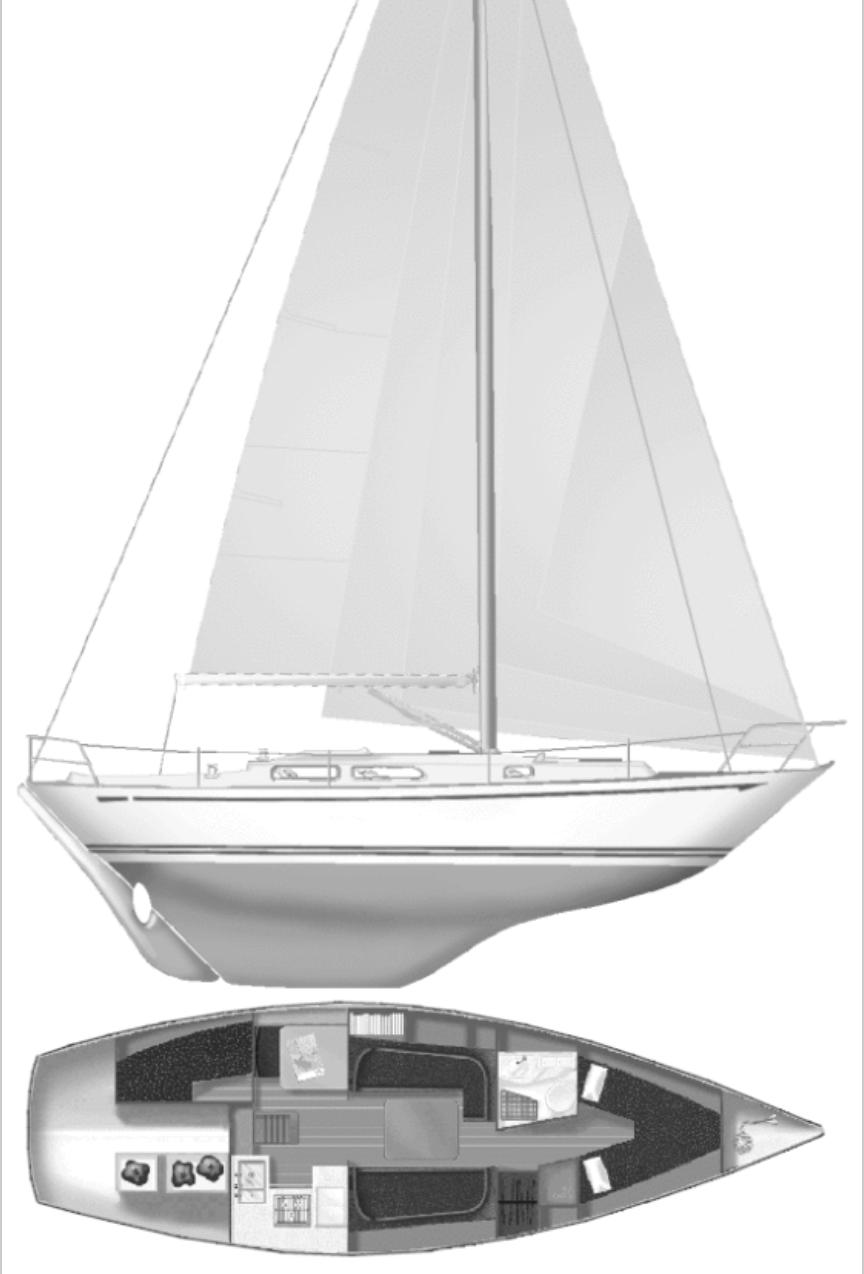
Because she was built semi-custom, there’s no single standard interior; each hull was finished to its original owner’s wishes rather than off a fixed production template. That said, a common arrangement puts a V-berth forward, a roomy head on the starboard side, and a hanging locker to port, with a narrow saloon typically holding two settees around a centerline table, though some boats use a single U- or L-shaped settee with an offset table instead.
Original hulls place a compact galley on the starboard quarter aft, with the chart table facing sideways to port. The Mark II’s galley is considerably roomier, good enough that designer Ted Brewer called it one of the best he’d seen on a boat this size, and adds a quarter berth plus a forward-facing chart table.
Headroom in the main cabin runs 6’4”, a bit less in the head and forward cabin, with generously sized berths throughout. Interior finish varies since some hulls were sold as kits, but yard-finished boats show attractive teak joinery to a high standard. Because of that semi-custom history, portlight placement and other hardware details can differ noticeably from one boat to the next.
Links, References and Further Reading
» Ted Brewer, Spencer 35: She’s capable of cruising anywhere in the world in comfort, Good Old Boat, Issue 38 - September/October 2004» Ferenc Mate, Best Boats to Build or Buy (1982), Chapter 23 (focuses on the Spencer 1330, but also addresses the Spencer 35 and Spencer yachts generally)» Hal Roth, Two on a Big Ocean (1972), After 50,000 Miles (1977), Two Against Cape Horn (1978), Always a Distant Anchorage (1988)» Marianne Scott, Bluewater Spencer: A baby-blue Mark II Spencer 35 heads for the horizon, Good Old Boat, Issue 38 - September/October 2004» Spencer Yacht Owner’s Association’s Facebook Group