Overview
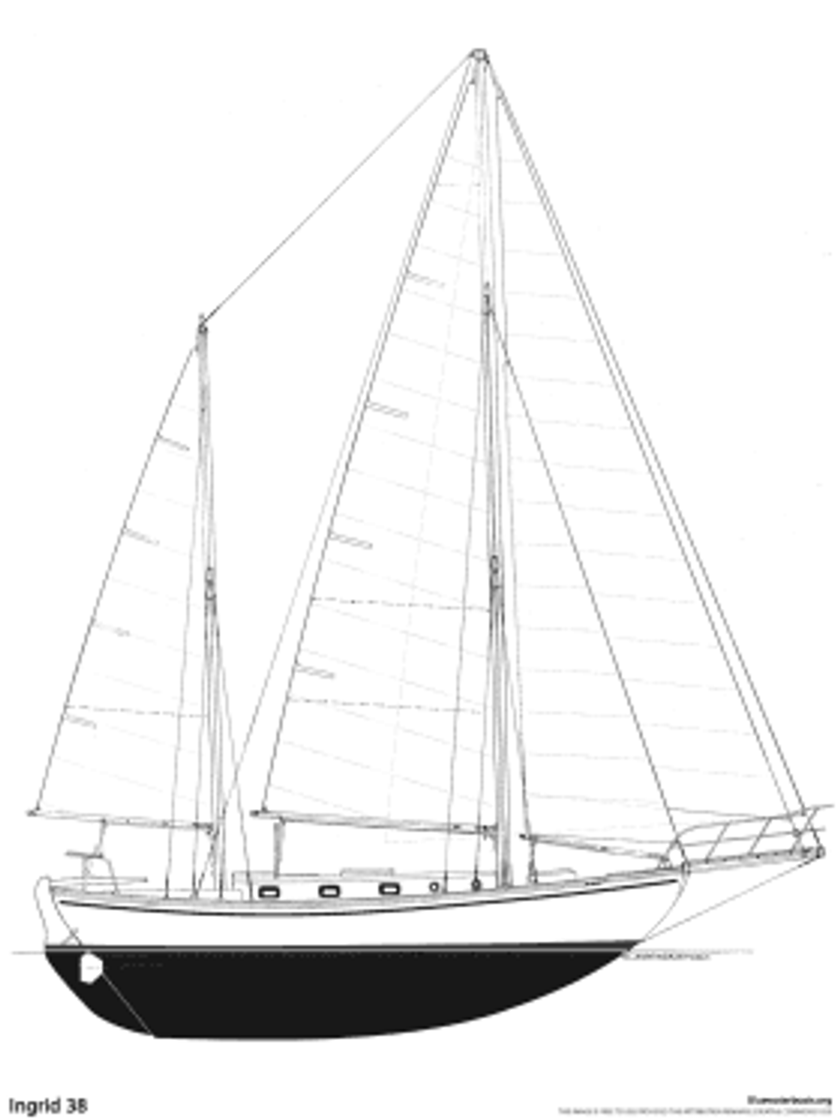
William Atkin drew the Ingrid 38 as a double-ender in the Colin Archer tradition, itself rooted in Viking hull forms known for behaving well in heavy weather. Atkin’s own description holds up: a boat that “behaves herself in rough water and can be depended upon to sail herself,” and owners consistently report the same one-finger-on-the-tiller tracking and comfortable motion. Rigged length overall with bowsprit and boomkin runs to about 47 ft; the hull itself is 38 ft.
History
Around 1934, demand for a larger ketch-rigged version of Atkin’s own Thistle 31 double-ender led him to adapt Colin Archer’s lines into the Ingrid 38. Early boats were built privately from Atkin’s plans in wood, steel, and ferrocement, but fiberglass production didn’t begin until 1971, when two Seattle sailors, James Musser and Donald Pitblado, built the plug and mold, reportedly in a converted chicken coop. Musser’s own plan was simply to build hull #1, Sandaldust, and sail off to the Pacific; enough interest from others who saw the boat led to Blue Water Boats Inc., with Pitblado himself taking hull #2, Donna Marie. Jerry Husted joined as an equal partner in 1973, freeing Musser to make good on his original Pacific cruise, then bought out the remaining shares in 1974 and continued production until about 1985. The molds were sold and stored in Graham, Washington for over a decade before Bill Ingerson bought them in the late 1990s and moved them back to Woodinville, though renewed production never found enough buyers at modern costs. Roughly one hull a month left the yard for its 10-to-12-year run, with around 140 to 143 fiberglass boats thought to exist today, plus an unknown number built from other materials off the plans. A closely related design, the Alajuela 38, uses a derivative of the same hull built to a higher standard and finished with a cutter rig, distinct from this boat’s own ketch identity.
Design and Construction
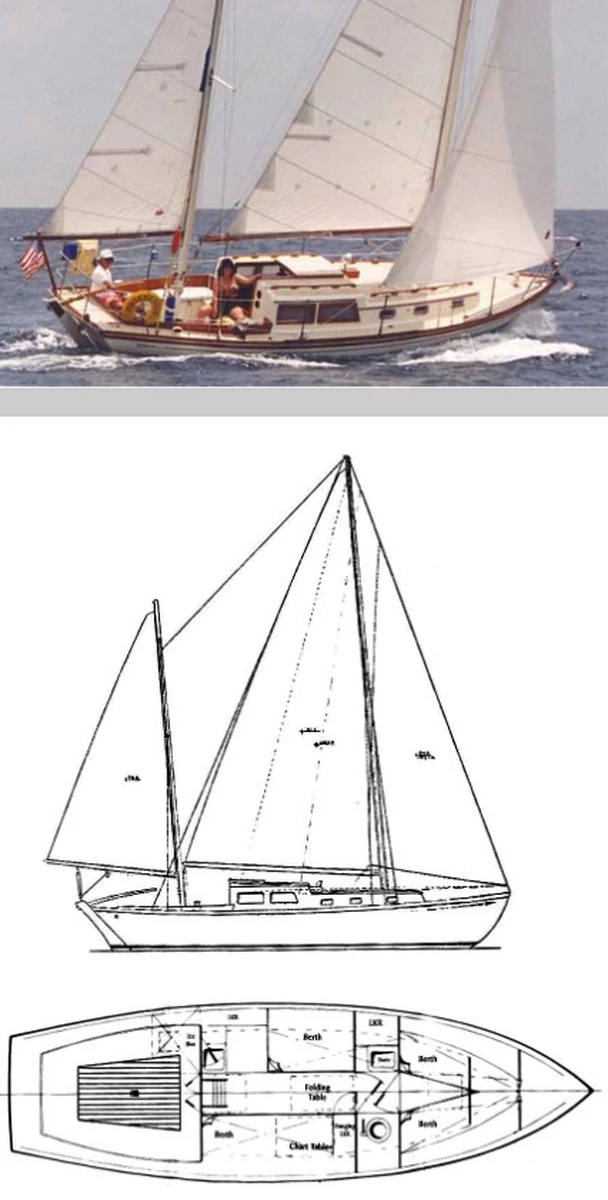
Atkin’s main departure from Archer’s original was a finer bow entry to soften the boat’s landing off waves. Below the waterline, a long full keel with deep forward V-sections keeps her stable in a seaway, and encapsulated ballast spread from bow to stern helps avoid the hobbyhorsing motion more common on fin-keel boats. The hull is heavily hand-laid fiberglass with robust outboard chainplates; the outboard rudder is protected by extra glass layup and a substantial bronze shoe casting against grounding. Most Ingrid 38s were sold as bare hull-and-deck kits and finished by their owners to a wide range of standards, including some built with cutter rigs rather than the design’s standard ketch.
Under Sail
The tradeoff for heavy displacement and strong ultimate stability is speed: the Ingrid 38 isn’t fast, but owners report she sails surprisingly well in light air, making roughly half the wind speed up to about 8 knots true. She comes into her own as conditions build. Theoretical hull speed works out to 7.2 knots, with 6 knots a more typical cruising pace. The ketch rig spreads sail area across multiple smaller sails, giving real flexibility on all points of sail and making the boat genuinely easy to handle shorthanded. Hull #1, Sandaldust, made the Pacific crossing that created demand for the design in the first place, though no further specific named ocean crossing is documented in current sources.
Buyers Notes
Production ended decades ago, so examples on the used market, mostly in the US, vary widely in finish quality given how many were owner-completed from bare kits. Confirm exactly how a specific hull was built and finished, and what rig it actually carries, before comparing it against another Ingrid 38. Current owners’ groups are the best resource for model-specific survey guidance.