Overview
The Morris 32 is a Chuck Paine sloop designed for Morris Yachts in Maine in 1987 and introduced in 1988. Paine called it a shoal-draft cruiser just large enough to range far from home. It was the first Morris to carry the builder’s logo tooled into the cove stripe.
Design and Construction
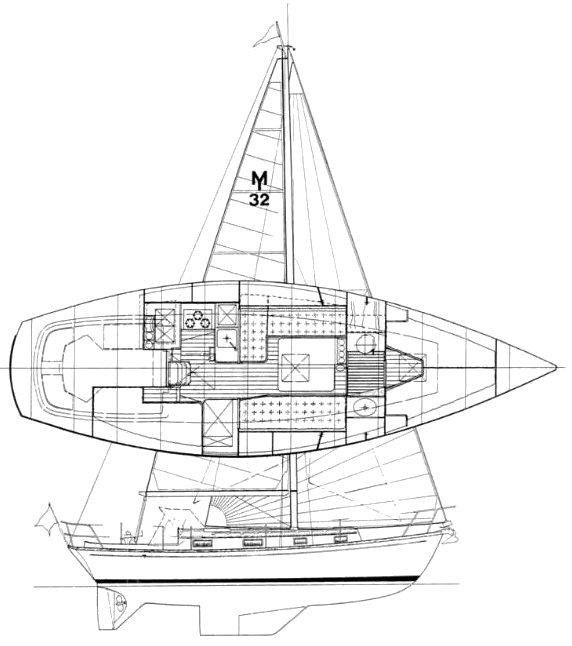
Instead of a full keel, Paine drew a Scheel keel, which keeps draft to 4 ft 3 in, and a skeg-hung rudder balanced by blade area forward of the rudderpost, a design he first used on the Able 42. Displacement is 11,400 lb at half load with 4,670 lb of lead ballast, a displacement-to-length ratio of 295. SpinSheet describes fiberglass construction with plywood bulkheads and stringers tabbed in, and just enough exterior wood and bronze ports. SpinSheet’s Jack Hornor describes round hull sections near amidships rather than wine-glass sections, with a moderately wide waterline beam for form stability and a V shape forward to reduce pounding in choppy seas. Structure comes from full and partial plywood bulkheads, longitudinal stringers and joinerwork, all tabbed to the hull with fiberglass and resin.
Under Sail
Paine wrote that the lines were moderate in every respect and that she sailed beautifully, with a rudder a bit on the small side. SpinSheet’s reviewer expected good windward ability and reasonable speed from the design, with the fin keel reducing wetted surface for better light-air performance. Hornor notes that the shrouds are well inboard so the genoa can be sheeted inside the lifelines, the side decks are wide enough for easy passage forward, and the foredeck is unobstructed with a roller at the bow for ground tackle. He also points out that Paine angled the rudderpost slightly and added blade area forward of it to balance a skeg-hung rudder, which can otherwise give heavy helm pressure on tiller-steered boats.
Buyers Notes
The interior has three good sea berths, a V-berth, a full-width head and a U-shaped galley. SpinSheet noted the 18 hp engine is small for strong winds and foul currents, engine access is only acceptable, and the cockpit seats are cut short to make room for optional wheel steering. Used prices are high for the size. The head sits just aft of the V-berth and runs the full width of the boat, with a hanging locker to port and washbasin to starboard. The saloon dining table folds up against the forward bulkhead, the galley has more counter space than is usual at this size, and the navigation table shares its seat with the port quarter berth. Ferenc Maté’s 1986 book The World’s Best Sailboats featured three Morris Yachts, all Paine designs, though the 32 came too late to be included.