Overview
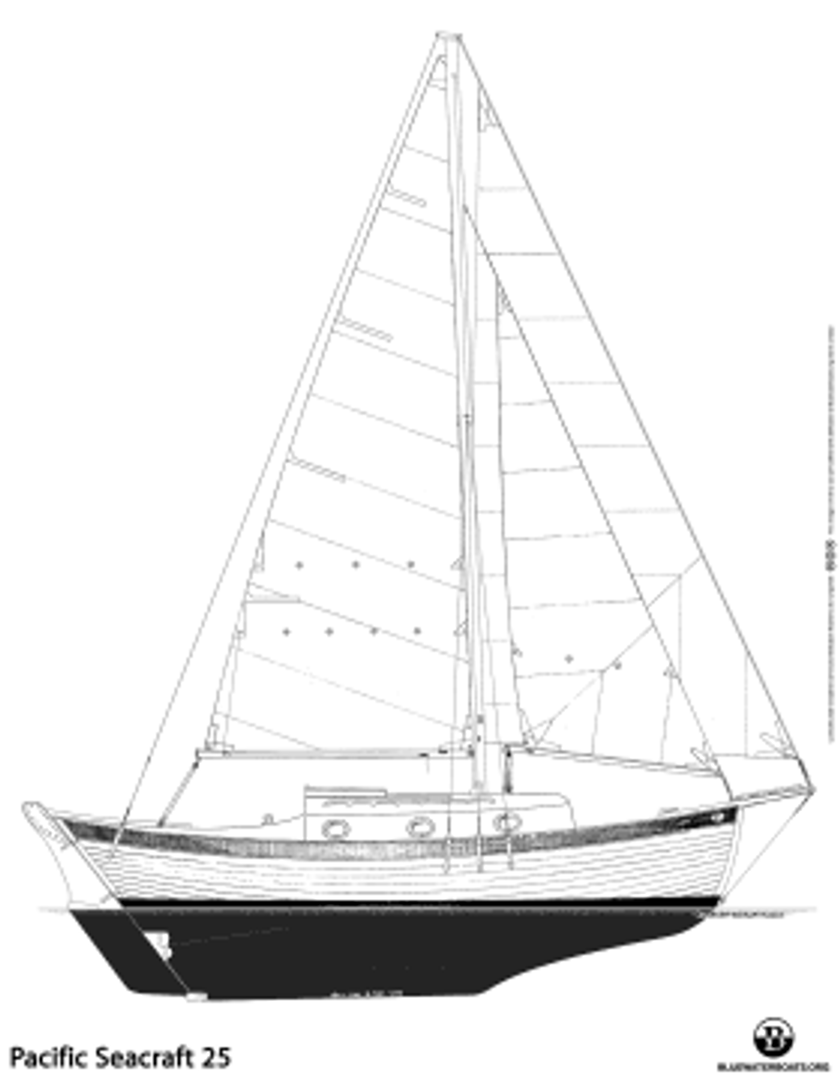
The Pacific Seacraft 25 was the first boat to carry the Pacific Seacraft name, designed by Henry Mohrschladt and first built in his own garage in Orange County, California, in 1976. The design draws on 19th-century workboats, trading speed for load-carrying capacity and heavy-weather manners, a genuinely small full-keel double-ender rather than a scaled-down coastal daysailer.
The Mark I carried a masthead sloop rig; a later Mark II added a small bowsprit and a cutter rig with a tight slot between the staysail and headsail. Beneath the waterline, a full keel with a cutaway forefoot and a transom-hung rudder gives good directional tracking, and a long, flat run along the bottom of the keel lets the boat sit upright, rather than nosing forward, when dried out on a falling tide.
Design and Construction
At 4,750 lb displacement with a 37 percent ballast ratio, the 25 is genuinely overbuilt for its size: hand-laid fiberglass hull with molded-in lengthwise planking lines, and a balsa-cored deck and cabin trunk to keep weight down while still fitting a five-foot-plus-a-few-inches of headroom below. The cockpit is sized and shaped for offshore use, with rounded corners, a stern lazarette, and a port-side locker, though its stock two-drain setup is on the thin side for serious offshore work.
Pacific Seacraft moved production from Mohrschladt’s garage to a dedicated facility in Santa Ana after the original boat sold at a local boat show and drew real interest. A wide range of factory options existed across the run, including teak decks, cockpit grates, hull color choices, and a private forward cabin with its own bulkhead and door; a handful of hulls were built with swing keels, and some were sold owner-finished. Production ran from 1976 to 1981, 157 hulls across both marks, before Pacific Seacraft replaced it in the lineup with Bruce Bingham’s Flicka 20.
Under Sail
No specific named ocean crossing was independently verified for this model in this research pass, though it appears in John Vigor’s Twenty Small Sailboats to Take You Anywhere as a genuinely capable small offshore boat. Owners report a light helm and good tracking, disappointing light-air performance that needs more sail area than the boat carries, and a real turn of speed once the wind builds past 8 knots, reaching hull speed in the 12-14 knot range. She’s tender initially, stiffening around 10 degrees of heel, with a first reef typically called for above 16 knots, and is reported to heave-to well under a reefed staysail and triple-reefed main.
Buyers Notes
The standard aluminum fuel tank, tucked in the bilge forward of the engine for a low center of gravity, is a well-known weak point: despite drip pans underneath, saltwater exposure typically causes corrosion and leaks within six to eight years, and replacing it is a common, well-precedented job on this model rather than a rare surprise. The engine itself, a single-cylinder 8 hp Yanmar diesel, sits under the cockpit behind a large removable floor hatch, giving reasonable access for its size, though the view from behind the companionway steps is limited to little more than a peek. The mast steps on a tabernacle for easy raising and lowering, supported by a wooden compression post transferring rig loads to the keel, worth checking for rot or compression damage on survey.
Layout and Interior
Below deck sleeps up to five on paper, though two is the realistic offshore complement for a boat this size. A small V-berth forward suits children better than adults, flanked by a head and hanging locker on opposite sides of the hull, with a curtain separating the forepeak from the saloon. The galley is well laid out for the boat’s size, with fresh and saltwater hand pumps and a two-burner kerosene or alcohol stove; opposite, a dinette and settees seat up to three and convert to a double berth, with a further quarter-berth aft. Six bronze opening ports plus an overhead hatch give reasonable light and ventilation, and the joinerwork throughout matches Pacific Seacraft’s usual standard.