Overview
Clint and Everett Pearson introduced the Triton at the 1959 New York Boat Show, where Carl Alberg’s fiberglass 28-footer caused enough of a stir to leave the cousins with 17 deposits by closing day. It’s widely regarded as one of the first production fiberglass cruising sailboats, and the design held up: production continued through 1967-68 across three different builders, ending north of 700 hulls.
Alberg drew her lines from the Scandinavian Folkboat, giving her a narrow beam, long overhangs, and the low freeboard typical of Cruising Club of America rule boats of the era. Interior volume is modest for her length by modern standards, but that hasn’t stopped her from making ocean passages: James Baldwin sailed his Triton Atom around the world twice, a voyage he documented in detail and that remains one of the most thoroughly logged small-boat circumnavigations on record.
History
Alberg had no track record as a yacht designer when yacht broker Tom Potter brought him the brief in 1959: a 28-foot racer-cruiser with standing headroom, berths for a family of four, and a build cost under $10,000. Fiberglass was the way Alberg hit that number, since it let him pack in more interior volume than a comparable wood boat at a lower price; the finished boat sold as a bare hull for $9,700. Pearson Corporation, a fiberglass yard the cousins had founded three years earlier, took on production, borrowing the money just to get the prototype to the New York show.
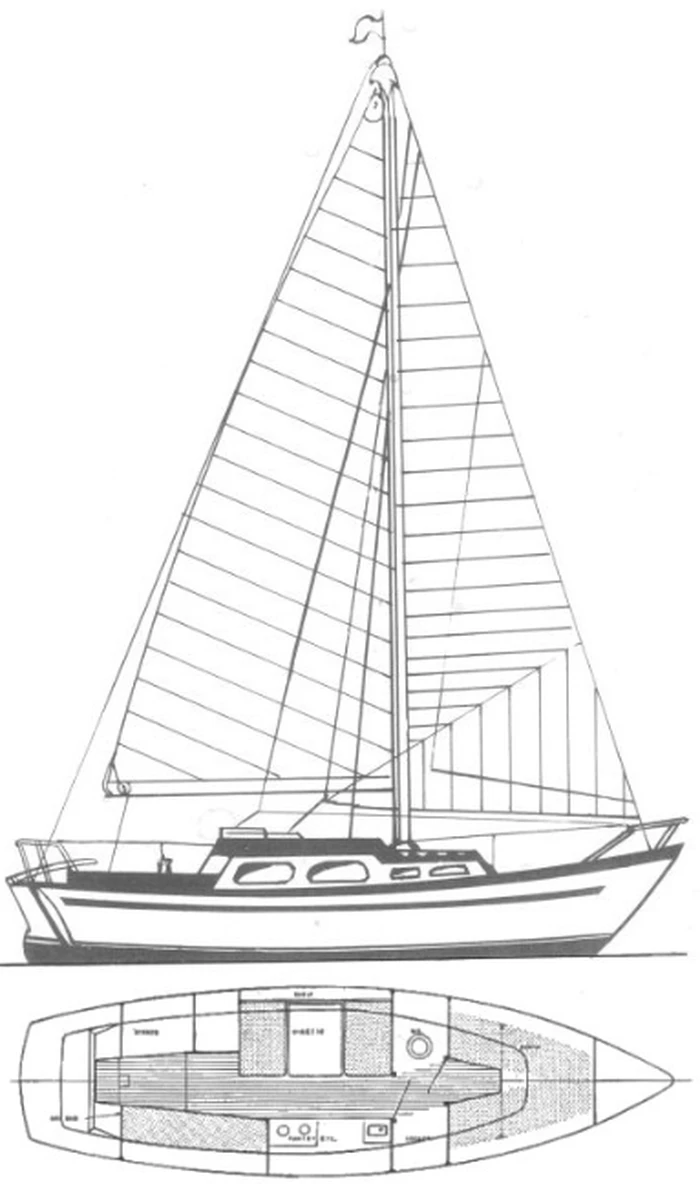
Most Tritons, commonly called the ‘East Coast’ boats, came out of Pearson’s yard in Portsmouth, Rhode Island. A second run came out of Aeromarine Plastics’ yard in Sausalito, California on the West Coast starting in 1960, usually cited around 125 boats, though Wikipedia’s own figure runs higher at roughly 150; neither source documents how the count was taken, so the discrepancy is noted here rather than resolved. The two production lines vary in ways that are hard to pin down consistently across the run, but the clearest tell is trim: East Coast boats carry wood coamings and trim, West Coast boats are finished entirely in fiberglass. A third, much smaller run came out of Jouet in France starting in 1965, roughly 60 boats altered with a different bridge deck, interior layout, and a distinctive long forward cabin portlight shared with the Jouet Tiburon.
Layout and Configuration
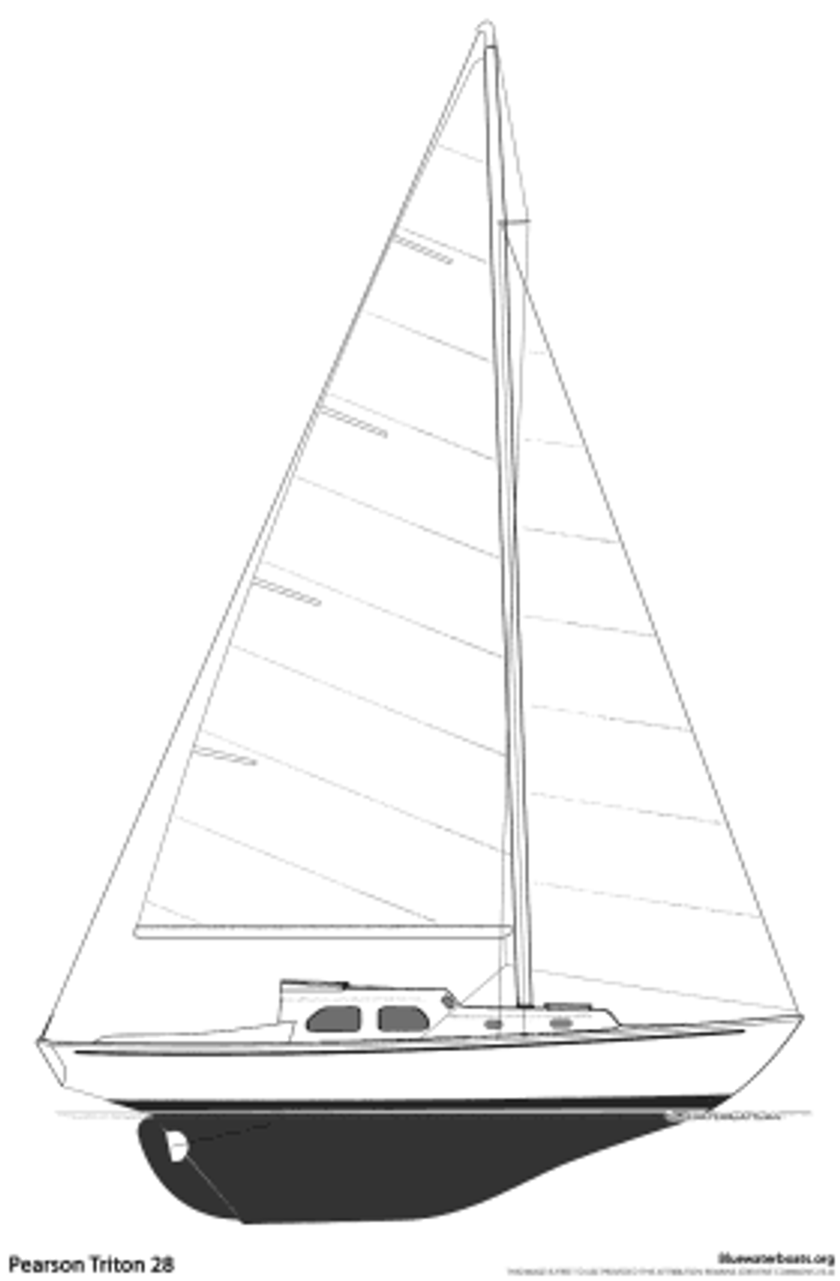
Pearson offered both sloop and yawl rigs, though the fractional sloop is the more common sight. Below the waterline she carries a full keel with a slight cutaway fore and aft and a wooden rudder hung off the back of it. Forward hull flare keeps the deck drier and easier to work in a seaway. Deck styles vary more than most production boats of the era, one owner survey turned up at least four distinct configurations, plus assorted smaller variations, and the stepped cabin top, while a slight departure from her otherwise sleek sheer, buys real headroom below.
The cockpit runs large and low, wet in a seaway but with a bridge deck that keeps green water from finding its way below. Accommodation is tight by modern standards, typical for a boat of this style and era, but the absence of a molded fiberglass interior liner makes owner modifications and repairs more straightforward than on many later production boats.
Construction
Individual Tritons vary more in build quality than a typical production run, generally trending toward the thicker, less refined hulls common to early fiberglass boats: Practical Sailor’s own inspection found hull thickness ranging from about 3/8 inch at the rail up to 3/4 inch around the keel, using conventional mat, cloth, and polyester resin. Most East Coast decks are balsa-cored; most West Coast decks are solid fiberglass, though this isn’t a hard rule across the run. Ballast started as iron encapsulated in the keel and shifted to encapsulated lead in later years.
Practical Sailor also flags several issues worth checking on any individual boat: deck delamination common to boats of this age, owner reports of the deck caving under the mast step, and cracking in the mahogany rudder where it meets its bronze pins. Early boats used a single lower shroud on each side, an under-built arrangement Pearson corrected with double lowers starting around hull #120. On the durability side, one Triton came through Hurricane Hugo with her hull “completely intact, albeit with a few gouges,” despite being crushed between larger boats.
Under Sail
She sails as gracefully as she looks, forgiving and nimble, with a persistent weather helm that owners commonly address either with a small bowsprit to move the foretriangle forward or by recutting the mainsail smaller. Her PHRF rating, around 246, puts her among the slower boats in US fleets, unsurprising given her waterline, though Practical Sailor notes she still moves well for her length and remains an easy, forgiving boat for a less experienced sailor.
Light air performance benefits from that short waterline, and she heels readily as the breeze builds, which lengthens her effective waterline and adds to hull speed. She’s tender to about 15 degrees of heel before stiffening up. The heavier-built West Coast boats tend to stand up straighter in a breeze; East Coast boats heel sooner but respond more readily to the helm.
Links, References and Further Reading
» Twenty Small Sailboats to Take You Anywhere by John Vigor, (Ch18, p77-82) an in depth look at the Pearson Trition 28. ISBN:978-0939837328» Used Boat Notebook by John Kretschmer, a review of the Pearson Triton (p28-31)» Wikipedia’s entry on the Pearson Triton» National Triton Association, links and information.» Pearson Triton Yahoo Group» French Jouet Triton webpage» Circumnavigation on a by James Baldwin on sailboat ‘Atom’