Overview
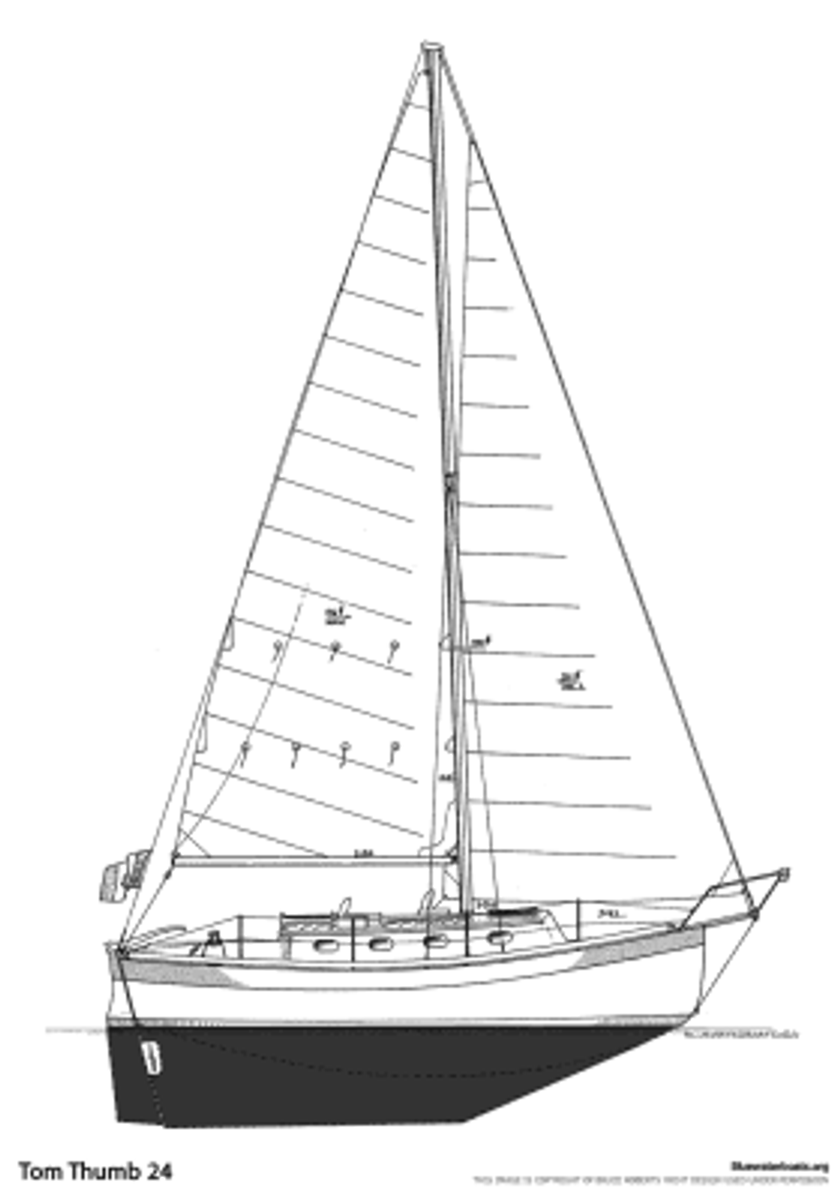
At 24 feet, the Tom Thumb 24 sits at the small extreme of steel cruiser design. Conventional wisdom says a boat this size would be too heavy to work in plate steel, but designer Grahame Shannon got around that by treating the hull like a fiberglass monocoque: frameless, stiffened only by interior plywood furniture, the same trick modern fiberglass builders use with structural liners. The result is, by most accounts, the smallest genuinely capable steel go-anywhere cruiser around.
History
Shannon designed the Tom Thumb 24 in about 1983, in his own words half as a joke. He’d designed other steel boats and kept hearing the same question: why aren’t there small steel boat plans? The standard objections, too heavy, plating too thin to avoid distortion, kept coming up, until Shannon realized a frameless, GRP-style monocoque hull would keep the weight within reason. He drew up a wishlist, full keel, bowsprit, standing headroom, inboard diesel, a “shippy” look, and completed the plans in about eight weeks with help from John Woods, a former Bruce Roberts colleague. An ad in Cruising World offering plans for $99 sold over 300 sets within a year. Shannon then sold the design rights to Bruce Roberts, who has sold many hundreds more since; Shannon himself designed the related Tom Thumb 26, and the design later inspired the 28, 305, and 330. By his own account, the Tom Thumb 24 outnumbered every other design he’d drawn combined, until his later Walker Bay 8 dinghy overtook it.
Design and Construction
The boat is built in multi-chine steel or aluminum from plans or kits, mostly by amateur builders working economically, which means real variation between individual boats depending on builder skill and material choices. Despite her short hull, heavy displacement, and wide beam, she has a reputation for surprising speed, easily exceeding her theoretical 6.2-knot hull speed, and points reasonably well for a full-keeled design. Her weight gives a comfortable motion at sea, and interior space is described as genuinely roomy, with standing headroom for owners under six feet.
Buyers Notes
As a home-build design constructed by amateur builders worldwide, expect real variation in build quality and finish between individual boats; inspect welds, plating thickness, and interior structural bonding carefully rather than assuming factory-standard consistency. Plans and kits remain available from Bruce Roberts Yacht Design and Fine Line Boat Plans for anyone considering a new build.