Overview
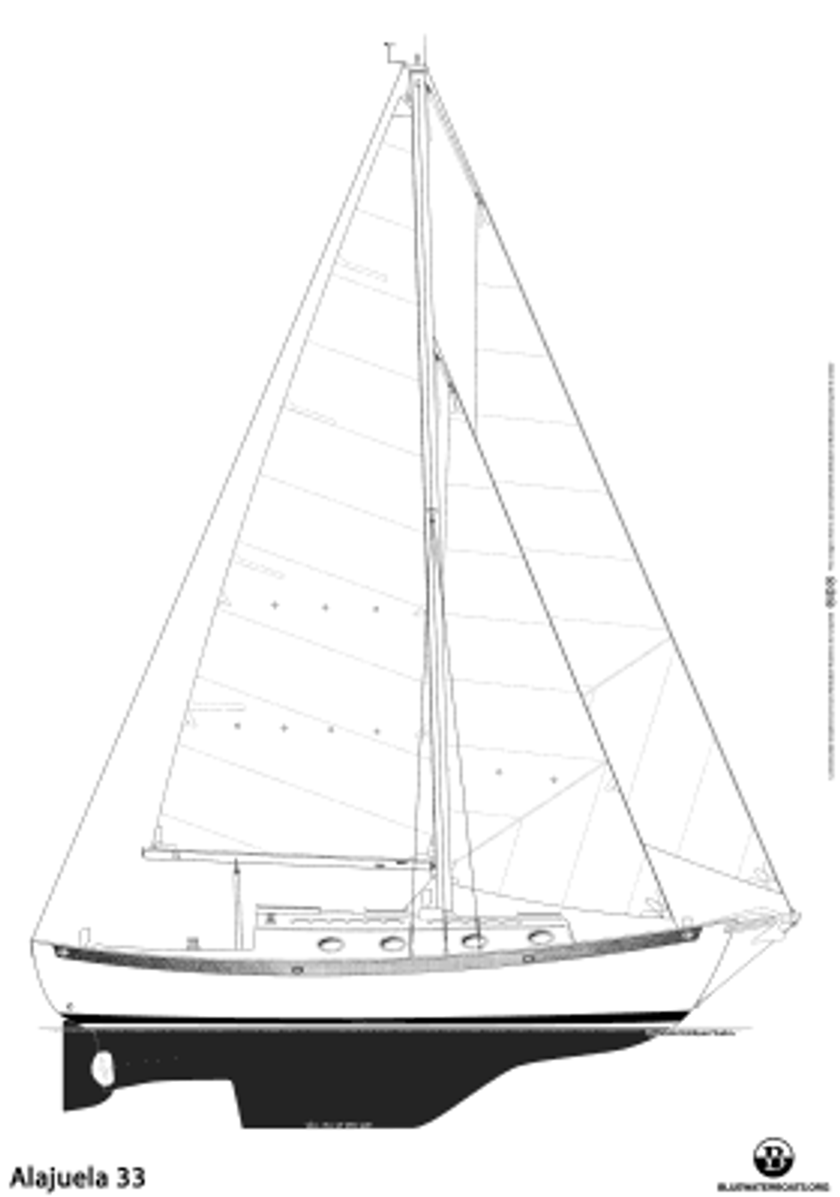
Launched in 1977, the Alajuela 33 followed its larger, Atkin-inspired sibling the Alajuela 38 as a more affordable design for the hard economic times of the late-1970s oil shocks. Designer Ray Richards paired traditional looks with a genuinely modern underbody to produce a capable cruiser suited to both coastal work and real offshore passages.
History
Alajuela Yachts was founded in 1974 by Rod Jermain and Mike Riding to build the Alajuela 38, a well-constructed yacht based on William Atkin’s time-tested designs; what started as a boat for themselves turned into a production run once other buyers took notice. As the OPEC oil embargo and Vietnam War inflation pushed resin, fiberglass, lead, and teak prices sharply higher through the late 1970s (crude oil alone rose from $3.50 a barrel in 1973 to $38 by 1980), the resin-hungry 38 (roughly 10 barrels per hull) grew out of reach for many buyers. Jermain’s team began scoping a smaller, more affordable design, first around 28 feet, but the interior space needed for genuine cruising made that hull too tubby, with an underwater shape Jermain himself likened to an avocado. The project grew to 33 feet for the length and inertia to handle real offshore conditions, and Ray Richards, a naval architect known for both fast and practical designs (including car ferries and jet catamarans), was eventually commissioned to finish it.
Design and Construction
Richards took a genuinely different approach below the waterline than the conventional full keel of the era: a substantially cut-away forefoot for maneuverability and reduced wetted area, paired with a wide, flat-bottomed profile that let the hull sit well on the hard and that housed both water and fuel tankage low in the keel cavity, freeing interior space while lowering the center of gravity. The canoe stern is mostly an aesthetic choice but helps in large following seas. Construction matches the well-regarded Alajuela 38: a one-piece hand-laid fiberglass hull and plywood-cored deck, with a hull-to-deck joint locked together by a double-bonded fiberglass seam running the full length of the hull, a genuinely more expensive and more reliable approach than the industry norm. Chainplates are brought inboard for a tighter sheeting angle, and the cutter rig (with a small aluminum bowsprit) was chosen specifically for easier, better-balanced reefing offshore. Most boats shipped with tiller steering alone, the cheaper option at the time, though wheel steering was a straightforward aftermarket retrofit many owners made.
Under Sail
The 33 is easy to single-hand and, thanks to her modern underbody, notably nimble in tight quarters for her length. Sea Magazine’s 1979 debut test sail, conducted in light air, described steady, responsive handling with some of the driving feel of a larger boat; owners have separately reported some weather helm. Below, the boat carries six berths including twin sea-going quarter berths, a genuinely unusual amount of accommodation for a 33-footer, achieved partly by using the keel cavity for tankage and partly by trading some stowage space for the extra berths.
Buyers Notes
No documented ocean crossing or independent bluewater assessment was found for this design in this research pass; the only period test sail on record covered light-wind coastal handling, not offshore conditions. Alajuela Yachts closed in the mid-1980s, so any example on the market today is at minimum four decades old and should be surveyed accordingly. Confirm whether wheel steering has been retrofitted, since most boats originally shipped with tiller only.